Key takeaways
- Rough opening width: Add at least 2 inches to the bookcase width for the jamb and shims. A 30-inch wide bookcase typically needs a 32.5 to 33-inch rough opening. A 36-inch wide unit needs 38 to 38.5 inches. If your hallway is only 36 inches wide, a 36-inch swing will block the entire passage when open.
- Rough opening depth: The bookcase carcass is 10 to 14 inches deep. A standard 2×4 wall is only 4.5 inches deep with drywall. That means the bookcase will protrude 5 to 9 inches into the room unless you build out the wall or recess it into a closet depth. Plan on at least 7 inches of usable wall depth for a flush look on one side.
- Swing arc and furniture clearance: You need a clear floor arc equal to the door width. Do not place a side table, rug pad lip, or floor lamp inside that radius. Allow at least 36 inches of clear floor space in front of the bookcase and 2 inches on the hinge side so baseboard and trim do not bind. In a 10×12 ft room, a 36-inch outswing bookcase door will consume nearly 10 sq ft of swing space.
- Header support: If you are cutting a new opening in a load-bearing wall, you need a doubled 2×8 or 2×10 header with jack studs, not just drywall patching. Many municipalities require a permit for this modification.
A door that looks like a bookcase is a full-size interior door built into a bookcase frame and hung on specialty hardware so the entire bookcase swings open like a concealed door, usually supporting 200 to 500 pounds when fully loaded with books and decor.
Unlike doors that look like bookshelves in movies where a light prop swings effortlessly, a real hidden bookcase door is an engineered system. The bookcase itself is the door slab, the jamb is reinforced, and the hardware is rated for serious weight. Understanding that difference is what determines whether the idea will work in your home or whether a freestanding lookalike unit gives you the look without construction.
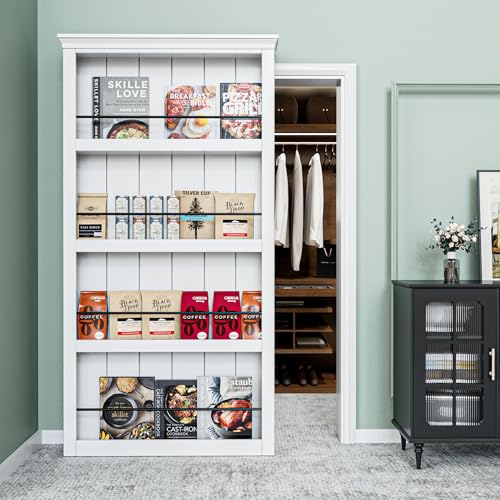
Bookshelf Style Solid Core Ghost Door Secret Hidden Door, 42"*84"
Included for 'Door That Looks Like a Bookcase: How Hidden Bookcase Doors Work' because the listing specifies 42"*84", details this guide uses to compare options.
View on Amazon
Hidden Door Pivot Hinge, 570LBS Load Capacity Heavy Duty Hidden Door Bookcase Hinge 360° Rotation Solid 304 Stainless Steel Hidden Door Hardware Kit for Murphy Door, Secret Bookcase, Bookshelf Door
Included for 'Door That Looks Like a Bookcase: How Hidden Bookcase Doors Work' because the listing specifies Secret Bookcase and Bookshelf Door, details this guide uses to compare options.
View on Amazon
TamBee Hidden Bookcase Hinges Pivot Door Hinge with Lock Hidden Door Hinges for Secret Door 304 Stainless Steel with Spring Latch Lock and Cable
Included for 'Door That Looks Like a Bookcase: How Hidden Bookcase Doors Work' as a relevant option in this category; details come from the product listing.
View on Amazon
MURPHY DOOR Hidden Hinge Hardware - Easy DIY Hidden Door System, Heavy Duty Swinging Door Hinge for Secret Door or Hidden Door Bookcase, Up to 300 lbs
Included for 'Door That Looks Like a Bookcase: How Hidden Bookcase Doors Work' because the listing specifies Easy DIY Hidden Door System and Up to 300 lbs, details this guide uses to compare options.
View on AmazonHow a Hidden Bookcase Door Actually Works
Every concealed bookcase door has three parts: a rigid bookcase carcass, a reinforced door jamb, and load-rated hardware that carries the weight and controls the swing. The carcass is typically built from hardwood plywood or solid wood with a fixed back panel that prevents racking. The jamb is not a standard door frame; it is squared, shimmed, and lag-bolted into the studs or a new rough opening header so it does not flex when 300+ pounds swing on it.
Pivot Hardware vs. Side-Hinge Hardware
The two systems you will encounter work very differently, and your choice affects cost, installation complexity, and how the door feels to use.
Side-hinge (concealed bookcase hinges): The bookcase is hung on 3 to 4 heavy-duty ball-bearing hinges mortised into the bookcase stile and jamb, similar to a very heavy entry door. It swings like a normal door from one side. This system is simpler to install and adjust, keeps the pivot point at the edge of the jamb, and leaves the trim profile familiar. The downside is that all the weight hangs on one side, so sagging is a risk if the jamb is not perfectly plumb or the hardware is under-rated.
Pivot hinge (top and bottom pivot): The bookcase pivots on a pin at the top header and a bearing at the floor, so the weight is carried vertically rather than hanging off the side. A center-pivot or offset-pivot allows a much heavier load and a smoother swing, and many kits include a closer to keep the door flush when closed. The trade-off is precision: the floor must be level within about 1/8 inch across the swing, and you need clearance at the top and bottom for the pivot plates.
| Feature | Side-Hinge Bookcase Door | Pivot Bookcase Door |
|---|---|---|
| Typical Loaded Weight Limit | 200 – 300 lbs | 300 – 500 lbs |
| Rough Opening Depth Needed | 6.5 – 8 inches (standard 2×4 or 2×6 wall) | 7 – 10 inches (often requires built-out jamb or deeper wall) |
| Swing Clearance Required | Full width of bookcase + 2 inches (e.g., 30-36 inch door needs 32-38 inch arc) | Full width + 2-4 inches, plus 1 inch floor gap for bottom pivot plate |
| Wall Level Tolerance | Jamb must be plumb within 1/16 inch over 80 inches | Floor must be level within 1/8 inch across swing path |
| Best For | Retrofits into existing doorway, lighter loads | New construction, heavy book loads, daily-use entry |
| General Market Price Range (Hardware + Unfinished Carcass) | Usually $800 – $2,000 | Usually $1,500 – $3,500 |
Most doors that look like bookshelves sold as complete kits include adjustable shelves, but the shelves should be fixed or pinned for structural strength. Fully adjustable, thin shelves will bow under book weight and weaken the carcass over time.
What Your Wall Needs: Rough Opening, Depth, and Swing Clearance
A product listing rarely explains this, but the wall determines everything. A standard interior door opening is about 32 x 80 inches, but a hidden bookcase door needs more depth and a perfectly square frame.
- Rough opening width: Add at least 2 inches to the bookcase width for the jamb and shims. A 30-inch wide bookcase typically needs a 32.5 to 33-inch rough opening. A 36-inch wide unit needs 38 to 38.5 inches. If your hallway is only 36 inches wide, a 36-inch swing will block the entire passage when open.
- Rough opening depth: The bookcase carcass is 10 to 14 inches deep. A standard 2×4 wall is only 4.5 inches deep with drywall. That means the bookcase will protrude 5 to 9 inches into the room unless you build out the wall or recess it into a closet depth. Plan on at least 7 inches of usable wall depth for a flush look on one side.
- Swing arc and furniture clearance: You need a clear floor arc equal to the door width. Do not place a side table, rug pad lip, or floor lamp inside that radius. Allow at least 36 inches of clear floor space in front of the bookcase and 2 inches on the hinge side so baseboard and trim do not bind. In a 10×12 ft room, a 36-inch outswing bookcase door will consume nearly 10 sq ft of swing space.
- Header support: If you are cutting a new opening in a load-bearing wall, you need a doubled 2×8 or 2×10 header with jack studs, not just drywall patching. Many municipalities require a permit for this modification.
Ceiling height also matters. Most carcasses are 80 to 81 inches tall to fit under an 82-inch header. If you have 8-foot ceilings, you will have a 12 to 15-inch gap above that must be filled with a header panel or crown to hide the door line. With 9-foot ceilings, you may need a custom-height carcass or a transom panel.
Weight, Construction, and Why Hardware Fails First
The weight rating on the hardware is the real limit, not the wood. A single linear foot of books can weigh 20 to 30 pounds. A 30-inch wide bookcase with five shelves fully loaded with hardcovers can easily reach 250 to 350 pounds before you add the 80 to 120-pound carcass itself.
Construction trade-offs directly affect that limit:
| Material | Loaded Strength | Weight of Carcass | Trade-off |
|---|---|---|---|
| Solid Hardwood (poplar, maple, red oak) | Highest, resists sag and screw pull-out | 90 – 130 lbs empty | Most stable and repairable, but heaviest and usually $500+ more than plywood |
| Hardwood Plywood with Solid-Wood Face Frame | High, good screw holding in face frame | 75 – 100 lbs empty | Best value for built-ins; lighter than solid wood but can chip at edges if not banded |
| MDF / Engineered Wood with Laminate | Low to moderate, sags over 24-inch shelf spans | 60 – 85 lbs empty | Lowest cost and smooth paint finish, but hinge screws strip easily and shelves bow over time |
What wears first is almost never the wood. It is the hinges, pivot bearing, and latch alignment. Low-rated hinges stretch, causing the bookcase to lean and drag on the floor. A magnetic latch or roller catch that is too weak will let a loaded door drift open. Look for kits with three 400-pound rated hinges or a 500-pound rated pivot set, an adjustable strike plate, and a ball catch rated for at least 30 pounds of pull.
Built-In Hidden Door vs. Freestanding Lookalike: Which Fits Your Situation
A true built-in door that looks like a bookcase is construction. A freestanding lookalike is a standard bookcase placed in front of a door or on a hidden track that mimics the look. Many homeowners actually want the second option.
| Your Situation | Best Choice | Why |
|---|---|---|
| Renter, condo with HOA, or no permit flexibility | Freestanding bookcase on furniture sliders or French cleat in front of existing door | No wall modification, moves with you, doorway width stays standard 29-30 inches for moving furniture |
| Small apartment or 10×10 ft home office | Freestanding 24-28 inch shallow unit (10-12 inch deep) | Requires zero swing arc from wall demo; you keep floor space and avoid blocking HVAC vents |
| Kids and pets at home | Pivot built-in with soft-close and flush latch | Pinch-free pivot gap and magnetic latch prevents slamming; side-hinge doors can swing into children |
| Daily-use passage to pantry, office, or primary bedroom | Pivot built-in with high weight rating | Built for 20+ daily cycles without sagging; freestanding units wobble with frequent moving |
| Home theater, storage room, or occasional use | Side-hinge kit in existing doorway | Lower cost, easier DIY install, load stays under 250 lbs with decor rather than full book loads |
| Back pain or need low maintenance | Freestanding lookalike with light decor only | No heavy door to push (30-50 lbs of push force when loaded), no hinge adjustment ever needed |
If you choose the freestanding mimic, use a shallow bookcase 10 to 12 inches deep, anchor it with an anti-tip strap to the door it covers or adjacent wall, and leave 1 inch of clearance on the hinge side so the real door behind it can still open. You get 90% of the visual effect for usually $200 to $600, no construction, and no permit questions.
Assembly, Moving, and Durability Realities
Expect real-world logistics before you buy. An unfinished solid-wood carcass ships in one or two crates weighing 120 to 180 pounds total. Plywood kits ship flat at 90 to 130 pounds. You need a 30-inch minimum doorway width just to carry the carcass into the room, and a 32-inch hallway to turn it. Check stairwell turns and elevator dimensions if you live above the first floor.
Assembly is not typical flat-pack. Jamb installation requires a 4-foot level, shims, a drill driver, and often a router for hinge mortises. Plan 4 to 8 hours for a skilled DIYer or 3 to 5 hours for a carpenter. You will also need to cope or re-cut baseboard and case molding to meet the thicker jamb, and touch up paint after.
For durability, load books from the bottom up and heaviest items on the bottom two shelves to lower the center of gravity. Leave 1/8 inch of air behind books so the back panel can breathe and avoid warping. Tighten hinge screws every 6 to 12 months; a 1/32-inch hinge shift at the top becomes a 1/4-inch drag at the floor after a season of humidity changes. Replace felt pads under pivot points annually if the door is used daily.
A well-built pivot system in a climate-controlled home will stay true for 15 to 20 years with occasional adjustment. An MDF carcass on undersized side hinges in a humid or unconditioned space may start to sag or bind within 2 to 3 years. If long-term stability matters, invest in the hardware rating first and the wood species second.
Final Checklist Before You Order
- Measure rough opening height, width, and wall depth with a tape measure at three points each; use the smallest number.
- Confirm swing direction and that no light switch, vent, or outlet falls inside the swing arc.
- Choose hardware rated for at least 20% more than your intended loaded weight.
- Decide if you need a flush push-latch for a truly hidden line or a small recessed handle for easier daily use.
- If you are renting or unsure, start with a freestanding lookalike unit and test the look for a few months before cutting drywall.