Key takeaways
- Sand with 120-grit, then 150, then 180 (oak can go to 220). Sand doors and shelves before assembly if the unit ships flat.
- Apply pre-stain conditioner on pine or poplar — skip this on oak. Wait 15–30 minutes.
- Brush on stain (oil-based stains like Minwax or Varathane give the longest working time), wipe off excess after 5–15 minutes, dry 8–24 hours.
- Seal with 2–3 coats of polyurethane, sanding lightly with 320-grit between coats. Water-based poly dries in 2–4 hours per coat and won’t amber; oil-based poly is tougher but adds a warm yellow cast.
- Cure before loading: dry to the touch in 24–72 hours, but books shouldn’t sit on shelves for 7 days (water-based) to 30 days (oil-based) — full hardness takes that long.
An unfinished wood bookcase with doors is worth buying for one reason: you get solid, real wood at a lower price than factory-finished furniture, and you control the final look — but the right species and finish depend entirely on whether you want to stain, paint, or go black. Pick red or white oak if you want a rich stained grain, poplar if you plan to paint (including black), and pine if budget matters most. Here’s how to choose, finish, and maintain it.
Pine vs. Oak vs. Poplar: Which Unfinished Bookcase to Buy
Most unfinished bookcases with doors in the $250–$900 range come in one of three species, and they behave very differently once stain or paint hits them.

IC International Concepts Solid Wood Shaker Bookcase 30" H, Unfinished
Included for 'Unfinished Wood Bookcase With Doors: Finishing, Painting and Care Tips' because the listing specifies Unfinished, details this guide uses to compare options.
View on Amazon
IC International Concepts Solid Wood Shaker Kids Bookcase, 36" H
Included for 'Unfinished Wood Bookcase With Doors: Finishing, Painting and Care Tips' because the listing specifies 36" H, details this guide uses to compare options.
View on Amazon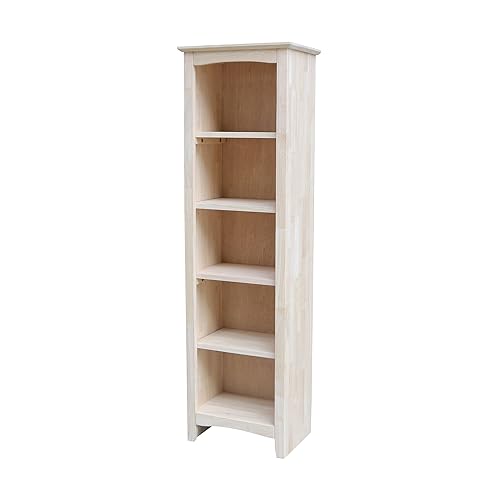
IC International Concepts Solid Wood Narrow Shaker Bookcase, Unfinished
Included for 'Unfinished Wood Bookcase With Doors: Finishing, Painting and Care Tips' because the listing specifies Unfinished, details this guide uses to compare options.
View on Amazon| Species | Janka Hardness | Typical Price (72–84″ unit with doors) | Unit Weight | Stains Well? | Paints Well? |
|---|---|---|---|---|---|
| Pine (Eastern white / Southern yellow) | 380–870 | $250–$500 | 70–100 lbs | Blotchy — needs pre-stain conditioner | Good — knots must be sealed first |
| Poplar | 540 | $350–$650 | 80–110 lbs | Poor — green/purple streaks show | Excellent — the “painter’s wood” |
| Red / White Oak | 1,290–1,360 | $500–$900 | 110–150 lbs | Excellent — deep open grain absorbs evenly | Fair — grain texture shows through paint |
Choose oak if the whole point is a warm, furniture-grade stained finish — oak’s open pores take pigment evenly and the grain becomes the feature. It’s also the most dent-resistant of the three, roughly 2–3× harder than pine on the Janka scale.
Choose poplar if you’re painting. Its fine, even grain disappears under primer and enamel, giving the smoothest result. Its streaky green-brown coloring is why it looks odd under stain — that’s not a defect, it’s the species.
Choose pine for the lowest price and lightest weight — relevant if you’re carrying it up stairs or expect to move. The trade-offs: it dents easily (a dropped book corner leaves a mark) and absorbs stain unevenly without a conditioner coat.
One caution on “real wood” claims: a genuine real wood bookcase with doors will show end grain at shelf edges and door tops, weigh noticeably more than a same-size particleboard unit, and typically cost 40–60% more than a veneered MDF version. If a listing says “wood” without naming a species, assume engineered core.
Staining vs. Painting: The Honest Trade-Off
Stain preserves grain and hides future wear — scratches on stained oak blend in because the color penetrates the wood. Paint gives unlimited color options and covers poplar’s odd streaks, but chips on painted edges show bare wood and require touch-ups. Expect a stained finish to last 10+ years before needing attention; painted furniture in a high-traffic room often wants a touch-up within 3–5 years.
Staining is faster (one coat, wipe, seal) but locks you into brown-red-gray wood tones. Painting takes an extra primer step and a second coat but produces the only true solid colors — essential if you want white, navy, or a black wood bookcase with doors look.
Step-by-Step: Finishing Your Bookcase
If staining
- Sand with 120-grit, then 150, then 180 (oak can go to 220). Sand doors and shelves before assembly if the unit ships flat.
- Apply pre-stain conditioner on pine or poplar — skip this on oak. Wait 15–30 minutes.
- Brush on stain (oil-based stains like Minwax or Varathane give the longest working time), wipe off excess after 5–15 minutes, dry 8–24 hours.
- Seal with 2–3 coats of polyurethane, sanding lightly with 320-grit between coats. Water-based poly dries in 2–4 hours per coat and won’t amber; oil-based poly is tougher but adds a warm yellow cast.
- Cure before loading: dry to the touch in 24–72 hours, but books shouldn’t sit on shelves for 7 days (water-based) to 30 days (oil-based) — full hardness takes that long.
If painting
- Sand to 120–150 grit — paint doesn’t need a finer surface.
- Prime with a shellac-based primer (Zinsser B-I-N is the standard) especially on pine — it seals knots that otherwise bleed yellow through latex paint for years.
- Sand primer lightly at 220 grit, then apply two coats of a self-leveling enamel or urethane-fortified trim paint (Benjamin Moore Advance and similar products are designed for exactly this).
- Optional topcoat of water-based poly on shelves only — the highest-wear surface.
Getting the Black Wood Bookcase With Doors Look
Black is the most-requested finish for unfinished units and there are two distinct routes. For a solid matte or satin black — the modern, clean look — use poplar, prime, then paint with a black enamel. This hides grain completely.
For a black finish that still shows wood grain, use oak with a black or “ebony” penetrating stain: the open pores go dark while the grain pattern stays visible, producing the high-end look seen in designer furniture. Traditionalists achieve the same effect on oak with iron acetate (steel wool dissolved in vinegar), which chemically ebonizes the tannins. Either way, pair it with matte black or aged brass pulls — hardware is half the look.
Hardware Choices That Affect Durability
- Hinges: If the doors are pre-drilled with 35mm cups, use European concealed hinges — adjustable in three directions, which matters because solid-wood doors shift slightly with humidity. Soft-close clip-ons are a worthwhile $10–$20 upgrade. No pre-bored cups? Surface-mount butt hinges are simpler and just as durable.
- Catches: Magnetic catches forgive imperfect door alignment better than roller catches on solid wood doors that move seasonally.
- Pulls: 96mm or 128mm centers are standard; buy pulls with the screws included since solid wood needs different screw lengths than hollow-core doors.
- Shelf pins: Upgrade included plastic pins to 5mm metal pins if you’ll load shelves with hardcovers — a foot of books weighs roughly 20–30 lbs.
Fit, Weight, and Assembly Realities
A typical 72–84″ unfinished bookcase is 30–48″ wide and 12–14″ deep, so it passes through any standard 30–32″ doorway — but an 84″ fully-assembled oak unit weighing 130+ lbs can’t always be tilted upright around a stairwell landing. Measure the turning clearance, not just the door. Flat-pack versions ship in one or two boxes of 50–90 lbs each and are the safer choice for upstairs rooms. Leave at least the door’s depth plus 18″ of clearance in front for the doors to swing and for you to stand while browsing.
| Your Situation | Best Species | Best Finish Route |
|---|---|---|
| Budget under $400 | Pine | Conditioner + stain, or paint |
| Kids, pets, daily door use | Oak | Stain + oil-based poly (hides wear) |
| Want solid black or a bold color | Poplar | Shellac primer + enamel |
| Want grain visible under black | Red or white oak | Ebony stain or iron acetate |
| Moves often / apartment living | Pine (lightest) | Paint — easier touch-ups than stain |
| Heavily loaded shelves (hardcovers) | Oak, shelf spans ≤36″ | Any; add metal shelf pins |
On sag: a 36″ solid pine or poplar shelf will visibly bow under ~40 lbs over time; oak handles that span comfortably. For heavier loads, choose adjustable shelves so you can double up a shelf board, or keep book rows under 32″ wide.
Care After Finishing
Dust with a dry or barely damp microfiber cloth — water pooling on a finish clouds it. Keep indoor humidity between 35–55%; solid wood doors swell in summer and can stick, which is normal and resolves itself — don’t sand a sticking door in August. Retighten hinge and pull screws annually, keep the unit out of direct sun (stain fades unevenly), and use felt pads under anything heavy on the top surface.
Quick Answers
Can you leave an unfinished bookcase raw? Not recommended — bare wood absorbs moisture, oils, and grime permanently. At minimum apply paste wax or a clear coat.
Is unfinished furniture actually solid wood? Usually yes — unfinished pieces from specialty retailers are typically solid pine, poplar, or oak because there’s no veneer to hide. Verify by checking end grain and unit weight.
How long until the smell goes away? Water-based finishes off-gas in days; oil-based poly can smell for 1–2 weeks. Ventilate and don’t put a freshly finished unit in a nursery or bedroom immediately.