Key takeaways
- A sectional sofa with pull out bed has to work twice: as everyday seating and as a real sleep surface. The catch is that the bed is smaller than the sofa footprint suggests, and sleeper sizes here are irregular, not…
A sectional sofa with pull out bed has to work twice: as everyday seating and as a real sleep surface. The catch is that the bed is smaller than the sofa footprint suggests, and sleeper sizes here are irregular, not neat Queens. This guide compares the actual sleep surface against the overall footprint.
As an Amazon Associate we earn from qualifying purchases.
By KK Home Furnishings Editorial Team
How to Choose a Sectional Sofa with a Pull-Out Bed
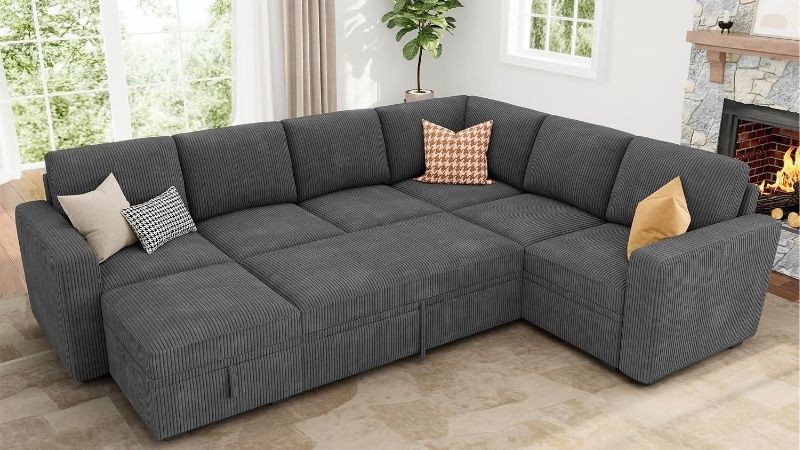
A sleeper sectional is judged by two footprints: the sofa it is most days, and the bed it becomes. The pull-out surface is usually smaller and an odd size, so measuring both matters. Four things decide the buy: the real sleep-surface size, the sofa footprint, mattress comfort, and the mechanism.
Measure the Real Sleep Surface, Not the Label
The bed is the reason to buy, so start there. An IKEA FRIHETEN with KLAGSHAMN mattress opens to a 55⅛ by 80⅜ inch sleep surface, while several pull-out sectionals here measure about 73 by 53 inches. Those are irregular sizes, not standard Queens or Fulls, so read the stated bed dimensions rather than a size name.
Match the surface to who sleeps on it. A 73-inch-long pull-out is shorter than a standard 75-inch Full, which matters for a tall guest; the FRIHETEN’s 80⅜-inch length suits taller sleepers better. Measure a sleeper you know against these numbers, since the listing’s size words rarely map to a mattress you can picture.
A bigger sleep area is not automatically more comfortable, either. Thin pull-out mattresses, often around four to six inches, and a bar frame underneath affect comfort more than raw dimensions. Judge the sleep by the mattress type and support, not just the surface size, since a large but thin pad can sleep worse than a firm smaller one.
Check the Sofa Footprint and Chaise Side
As a sofa, the sectional has to fit the room every day. A FRIHETEN measures about 90½ by 59½ inches in sofa mode, and sectionals need clearance for the chaise and to open the bed. Measure the wall and floor for the sofa footprint plus the space the bed needs when extended out in front of it.
Decide which side the chaise sits on, since most sleeper sectionals are left- or right-hand and cannot be swapped unless reversible. Map it against the room so the chaise does not block a walkway or a door. Leave room in front for the bed to pull out fully, which a tight coffee-table layout often forgets.
The footprint also governs delivery. A sectional ships in large, heavy pieces that must clear the doorway, hall turn and stairs, so measure the route before buying. Some arrive in sections that assemble in the room, which helps; a one-piece sleeper sectional is the hardest furniture to get upstairs, so confirm access first.
Judge the Pull-Out Mattress, Not Just the Frame
The mattress makes or breaks a sleeper. Pull-out pads run thin — commonly in the mid-single-digit inches — over a folding metal frame, so a thinner pad means you feel the bar more. The FRIHETEN uses a folding foam mattress rather than a bar mechanism, which sleeps differently from a classic pull-out metal frame.
Match the sleeper to how often it is used. For occasional guests, a thin pull-out is fine; for regular sleeping, look for a thicker pad or plan to add a topper, which also raises the final height. Check whether a topper still lets the bed fold back into the sofa, since some do not once padding is added.
Comfort complaints usually trace to the mattress and the bar, not the size. A thin pad compresses and the frame bar can be felt across the back, which a topper eases but a bigger surface does not. Favor a sleeper whose mattress can be replaced or supplemented, since that is the part that wears and the part you feel.
Look at the Mechanism and Build
The pull-out mechanism is the part that fails, so it is worth weighing. A classic bar-and-frame pulls out in one motion but can sag or stick over time; a fold-down or flip style like the FRIHETEN has fewer moving parts. Check how the bed deploys and whether it needs clearance in front to open fully each time.
Build quality shows in the frame and the upholstery. A hardwood or metal frame holds up better than all-engineered-panel construction under the repeated load of converting to a bed, and performance fabric resists wear on a piece used daily. Judge sturdiness by the frame material and the fabric rating where it is stated.
Expect the mechanism and the mattress to be the long-term watch points, not the shell. A squeaking or sticking frame is common with age, and a flattened pad is normal wear. Favor a maker that sells replacement mattresses or mechanism parts, since a worn pull-out should be refreshed, not thrown out with the sofa.
Top Picks
Four sleeper sectionals cover the range, from a published dual-mode IKEA set to budget pull-outs with similar surfaces. The real separator is the sleep surface against the footprint, and these bed sizes are irregular, not neat Queens. Each leans on manufacturer-stated specs and a tier, not a fixed price — confirm it first.
| Product | Best For | Key Spec | Watch Out For |
|---|---|---|---|
| IKEA FRIHETEN/KLAGSHAMN | Best overall for a real sleep surface | 55⅛×80⅜ in bed; 90½×59½ in sofa | Fold mechanism, not a bar |
| Latitude Run 82.5 | Best for a roomier pull-out | ~73×53.5 in sleeper; 16.5 in deep | Bed shorter than a Full |
| Latitude Run 81.5 | Best for a tighter footprint | ~73×53 in sleeper | Thin pull-out pad |
| Ucloveria | Best for a budget sleeper | ~73×53 in sleeper | Irregular size; not a Queen |
IKEA FRIHETEN/KLAGSHAMN: Best Overall for a Real Sleep Surface
For a genuine bed, the FRIHETEN with a KLAGSHAMN mattress leads because IKEA publishes both modes: a 55⅛ by 80⅜ inch sleep surface and a roughly 90½ by 59½ inch sofa footprint. It reads mid tier for a sleeper sectional; prices move, so confirm the current price at IKEA and the chaise side before you order.
Its 80⅜-inch bed length suits taller guests better than the 73-inch pull-outs here, and the fold-down foam mattress avoids a hard center bar. Measure the room for both the sofa and the extended bed, and pick the correct left- or right-hand chaise, since the orientation is set at purchase and shapes the whole layout.
The fold mechanism has fewer parts than a bar pull-out, but the foam mattress is the wear item and can be replaced. Being flat-pack, joints can loosen over time, so re-tighten after a move. Confirm IKEA stocks a replacement mattress and cover, since those are what age on a sofa that doubles as a guest bed.
Latitude Run 82.5: Best for a Roomier Pull-Out
Among the pull-out sectionals, the Latitude Run 82.5 offers a slightly wider sleeper at about 73 by 53.5 inches with a 16.5-inch seat depth. It reads budget-to-mid tier; verify the current price, the chaise side and the fabric, since marketplace sleeper sectionals vary between runs under similar model numbers over time.
The extra half-inch of width is marginal, so choose it for the overall sofa footprint and look as much as the bed. At 73 inches long the sleeper is shorter than a standard Full, which a tall guest will notice, so measure a known sleeper against it rather than trusting any size name on the listing itself.
As a pull-out, the thin pad over a frame is the comfort limit; a topper helps for regular use but raises the height and may affect folding. Judge the build by the frame and fabric, treating any load claim as manufacturer-stated. Confirm whether a replacement mattress is available before relying on it as a guest bed.
Latitude Run 81.5: Best for a Tighter Footprint
The Latitude Run 81.5 is the near-twin with a marginally smaller overall footprint and a similar roughly 73 by 53 inch sleeper. It reads budget-to-mid tier; confirm the current price, the orientation and the exact dimensions, since the 81.5 and 82.5 versions differ mainly in overall length, not the sleep surface.
Pick it over the 82.5 if the slightly shorter sofa fits your wall better, since the beds are effectively the same size. Map the sofa footprint and the pull-out clearance in the room, and the chaise side, before buying. The 73-inch bed length again suits shorter guests better than tall ones, so measure first.
Comfort depends on the thin pull-out pad and the frame bar, which a topper can ease. The usual long-term watch points are the mechanism sticking and the pad flattening. Favor availability of a replacement mattress, and judge the frame by its material rather than a capacity figure, since those are rarely tested here.
Ucloveria: Best for a Budget Sleeper
For the lowest entry, the Ucloveria sleeper sectional offers a roughly 73 by 53 inch pull-out at a 16.5-inch depth. It reads budget tier; verify the current price, the chaise side and the fabric, and note that its sleeper is an irregular size — not a Queen or Full, despite how listings in this class often describe them.
A budget sleeper suits occasional guests more than nightly use. The 73-inch length is short for tall sleepers, and the thin pad sits over a frame, so set expectations by the mattress, not the size. Measure the room for the sofa and the extended bed, and confirm the orientation matches your layout before buying it.
At this tier, the mechanism and pad are the first to show wear, and a squeak or a flattened center is common. A topper improves regular use but check it still folds away. Favor a seller that offers a replacement pad, and judge the frame by its materials, since budget sleepers rarely publish a tested load rating.
Frequently Asked Questions
Sleeper-sectional shoppers ask the same practical things: what size the bed really is, whether it sleeps comfortably, how much room it needs, and whether the mechanism lasts. The answers below use the stated bed and sofa dimensions above rather than the size names listings tend to borrow from real mattresses.
What Size Is the Pull-Out Bed Really?
Read the stated bed dimensions, not the size word. The sleepers here are irregular — around 73 by 53 inches on several, and 55⅛ by 80⅜ on the FRIHETEN — which do not match standard Queen or Full sizes. A listing calling a 73-inch pull-out a Full is stretching it, so go by the inches, not the label.
Those numbers matter for bedding and for guests. A 73-inch length is shorter than a 75-inch Full, so a tall sleeper’s feet may hang over, and odd widths make fitted sheets tricky. Measure a bed you know against the stated surface, and buy sheets to the actual dimensions rather than a size name that may not fit.
If a true full-size sleep area matters, the FRIHETEN’s 80⅜-inch length is the longest here, while the 73-inch pull-outs suit shorter guests or occasional use. Decide by the real surface and who will sleep on it, since the comfort of a guest bed comes from fit and mattress, not from a reassuring size name.
Is a Sleeper Sectional Comfortable to Sleep On?
It can be, for occasional use, but temper expectations. Pull-out pads are thin — often mid-single-digit inches — over a folding frame, so you feel more support variation than on a real bed. The FRIHETEN’s fold-down foam avoids a hard bar, while classic bar pull-outs can press through, which a topper helps to ease.
Comfort comes from the mattress and mechanism, not the surface size. For regular sleeping, add a topper or choose a thicker pad, remembering that padding raises the height and may stop the bed folding away. For nightly use, a dedicated bed still beats any sleeper; these shine for guests and small spaces.
If a guest will stay often, prioritize a replaceable mattress and a simple mechanism over a larger surface. A thin pad over a bar is the usual complaint, and it is fixable with a topper or a new pad. Buy the sleeper whose mattress you can refresh, since that part wears faster than the sofa around it.
How Much Room Does It Need?
Plan for two footprints. The sofa needs its own space — around 90 by 60 inches on the FRIHETEN — plus clearance in front for the bed to pull out fully, which can add two or three feet. Measure both the everyday footprint and the extended-bed depth, since a layout that fits the sofa may not open the bed.
The chaise adds width on one side, so map the orientation against walkways and doors. Leave the pull-out zone clear of a coffee table you cannot move, or plan a light one you can shift. A sleeper sectional that cannot open because furniture blocks it is a common and avoidable layout mistake in a small room.
Delivery is the last space check. These ship in large, heavy pieces, so measure the doorway, hall turn and stair width before ordering, and confirm whether it arrives in sections or one piece. The assembled sofa fitting the room is no help if the boxes cannot reach it, which is the costliest surprise with big seating.
Does the Pull-Out Mechanism Hold Up?
With care, yes, but it is the main wear point. Bar-and-frame mechanisms can sag, stick or squeak over years of use, while simpler fold-down styles like the FRIHETEN have fewer parts to fail. Deploy and close the bed gently, fully, and clear of obstructions to keep the frame from bending or binding over time.
The mattress wears alongside the frame, flattening with use. Both are serviceable if the maker sells parts, so favor one that does. Re-tighten any loosened bolts after a move, since a flat-pack sectional can develop play. Treating the mechanism gently and refreshing the pad keeps a sleeper useful for years to come.
If the bed starts to sag or stick, work the simple causes first: clear debris from the frame track, re-tighten the hardware, and replace a flattened pad before assuming the mechanism has failed. A full mechanism failure is less common than a worn pad, so diagnose cheap to expensive before writing off the sofa.
Final Thoughts
The right sectional sofa with pull out bed is the one whose real sleep surface fits your guests and whose footprint fits the room in both modes, not the one with the most reassuring size label. Measure the stated bed and sofa dimensions, leave clearance for the bed to open, and favor a replaceable mattress.