A tiny front garden fails the moment the plants block the path to the door. The best ideas for tiny front gardens start from circulation — keeping a clear way in — then add planting around it. This guide favors movable, path-friendly containers over anything that narrows the walk, so the entry stays usable.
As an Amazon Associate we earn from qualifying purchases.
By KK Home Furnishings Editorial Team
Path-Clear Tiny Front Garden Ideas
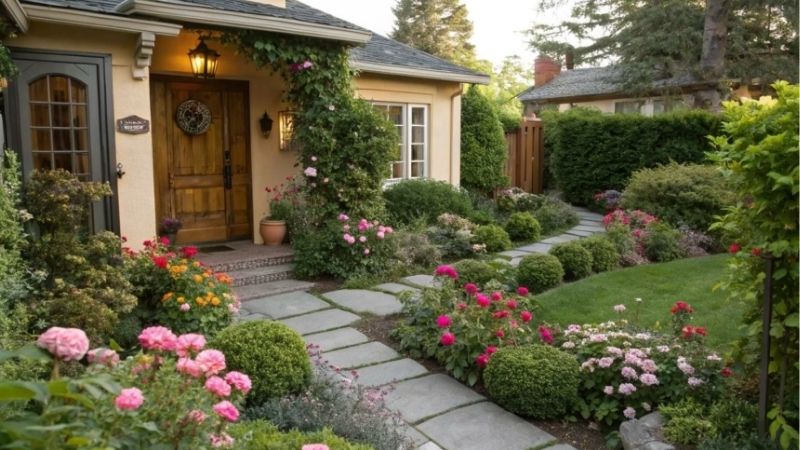
The first rule in a tiny front garden is to protect the way in. Each idea here measures what planting leaves behind — the clear path — rather than how much green it adds. Keep a usable walkway to the door and bins, and plant around it with containers you can shift. The table lists size, cost and effort.
| Idea | Space or Size Needed | Cost Tier | Effort and Time |
|---|---|---|---|
| Stagger pots along one edge | Pot width + clear path | Budget | Minutes |
| Movable pots you can shift | Any spot; portable | Budget | Minutes |
| Narrow planters against the wall | Measure the unit depth | Budget–mid | Under an hour |
| Plant the step edges, not the path | Step margins only | Budget | Minutes |
| Wheeled planters for flexibility | Floor; rolls aside | Budget–mid | Minutes |
| A single corner focal group | One corner, off the path | Budget | Under an hour |
| Boundary-edge raised strip | Along wall or fence | Mid | Half day; build |
| Hanging or wall pots | Wall; off the path | Budget | Under an hour; drilling |
Stagger Pots Along One Edge
Keep planting to one side so the path stays open. Staggering pots along a single edge — against the wall or the boundary — leaves the walkway clear while still greening the garden. Measure the pot diameter against the space, and keep enough clear width to pass, which a common guideline puts around 30 inches or more.
Alternating pot sizes adds interest without crowding the center, and keeps every plant reachable from the path for easy watering. Avoid lining both sides if that pinches the walk below a comfortable width. The test is simple: can you, and a delivery, still pass easily once the pots are in place?
Choose Movable Pots You Can Shift
In a tiny space, movable containers beat fixed beds because you can shift them when you need the path. Standalone pots let you rearrange for access, for bin day, or to follow the sun, and move them aside entirely when a larger item has to come through. Flexibility is worth more than permanence in a tight entry.
Keep pots a size you can lift or slide when full, since a huge planter defeats the point once heavy with wet soil. Group them loosely rather than fixing a layout, and leave the main route clear. The goal is planting that adapts to the path, not a path forced to work around the planting.
Hug the Wall With Narrow Planters
Narrow planters against the house or boundary wall add planting in the slimmest strip. By measuring the exact depth of the unit and setting it tight to the wall, you claim the edge while leaving the path its full width. A shallow trough or a slim rectangular planter suits this far better than a round pot that bulges out.
Measure the planter depth and the remaining path before buying, since one a few inches too deep narrows the walk awkwardly. Keep it stable against the wall, and choose a depth that holds enough soil for your plants. The wall edge is the space a tiny front garden gives up most easily.
Plant the Step Edges, Not the Path
Steps and thresholds have margins that take planting without touching the walkway. Pots set to the sides of steps, or on a wide threshold, green the approach while leaving the treads clear for safe footing. The key is to keep the walking surface and step edges unobstructed, planting only the dead margins beside them.
Keep pots off the treads and clear of handrails, since a pot on a step is a trip and fall risk, especially in the dark. Use stable, heavier-based pots here so they cannot be knocked onto the steps. Lighting the approach matters more than filling it, so leave the path and steps genuinely clear.
Flexible Container Ideas for Tiny Front Gardens
When you want more planting without losing the path, flexible and edge-based containers do the work. These ideas add capacity along boundaries and on wheels, keeping the center route open. Match the container to what you can move or reach, since in a tiny front the usable path is the feature you are protecting throughout.
Put Big Planters on Wheels
A wheeled planter or a pot on a plant caddy gives you a larger container you can still move. Rolling it aside for access, deliveries or cleaning keeps a big planting from permanently claiming the path. It combines the impact of a large pot with the flexibility a tiny front garden needs, so size is less of a commitment.
Choose sturdy casters rated for the loaded weight, since wet soil is heavy, and lock them so the planter does not drift on a slope. Position it off the main route by default and roll it out only when wanted. This suits the one big statement plant a small garden can take, moved aside the moment the path is needed.
Make One Corner a Focal Group
Concentrating planting in a single corner keeps the rest of the garden, and the path, open. A grouped cluster of pots in the corner furthest from the route reads as a deliberate focal point, and it leaves the walkway and entry completely clear. One strong corner beats planting spread thin everywhere.
Vary the heights within the group, but keep the whole cluster off the path and out of the door swing. Make sure you can still reach the back pots to water them, keeping the group shallow against two walls. A focal corner gives a tiny garden presence without compromising how you move through it.
Edge the Boundary With a Raised Strip
A narrow raised strip along the boundary wall or fence concentrates in-ground-style planting into a defined edge, keeping the center open. Even a foot-deep raised border lifts the soil for easier care and frames the garden, turning the margin along the boundary into the main bed while the path stays entirely clear of it.
Keep the strip narrow enough to tend from the path without stepping in, and ensure it drains away from the house wall. It is more work to build than pots, but it is permanent planting that uses the boundary edge a tiny front garden usually wastes, all without borrowing an inch from the walkway to the door.
Lift Planting Onto the Walls
Where the ground is full, the walls can hold pots without touching the path. A few wall-mounted planters or hanging baskets beside the door add greenery entirely off the walkway, freeing the ground for circulation. Used sparingly here, they keep the focus on an open path rather than a wall of stacked planting.
Fix brackets into solid wall and respect the loaded weight, since a watered basket is heavy and must not fall onto the path or a visitor. Keep them clear of head height over the walkway. The point here is not to build a vertical garden but to borrow the wall for a little planting so the ground path stays open.
Frequently Asked Questions
Tiny-front-garden questions circle the same worry: fitting plants without losing the path. People ask how much clear width to keep, what suits a shady entry, how to plant without blocking bins or deliveries, and whether containers or beds are better. The answers below keep circulation first throughout.
How Much Clear Path Should I Keep?
Keep a comfortable walking width to the door and bins, which a common guideline puts around 30 to 36 inches, though it depends on your space and who uses it. Measure the clear run first, then plant only what leaves it intact. The path is the fixed requirement; the planting adapts around it, not the other way around.
Remember to allow for deliveries, a stroller or a bin, which need the full width clear. Pots that encroach as plants grow should sit further back or be movable. If planting would pinch the path below a comfortable width, shift it to the wall or a corner rather than narrowing the walk.
What Plants Suit a Shady Front Entry?
Match plants to the light the entry actually gets. A shaded or north-facing front suits shade-tolerant foliage and flowers rather than sun-lovers, so read the aspect before buying. In containers you can also move pots to the brighter spots the entry does get through the day, which fixed beds cannot do in a tiny garden.
Shade plants in pots still need the right soil and drainage and dry more slowly, so avoid overwatering. Choosing for the conditions you have keeps a small, visible entry looking healthy, since there is no room to hide a struggling plant. Movable containers let you chase light without rebuilding the garden each season.
How Do I Plant Without Blocking Bins or Deliveries?
Plan the bin route and the delivery path first, then plant the leftover edges. Keep containers off the line the bins are wheeled along and clear of the door swing, using movable pots where the route and the planting compete. The approach has to work on bin day and for a parcel, not just look good when nothing moves.
Movable and wheeled planters are the fix where space is shared between planting and access, since you can shift them aside when needed. Keep the heaviest, least movable items in corners that are never on a route. The test is whether everything that has to pass — people, bins, deliveries — still can after the pots are placed.
Containers or a Planted Bed for a Tiny Front?
Containers usually win in a tiny front because they are flexible: you can move them for access, change them by season and keep the path clear in a way a fixed bed cannot. A narrow raised strip along the boundary is the exception, adding permanent planting at the edge without touching the central walkway to the door.
Beds commit the ground permanently, which a tiny front rarely spares, while containers adapt as needs change. Use a bed only on the boundary edge, and containers everywhere the path and planting might compete. The deciding factor is keeping circulation open, so favor whatever you can move aside.
Final Thoughts
The best ideas for tiny front gardens protect the path first and plant around it second — staggered edge pots, movable and wheeled containers, a focal corner off the route. Measure the clear width to the door and bins before buying, keep anything heavy movable, and plant the boundary edges so the way in stays open.
More from Amazon
Programs that pair well with the guide above. Offers and eligibility are set by Amazon and may change.
Collect the home and kitchen items you want in one registry that guests can shop from.
Create a wedding registrySet up recurring deliveries of everyday items on eligible products. Terms and savings are set by Amazon.
Explore Subscribe & SaveFree shipping on eligible items, Prime Video and more. Eligible new members can start with a free trial.
Start a Prime free trialAudiobooks and podcasts to listen to on the go. Eligible new members can start with a free trial.
Try Audible freeAs an Amazon Associate we earn from qualifying purchases.