Capacity is not the first thing to check, so a toy box for kids is chosen by its lid and closure design, the maker’s age guidance and then usable space, in that order. The four options below are compared on lid safety, age suitability and capacity so the one you pick is practical to use and sensible around children.
As an Amazon Associate we earn from qualifying purchases.
By KK Home Furnishings Editorial Team
How to Choose a Toy Box for Kids
Choosing a toy box for kids works best when you check the lid before the capacity, avoid automatic locks on enclosed chests, match the design to your child’s age, and weigh a closed box against open shelving. Those four steps keep safety and practicality ahead of raw storage volume when comparing the options.
Check The Lid Before You Compare Capacity
The lid design matters more than capacity, so check it first. A hinged lid should have a support that stops it dropping on little fingers, and a removable lid avoids the issue entirely. The KidKraft Austin and the Delta Children MySize use a safety hinge, while the Step2 2-in-1 uses a removable board rather than a falling lid.
Match the lid to how your child will use the box: a slow-close or supported hinge reduces the risk of a lid slamming shut, and a removable or soft-close design is gentler still. The U.S. Consumer Product Safety Commission highlights lid support as a key concern for toy chests, so it is the first thing to confirm.
The reason to lead with the lid is that a heavy, unsupported lid is the main hazard a toy chest poses, ahead of anything to do with capacity. Confirm the lid has a support or is removable before comparing how much each box holds, since the safest storage space is no use if the lid itself is a risk.
Avoid Automatic Locks On Enclosed Toy Chests
An enclosed chest should not lock automatically, so avoid closures that latch shut on their own. A closure that cannot be opened from inside is a hazard if a child climbs into the box, which is why guidance warns against self-locking latches on enclosed toy storage with a lid or deep compartment.
Match the closure to safety rather than tidiness: a lid that rests closed without latching, or one a child can push open, is safer than a self-locking catch on an enclosed box. The point is that a child should never be able to become trapped inside, so the closure must not fasten itself shut.
The reason this matters alongside the lid is that an enclosed compartment with a locking closure combines two risks at once. Favor a box whose lid rests gently or is removable and whose closure does not latch automatically, and ventilation becomes the related concern for any deep, enclosed compartment a child might climb into.
Match The Design To Your Child’s Age
The maker’s age guidance points you to the right design, so match it to your child. The Step2 Harmony is rated for ages 2 and up, while the KidKraft Austin and the Delta Children MySize are rated for ages 3 and up, so the published age is a guide to which box suits a given stage of childhood.
Match the design to the age: a younger toddler suits a lower, open or removable-lid box they can reach into safely, while an older child can manage a hinged lid. The age rating reflects the maker’s view of suitability for that product, so treat it as the starting guide rather than assuming any box suits any age.
Where an age range is not published, as with one option here, judge by the design and supervise a young child regardless. A box with a safe lid and an age suited to your child is easier and safer to use day to day, so match the design to the child rather than choosing on storage volume alone.
Compare Closed Boxes With Open-Shelf Storage Carefully
A closed toy box and open shelving solve different problems, so weigh them against each other rather than assuming a lidded box is best. A closed box hides clutter behind a lid, while open shelving, as on the Step2 Harmony which pairs a storage area with shelves, keeps toys visible and avoids the lid question entirely.
Match the format to your child and room: open shelving suits a toddler reaching for toys without a lid to manage, while a closed box gives a tidier look and a surface to sit or play on. The trade-off is visibility against tidiness, so decide which matters more for your space and your child’s independence.
The reason to compare rather than default to a lidded box is that a lid adds both tidiness and a safety consideration, which open shelving avoids. For the youngest children, open or removable-lid storage can be the simpler, safer choice, so weigh a closed box’s neat look against the straightforwardness of shelves before deciding.
Top Picks
These four options cover a removable-lid design, a value box, a wood bench-style chest and a storage-plus-shelving unit, with ages, lids and prices verified as of October 2026. No single box is named safest overall, because none had full independent verification of both its closure and its ventilation at the time of writing.
| Product | Best For | Key Spec | Watch Out For |
|---|---|---|---|
| Step2 2-in-1 Toy Box | Removable-Lid Design | 4.5 ft3; 30.5 x 19 x 19 in; ~$83.99 | Age not published in source |
| Delta Children MySize | Best Value | Age 3+; slow-close hinge; ~$47.99 | Capacity not published |
| KidKraft Austin | Wood Bench-Style Box | 30 x 18 x 21.25 in; safety hinge; ~$69.99 | Capacity not published |
| Step2 Harmony | Storage Plus Shelving | 4.2 ft3; age 2+; ~$169.99 | Highest price; largest footprint |
Step2 2-in-1 Toy Box – Best For A Removable-Lid Design
The Step2 2-in-1 is the pick for a safe lid, a box measuring 30.5 by 19 by 19 inches with 4.5 cubic feet of storage and a removable board rather than a hinged, falling lid, listed at about $83.99 as of October 2026. The removable lid sidesteps the dropping-lid concern entirely, which is its main safety advantage.
The removable board doubles as a surface and avoids a heavy hinged lid, and the 4.5 cubic feet is the largest published capacity here, if only slightly ahead of the Step2 Harmony at 4.2. For a parent who wants generous storage without a falling lid to worry about, it is the straightforward choice in this group.
The caveats are that its recommended age is not published in the current source, so judge suitability by the design and supervise a young child, and its capacity is only about 7 percent more than the Harmony, so it is not far roomier. Confirm the age guidance before buying for a very young child who will use it unsupervised.
Delta Children MySize – Best Value
The Delta Children MySize is the value pick, rated for ages 3 and up with a slow-close safety hinge, weighing about 22.93 pounds assembled, listed at about $47.99 as of October 2026. It is comfortably the lowest-priced here, and the slow-close hinge is designed to stop the lid dropping quickly on small hands.
The slow-close hinge is the key feature at this price, reducing the main hazard of a hinged lid, and the age-3 rating points it at preschoolers. For a parent on a budget who still wants a lid that closes gently rather than slamming, it covers the essentials at the lowest cost of these four options.
The caveats are that its capacity is not published in the current source, so judge size by the dimensions, and the maker’s statement that it meets CPSC standards is a manufacturer claim rather than an independent verification. Supervise young children regardless, and treat the safety wording as the maker’s own claim.
KidKraft Austin – Best For A Wood Bench-Style Toy Box
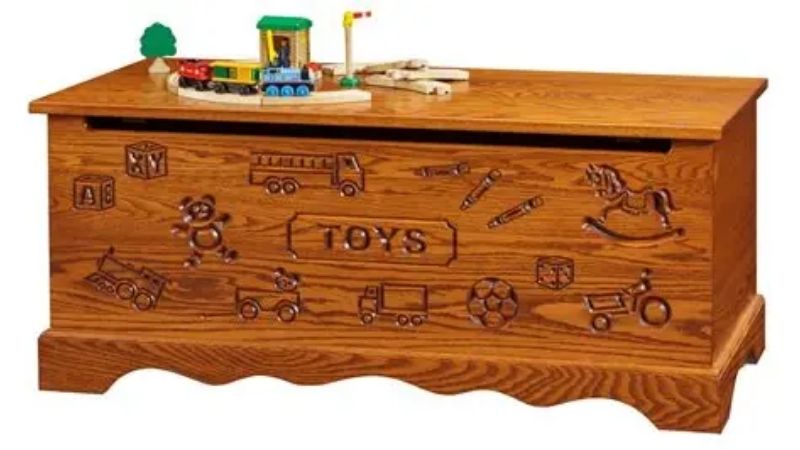
The KidKraft Austin is the pick for a wood bench-style box, measuring 30 by 18 by 21.25 inches with a safety hinge that prevents the lid dropping, rated for ages 3 and up, listed at about $69.99 from a $114.99 regular as of October 2026. Its wood construction and bench height suit sitting as well as storage.
The safety hinge addresses the falling-lid concern, and the solid wood look fits a bedroom or playroom better than molded plastic for some homes. The bench-style height lets a child sit on it, and at about $69.99 on sale it offers a wood chest with a safe lid at a mid-range price within this group.
The caveats are that its capacity is not published in the current source, so judge size by the 30-by-18-by-21.25-inch dimensions, and the age-3 rating points it at preschoolers rather than toddlers. Supervise use of any hinged lid even with a safety support, and confirm the box suits your child’s age before buying.
Step2 Harmony – Best For Toy Storage Plus Shelving
The Step2 Harmony is the pick for mixed storage, a 31-by-20.75-by-38-inch unit with 4.2 cubic feet of lower storage plus shelving, rated for ages 2 and up, listed at about $169.99 as of October 2026. The combination of a storage area and open shelves keeps some toys visible while others go away.
The added shelving is its appeal, letting a child reach display toys on open shelves while bulkier items go in the lower storage, and the age-2 rating suits younger children. For a playroom that wants both tidy storage and accessible display in one piece, it does more than a plain toy box, which is its main advantage.
The caveats are price and footprint: at about $169.99 it is by far the most expensive here, and its 31-by-20.75-inch base is the largest, standing 38 inches tall. Its 4.2 cubic feet is marginally less than the Step2 2-in-1, so choose it for the shelving rather than the capacity, and measure the space for the taller unit.
Frequently Asked Questions
Parents comparing toy boxes tend to ask the same practical questions, and most come back to lid safety rather than capacity. These answers keep the guidance tied to the picks above while being clear that supervision still matters and that a maker’s safety statement is not the same as independent verification.
Are Toy Boxes With Lids Safe For Kids?
They can be, provided the lid is supported or removable and the closure does not latch shut on its own. A hinged lid needs a support to stop it dropping, as on the KidKraft Austin and Delta MySize, while a removable lid like the Step2 2-in-1 avoids the dropping-lid hazard that guidance warns about entirely.
The reason to check the lid is that an unsupported lid dropping on small hands is the main risk a toy chest poses, which is why lid support is a key safety concern. A closure that cannot be opened from inside is a further hazard, so an enclosed box should not latch automatically in case a child climbs in.
So a lidded toy box can be safe when it has a supported or removable lid, a non-locking closure and ventilation for any enclosed space, used with supervision for young children. Treat any maker’s safety statement as its own claim rather than independent verification, and supervise use regardless of the features listed.
Does A Toy Box Need Ventilation?
An enclosed toy box or deep compartment does, in case a child climbs inside. Guidance highlights ventilation and a non-locking closure for enclosed toy storage precisely because a child could get into a large box, so a deep, lidded chest should allow air in and must not fasten itself shut.
The reason ventilation matters is the same as the closure: a child who climbs into an enclosed box must not be at risk if the lid closes. An open or shelved design, or a box that cannot fully seal, avoids the concern, which is why open-shelf storage like part of the Step2 Harmony sidesteps the issue.
For any deep, enclosed box, favor one with ventilation and a lid that does not seal or lock, and supervise young children around it. The ventilation and closure concerns go together for enclosed storage, so weigh them alongside the lid support when a box is large enough for a child to climb into.
Is A Removable Lid Better Than A Hinged Lid?
A removable lid avoids the dropping-lid risk entirely, which is a point in its favor, but a well-supported hinge is also fine. The Step2 2-in-1 uses a removable board, sidestepping the hinge question, while the KidKraft Austin and Delta MySize use supported or slow-close hinges designed to stop the lid dropping quickly.
The reason neither is simply better is that both can be safe when done right: a removable lid has nothing to drop, while a supported or slow-close hinge controls how the lid closes. The hazard is an unsupported lid that slams shut, so the mechanism matters less than whether the lid is controlled one way or another.
Choose by preference and use: a removable lid suits a younger child and doubles as a surface, while a hinged lid stays attached and tidy. Either is reasonable with the right design, so confirm the lid is supported, slow-close or removable rather than unsupported, and supervise young children with any hinged mechanism.
What Age Can A Child Use A Toy Box?
It depends on the design, with these boxes rated from ages 2 to 3 and up. The Step2 Harmony is rated from age 2, while the KidKraft Austin and Delta MySize are rated from age 3, so the published age points to who a given box suits, reflecting the maker’s view of its design and safety.
The reason the ratings differ is the design: a lower, open or removable-lid box suits a younger child, while a hinged chest suits one old enough to manage a lid. Where no age is published, as with one option here, judge by the design and height, and supervise a very young child with any lidded box.
Match the box to your child’s stage and supervise use regardless of the rating, especially around a hinged lid. A box suited to the child’s age, with a safe lid and closure, is easier and safer to use, so let the age guidance and the design guide the choice rather than storage capacity alone.
Final Thoughts
The best toy box for kids has a supported or removable lid and a safe closure, matched to your child’s age before capacity: the removable-lid Step2 2-in-1 for a roomy box, the value Delta Children MySize with its slow-close hinge, the wood KidKraft Austin chest, or the Step2 Harmony for storage plus shelving.