Key takeaways
- An oak coffee table can mean solid oak, oak veneer, or just an oak-colored finish, and those are three different purchases. This roundup compares four verified tables by how much real oak is in them first, then by size, storage…
An oak coffee table can mean solid oak, oak veneer, or just an oak-colored finish, and those are three different purchases. This roundup compares four verified tables by how much real oak is in them first, then by size, storage and construction, so you know whether you are buying hardwood, a veneer, or only the look of oak.
As an Amazon Associate we earn from qualifying purchases.
By KK Home Furnishings Editorial Team
How to Choose an Oak Coffee Table
The word oak covers everything from a solid hardwood top to a wood-tone finish, so the first job is to read the material scope, not the color. A solid-oak table, an oak-veneer one, and an oak-named finish age and cost very differently, so separate those claims before you compare dimensions, storage or construction between the tables here.
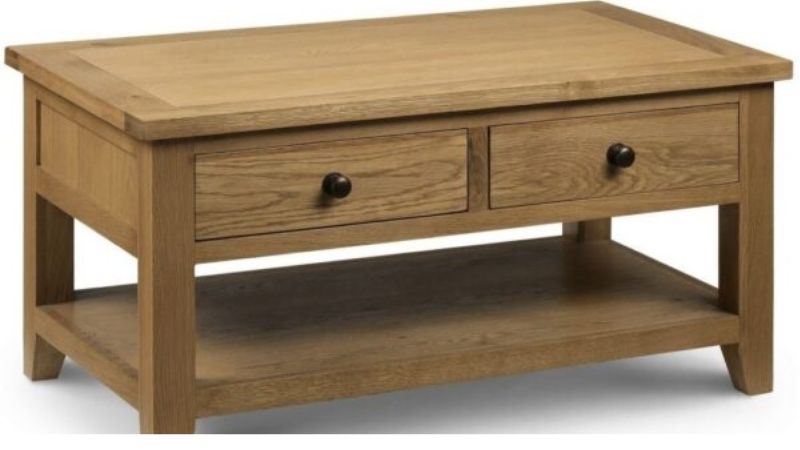
Separate Solid Oak From Oak Veneer
Solid oak and oak veneer are both real oak, but they are not the same build. The Article Amoeba is solid American oak throughout, while the IKEA TONSTAD pairs a solid-oak top panel with oak veneer and particleboard in other sections, so one is hardwood through and through and the other combines solid oak with veneered engineered wood.
The difference matters for how the table ages and what you pay. Solid oak can be sanded and refinished and takes knocks as scratches not chips, while oak veneer over engineered wood looks the same on the surface but cannot be sanded deeply and can chip at edges. Ask which parts are solid and which are veneer before judging a table.
Neither is a defect, so do not treat veneer as fake oak. Oak veneer over a stable core is a legitimate, period-appropriate construction that resists warping and costs less, while solid oak is the premium, renewable option. Decide which you actually want based on budget and longevity, not assuming only solid hardwood counts as a real oak table.
Treat “Oak Finish” as a Different Claim
An oak-named finish is a third claim entirely, and the weakest guarantee of real oak. The Article Cooper, for example, is a mix of solid and veneered wood sold in a Natural Oak finish, and the maker does not separately state the species of every component, so the finish name describes the look more than it confirms the wood underneath.
Read a finish name as a color and style cue, not a material guarantee. A Natural Oak or oak-tone finish can sit over genuine oak, another wood, or engineered board, so it does not by itself tell you what the table is made from. Where the maker names a finish not the wood, treat the species as unconfirmed unless the listing states it.
This matters most on pieces where composition is not published. The West Elm Zaccai is named Oak but its exact composition was not published on the sources checked, so it cannot be called solid oak until that detail is verified. Where the material is unstated, hold off on assuming hardwood and confirm the construction before paying for hardwood.
Compare Dimensions After Material Is Verified
Once the oak scope is clear, compare sizes, which here are closely matched among the single tables. The Cooper is 35.5 inches wide, the Amoeba 35, and the TONSTAD 33.125, so the three single-size tables sit within a narrow band, while the Zaccai is a nesting family spanning 36 to 48 inches rather than one fixed top to compare directly.
Match the footprint to the room and the seating. A 33-to-35-inch table suits a standard sofa and a modest living room, while a nesting set like the Zaccai flexes between sizes for a flexible layout. Measure the space in front of your sofa and leave a walkway, since the tables are close enough that the room, not an inch, decides the fit.
Do not over-read small width gaps. The Cooper and Amoeba differ by under two percent, and the Amoeba and TONSTAD by under six, so none is much larger than the next, and width is a poor way to rank them. With sizes this close, let the oak scope, the storage and the shape settle the choice rather than a marginal dimension.
Decide Whether Drawers or Nesting Matter More Than Purity
Function can outweigh material purity, so decide what you actually need. The IKEA TONSTAD adds two soft-closing drawers, the West Elm Zaccai nests for flexibility, and the Article Amoeba and Cooper are clean, storage-free tops, so a table with less solid oak can still be the better buy if it hides clutter or adapts to the room.
Weigh storage against the oak you give up. The TONSTAD’s drawers hide remotes and coasters but come with veneer and particleboard not all-solid oak, while the solid-oak Amoeba offers no storage. Decide whether concealed storage or a nesting format matters more than having hardwood throughout, since you often trade one for the other here.
Think about long-term use, not just the spec sheet. A storage table sees its drawers opened daily, where a veneer edge or a soft-close runner is the first thing to wear, while a clean solid-oak top simply collects scratches that can be sanded out. Match the format to your habits, then accept the construction trade-off that comes with it.
Top Picks
Each pick below fills a clear role, with the oak scope, dimensions and storage drawn from the makers’ listings, current as of October 2026. Prices move and one has unconfirmed composition, so confirm before buying. The table pairs the standout detail with the main catch for each before the fuller notes that follow just below it.
| Product | Best For | Key Spec | Watch Out For |
|---|---|---|---|
| Article Amoeba White Oak | Best Overall | solid American oak; 35 × 28.5 in | Organic triangle shape; no storage |
| IKEA TONSTAD | Best Storage | solid oak + oak veneer; 2 drawers | Not an all-solid-oak table |
| Article Cooper Natural Oak | Best Mixed-Construction Mid-Century | 35.5 × 28.5 in; solid + veneer | Not every part is solid oak |
| West Elm Zaccai | Best Nesting Format | 36-48 in nesting family | Exact oak composition unverified |
Article Amoeba White Oak: Best Overall
The Article Amoeba White Oak is the overall pick for genuine solid oak. It is built from solid American oak throughout, measures 35 inches wide by 28.5 deep by 18.5 tall in an organic, triangular form, and lists around $249 at Article as of October 2026 in the mid tier, the most affordable all-solid-wood option in this group of four.
It suits a buyer who wants real hardwood with no veneer or engineered core, since solid oak can be refinished and takes knocks as scratches not chips. The sculptural shape anchors a casual room. Measure the 35-by-28.5-inch footprint against your sofa, and note the organic outline reads differently in a layout than a plain rectangle.
The catch is shape and storage: the triangular, organic form has no corners to align neatly in a tight layout and offers no hidden storage, so if you need drawers, the TONSTAD fits better. As solid wood it also wants occasional care to keep the finish. Choose the Amoeba when genuine solid oak matters more than storage or a boxy footprint.
IKEA TONSTAD: Best Storage
The IKEA TONSTAD is the pick when you want hidden storage in an oak table. It measures 33.125 inches wide by 32.25 deep, pairs a solid-oak top panel with oak veneer and particleboard elsewhere, and adds two soft-closing drawers, one on each side, listing around $349.99 at IKEA as of October 2026 in the mid tier for a table.
It suits a living room that needs to tuck away remotes, coasters or clutter, since the two drawers do what the clean-top tables cannot, and the solid-oak top gives a genuine oak surface. Measure the nearly square 33-by-32-inch footprint against the sofa, and plan clearance for the side drawers to open fully on both sides of the table.
The catch is construction: only the top panel is solid oak, with veneer and particleboard in other sections, so it is not an all-solid-oak table, and the soft-close runners are moving parts that can wear over years. For most rooms that is a fair trade for the storage, so choose it when drawers matter more than solid wood throughout.
Article Cooper Natural Oak: Best Mixed-Construction Mid-Century
The Article Cooper Natural Oak is the pick for a mid-century look in a mixed-wood build. It measures 35.5 inches wide by 28.5 deep by 16 tall in a mix of solid and veneered wood with a Natural Oak finish, and lists around $349 at Article as of October 2026 in the mid tier, essentially level in price with the TONSTAD here.
It suits a room that wants the warm Natural Oak tone and a low, mid-century profile without paying for all-solid hardwood, and the clean rectangular top sits neatly against a sofa. Measure the 35.5-by-28.5-inch footprint, which is close to the Amoeba’s. The finish name describes the look, so read it as a tone not a material guarantee.
The catch is exactly that: the maker does not separately state the species of every component, so do not assume the whole table is solid oak just because the finish is called Natural Oak. The mix of solid and veneered wood is sound, but set expectations on the material. Choose the Cooper for the mid-century look, not for guaranteed hardwood.
West Elm Zaccai: Best Nesting Format
The West Elm Zaccai is the pick for a flexible nesting format. It is a nesting family spanning nominal sizes from 36 to 48 inches rather than a single fixed top, is named Oak by West Elm, and lists around $1,199 at the displayed state as of October 2026, the premium and most expensive option in this group of four tables.
It suits a room that wants adjustable surfaces, where the nesting tables spread out for guests and tuck together to free floor space. The 36-to-48-inch range flexes to the layout. Measure the largest table against the sofa and the nested footprint for storage, since a nesting set is sized by both its spread.
The important catch is material: the exact oak composition was not published on the sources checked, so despite the Oak name it cannot be called solid oak until that detail is verified. Confirm the construction before paying the premium price, and treat the Oak label as a starting point rather than proof of hardwood throughout the set.
Frequently Asked Questions
Buyers of oak tables ask the same core questions, mostly about veneer, solid wood, finishes and care. Each answer below leads with the direct reply, then adds the condition that changes it, so you can apply it to the exact table you are considering rather than a blanket assumption that any oak-named piece is solid hardwood throughout.
Is oak veneer real oak?
Yes, oak veneer is real oak, just a thin layer of it bonded over a stable core rather than solid hardwood. A veneered table like the IKEA TONSTAD uses genuine oak on the visible surface, so it looks like oak because it is oak on top, but the structure underneath is engineered wood, which is a different build from solid oak throughout.
The distinction affects durability and refinishing, not authenticity. Veneer cannot be sanded deeply because the oak layer is thin, and edges can chip to reveal the core, while solid oak can be refinished repeatedly. So veneer is real oak but behaves differently, which is the practical thing to weigh rather than whether it counts as oak.
Do not treat veneer as fake. Oak veneer over a good core resists warping and costs less, which makes it a sensible choice for many rooms, so the honest framing is that it is real oak in a different construction. Decide between veneer and solid oak on budget, refinishing and how hard the table will be used, not on a purity label.
Is solid oak better than oak veneer?
It depends on what you value; solid oak is more durable and refinishable, but veneer has real advantages. Solid oak, like the Article Amoeba’s, can be sanded and refinished and shrugs off knocks as scratches, while oak veneer over engineered wood resists warping, costs less and stays flatter in humidity. Neither is better for every room.
Weigh the trade-offs against your use. A solid-oak table suits a household that wants a piece to last decades and does not mind the higher price, while veneer suits a budget or a stable room where refinishing is unlikely to matter. Think about how long you plan to keep the table and whether you would ever refinish it before deciding.
Construction quality matters as much as the label. A well-built veneered table can outlast a poorly joined solid-oak one, and edges and joinery are where cheaper pieces fail first, so read how the table is made, not just whether it is solid or veneer. Match the build to your budget and longevity goals, not to a hope that solid always wins.
Does “oak finish” mean the table is made from oak?
No, an oak finish describes the color and look, not the material underneath. A table sold in a Natural Oak or oak-tone finish, like the Article Cooper, can be solid oak, oak veneer, another wood, or engineered board finished to resemble oak, so the finish name alone does not confirm what the table is actually made from inside.
Read the material description separately from the finish. Where a listing names the wood, such as solid oak or oak veneer, you know the construction; where it only names a finish, treat the species as unstated unless confirmed. The Cooper, for instance, is a mix of solid and veneered wood, which the Natural Oak finish name does not reveal.
When composition is unpublished, do not assume oak. The West Elm Zaccai is named Oak but its exact material was not published on the sources checked, so it cannot be called solid oak until verified. Treat an oak finish or an Oak name as a prompt to check the construction, especially before paying a price that implies solid hardwood.
How do you care for an oak coffee table?
Care depends on whether it is solid oak or veneer, but both want gentle, consistent habits. Wipe spills promptly, use coasters to avoid rings, and dust with a soft cloth, since oak and its finishes mark from standing liquid and heat. Avoid harsh chemicals and keep the table out of constant direct sun, which can fade or dry the wood.
Solid oak offers more recovery than veneer. A solid-oak table can be sanded and refinished to remove deeper scratches or water marks, while a veneered or finished table is limited to surface care because the oak layer is thin, so match your expectations to the build. Reapplying a recommended finish periodically helps solid oak keep its look.
Protect the edges and joints, which wear first. On veneered pieces, guard the edges where the thin oak layer can chip, and on any table keep drawers and runners clean so they glide, since grit is what wears moving parts. Following the maker’s specific care notes, rather than a generic routine, keeps an oak table looking right for years.
Final Thoughts
Choosing an oak coffee table starts with material scope, not color: separate solid oak, oak veneer and an oak-named finish, confirm composition where unstated, then compare size, storage and shape. The solid-oak Amoeba, storage TONSTAD, mixed Cooper and nesting Zaccai each suit a budget and need, and knowing how much real oak you buy matters most.