Our Top Picks
 HIKEMOON 150L Collapsible Wagon Compact with Big Wheels33.07 x 19.29 x 40.55 inches17 poundsCheck on Amazon
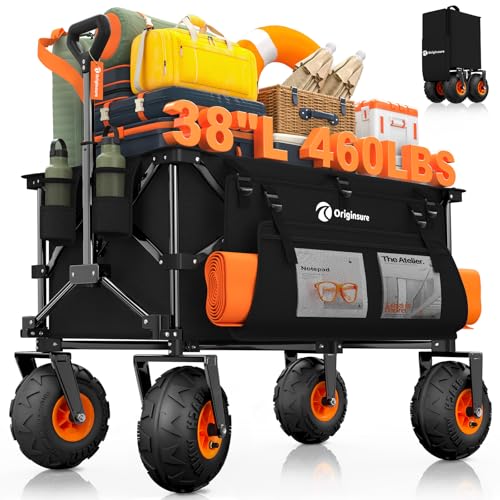 Originsure 220L Collapsible Beach Wagon with Balloon Wheels40.95 x 24.81 x 26.38 inches31 poundsCheck on Amazon
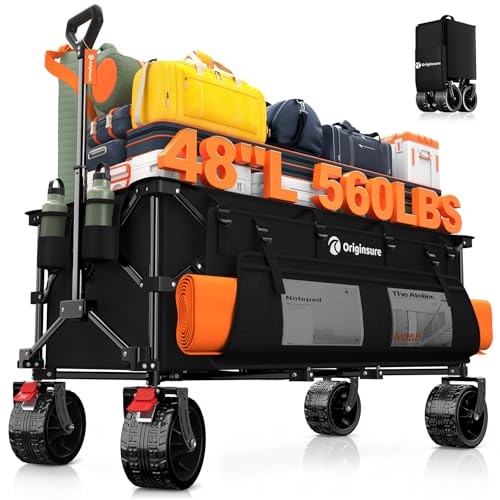 Originsure 300L Collapsible Beach Wagon Cart with Big48.43 x 24.02 x 42.52 Inches28.43 PoundsCheck on Amazon
Best All Terrain Beach Wagons for Sand & Trails
The best all terrain beach wagon for most families has wheels at least 4 inches wide, a load capacity of 150 pounds or more, a powder-coated steel frame, and a folded footprint that fits your vehicle or storage space. Choose wider wheels and a reinforced fabric bed for soft sand; prioritize a lighter frame and compact folded dimensions if you’ll carry it up stairs or store it in a small closet.
Choose by terrain and trip
“All terrain” isn’t a standardized performance rating. A wagon that rolls well over grass and packed gravel may bog down in dry, loose beach sand. Wheel width and diameter both matter: wider wheels spread the load over more sand, while larger wheels help clear roots and ruts. No wheel design eliminates the effort of pulling a heavily loaded wagon through deep, dry sand.
HIKEMOON 150L Collapsible Wagon Compact with Big Wheels, 420LBS Black
Included for 'Best All Terrain Beach Wagons for Sand & Trails' because the listing specifies 420LBS Black, details this guide uses to compare options.
View on AmazonOriginsure 220L Collapsible Beach Wagon with Balloon Wheels, 460lbs, Black
Included for 'Best All Terrain Beach Wagons for Sand & Trails' because the listing specifies 460lbs and Black, details this guide uses to compare options.
View on Amazon
Hikenture Beach Wagon with Balloon Wheels, 9" PU Tires Collapsible Wagon
Included for 'Best All Terrain Beach Wagons for Sand & Trails' because the listing specifies 9" PU Tires Collapsible Wagon, details this guide uses to compare options.
View on AmazonOriginsure 300L Collapsible Beach Wagon Cart with Big Wheels, 560lbs, Black
Included for 'Best All Terrain Beach Wagons for Sand & Trails' because the listing specifies 560lbs and Black, details this guide uses to compare options.
View on Amazon- For soft sand: Look for broad wheels around 4–7 inches wide, a stable wheelbase, and a fabric bed with a removable liner. Keep the load low and centered.
- For mixed trails and campsites: A 3–5-inch-wide wheel, sturdy frame, and manageable handle length are a useful balance. Check that the wheels can turn without striking the wagon body.
- For stairs, public transport, or small-car storage: Favor a lighter wagon with a simple folding mechanism. Narrower wheels can be easier to store but are less suited to loose sand.
- For bulky beach gear: Compare the wagon’s bed dimensions as well as its weight limit. A high capacity doesn’t guarantee enough floor space for a cooler, chairs, and a shade tent.
Compare the specifications that affect real use
Use the figures below as a shopping-screening guide, not a guarantee of beach performance. Dimensions and capacities vary by model, and manufacturers may measure folded size with the wheels attached or removed. Confirm the exact product specifications before buying.
| Wagon type | Typical wheel width | Typical capacity | Typical folded size | Frame and fabric trade-off | Best fit |
|---|---|---|---|---|---|
| Compact folding utility wagon | 2–3 in | 100–150 lb | About 30 × 10 × 8 in | Often a light steel frame with polyester fabric; easy to carry, but narrow wheels sink more readily in dry sand. | Packed paths, parks, and limited storage |
| Wide-wheel beach wagon | 4–7 in | 150–225 lb | About 35 × 12 × 10 in | Usually a heavier steel frame and reinforced polyester; better flotation on sand, with more weight and bulk to move. | Beach days with chairs, towels, and a cooler |
| Heavy-duty all-terrain wagon | 3–6 in | 200–300 lb | About 36 × 15 × 12 in | Stout steel or aluminum frame and thicker fabric; greater load potential can mean a harder pull and less convenient storage. | Gear-heavy camping and rougher trails |
These approximate ranges describe common design categories, not specifications for a particular model. A wagon’s stated capacity is a maximum load, not a promise that it will pull comfortably over sand. For a long walk, choose a wagon with capacity comfortably above the weight you expect to carry, and allow room for unevenly packed items.
Frame and fabric: what holds up, and what gives out?
| Component | What to look for | Practical trade-off | Likely wear point |
|---|---|---|---|
| Steel frame | Coated tubing, secure joints, and a stable base | Typically rigid and economical, but heavier; chipped coatings can allow corrosion, especially with salt exposure. | Scratches, joints, and hardware |
| Aluminum frame | Reinforced cross-bracing and solid fasteners | Lighter to carry, but can cost more; thin or poorly braced sections may flex under uneven loads. | Folding joints and stress points |
| Polyester fabric | Reinforced seams and a removable or replaceable liner | Light and quick-drying, but sand and sharp corners can abrade it over time. | Bottom panel, corners, and stitching |
| Heavier reinforced fabric | Thick weave, bound edges, and load-bearing attachment points | Better suited to frequent gear hauling, but heavier and slower to dry if packed away damp. | Seams and points where fabric meets the frame |
Frame material alone doesn’t determine durability. Check whether the load is supported by the frame or by fabric straps, whether the floor panel is reinforced, and whether replacement fabric is available. After a beach trip, rinse salt and grit from the frame and wheel hardware, shake sand from the fabric, and let everything dry fully before folding it away.
Best choice by situation
- Mostly loose sand: Choose the widest wheels you can store and lift, ideally around 4 inches or wider. A removable liner makes it easier to empty out sand. Expect to pull more slowly when the wagon is heavily loaded.
- Beach plus walking trails: Pick a balanced design with medium-wide wheels, a sturdy frame, and a handle that swivels smoothly. Check that wheel locks or brakes, if included, are easy to reach.
- Small car or apartment storage: Measure the cargo opening and the storage spot before shopping. A folded length of 35 inches may fit a trunk but still be awkward through a narrow hatch. Compare folded width, height, and weight—not just whether the wagon is described as compact.
- Heavy cooler and family gear: Favor reinforced seams and a capacity with a comfortable margin over your planned load. Put the heaviest items over the center of the base rather than hanging them from the handle.
- Frequent carrying by one person: A lighter frame may matter more than maximum load capacity. If you must lift the wagon into a car, check its listed product weight and whether the wheels can be removed for storage.
Before buying: measure, assemble, and check the load
- Measure the route to storage. Record your trunk opening, closet or garage space, and any narrow doorway or stair turn. Compare those measurements with the wagon’s folded dimensions, leaving a little clearance for handles and protruding wheels.
- Check setup details. Many folding wagons open by pulling a center strap, while others require wheel or handle assembly. Confirm which parts arrive detached and whether tools are needed; don’t assume “folding” means ready to use straight from the box.
- Estimate the real load. Add the weight of the cooler, chairs, towels, and other gear. Keep within the maker’s stated limit, and remember that sand increases rolling resistance even if the wagon remains under capacity.
- Try the pull and turning space at home. Load the wagon with a modest amount of gear on a clear, level surface. Check handle reach, turning clearance, and whether the wheels rub when turning sharply. This won’t predict performance on soft sand, but it can reveal a poor fit or awkward steering.
- Plan for cleaning. Look for accessible wheel axles and a liner that can be removed or wiped down. Let wet fabric dry fully before storage to reduce odor and mildew risk.
Bottom line
For frequent beach use, choose broad wheels, reinforced fabric, and a frame you can maintain; for mixed trails, balance wheel width against weight and folded size. The right wagon is the one that fits your vehicle and storage space, carries your actual gear with a safety margin, and remains manageable when the sand turns soft—not simply the one with the highest advertised capacity.