Key takeaways
- Small apartment: Choose an inflatable model that fits in a closet or under-bed storage once packed. Confirm the packed-bag dimensions and whether a pump is included.
- Children or pets: Choose a wide sit-on-top with an open center area and a capacity comfortably above the combined family load. Secure loose equipment; an open deck is not a substitute for supervision or flotation gear.
- Renter without a roof rack: An inflatable avoids permanent vehicle accessories. Allow time at the launch for inflation and at home for rinsing and drying.
- Back pain or limited mobility: Prioritize higher seats, supportive adjustable backrests, wide cockpit openings, and a launch with a gradual shoreline. A lighter boat can matter more than a faster hull.
- Long day trips: Select a longer touring tandem with foot braces, dry storage, and enough capacity for water and safety equipment without reaching the limit.
- Unequal paddling strength: A convertible kayak with a usable solo position gives the stronger paddler more control when the other person needs a break.
The best tandem kayaks depend on where you paddle: a stable recreational sit-on-top is easiest for beaches and families, a longer touring kayak tracks better on open water, and an inflatable tandem wins when storage and transport matter more than speed.
Quick picks by paddling situation
| Best for | Recommended type or model | Why it fits | Main compromise |
|---|---|---|---|
| Families, beginners, and warm-weather recreation | Ocean Kayak Malibu Two | Wide sit-on-top layout, open seating, simple entry, and room for a small child or pet between paddlers | Heavy and slower than a narrow touring tandem |
| Day touring on lakes, bays, and calm coastal water | Wilderness Systems Pamlico 135T | Longer hull, adjustable outfitting, and a cockpit arrangement that can be paddled solo or tandem | Less open and carefree than a sit-on-top |
| Maximum recreational stability | Old Town Twin Heron | Stable sit-in design with a removable child seat and a predictable platform for new paddlers | Bulky to carry and not intended for fast-distance touring |
| Apartment storage or car-trunk transport | Two-person inflatable kayak, such as the Aquaglide Chinook 2 | Packs into a carry bag and can be transported without a roof rack | Requires inflation, drying, and more careful storage |
| Portable touring with a higher-performance hull | Advanced Elements Convertible Elite | Inflatable construction with a more structured, pointed hull than a basic recreational inflatable | More expensive and slower to set up than a rigid kayak |
Model specifications and included accessories can change, so confirm the manufacturer’s current dimensions, capacity, and package contents before buying. The practical differences below matter more than a product name alone.
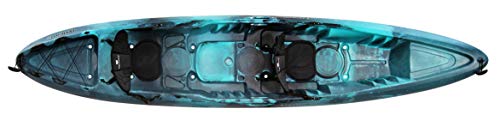
Perception - Rambler 13.5 Recreational Kayak - Sit on Top Tandem Kayak - Storage with Tie Downs - 13.6 ft - Dapper
Included for 'Best Tandem Kayaks for Two-Person Adventures' because the listing specifies Rambler 13.5 Recreational Kayak and Sit on Top Tandem Kayak, details this guide uses to compare options.
View on Amazon
Pelican Argo 136XP - Sit in Tandem Kayak - Iris - Patented Ram-X™ Material - Lightweight Stable - 13 ft
Included for 'Best Tandem Kayaks for Two-Person Adventures' because the listing specifies Sit in Tandem Kayak and Iris, details this guide uses to compare options.
View on Amazon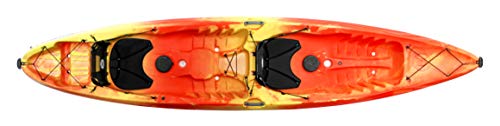
Perception - Tribe Tandem Kayak - Sit on Top - Large Rear Storage with Tie Downs - 13.5 ft - Sunset
Included for 'Best Tandem Kayaks for Two-Person Adventures' because the listing specifies Tribe Tandem Kayak and Sit on Top, details this guide uses to compare options.
View on Amazon
Perception Kayaks Tribe 13.5 Sit on Top Tandem Kayak for All-Around Fun Large Rear Storage with Tie Downs, Dapper
Included for 'Best Tandem Kayaks for Two-Person Adventures' because the listing specifies Dapper, details this guide uses to compare options.
View on AmazonHull stability: choose predictable balance over maximum width
For two people, stability is affected by more than the kayak’s beam. A wide, flat-bottomed hull feels steady when entering from shore and is reassuring when one paddler shifts position. That makes a broad sit-on-top useful for swimming stops, children, fishing, and casual lake trips. The trade-off is greater drag: it takes more effort to maintain speed, especially into wind.
A rounded or moderately V-shaped touring hull may feel less planted during the first few minutes, but it generally tracks more efficiently and handles small waves with less slapping. It is a better choice when the pair plans to paddle several miles rather than drift, picnic, and repeatedly get in and out.
Look for a usable weight capacity with a safety margin. Add both paddlers, clothing, water, food, dry bags, and a cooler. For example, two adults weighing 175 pounds each plus 40 pounds of equipment equal 390 pounds. A kayak rated for 425 pounds leaves little room for wet gear and changing conditions; a capacity around 500–600 pounds is more comfortable for that load.
Cockpit layouts: open, enclosed, or convertible
Sit-on-top tandems
Sit-on-top kayaks have open molded seats rather than enclosed cockpits. They are easy to enter, drain water through scupper holes, and accommodate a child, dog, or cooler more naturally. They are also forgiving when a wave washes over the deck. Because your legs are exposed, however, you get less protection from cold spray and wind.
Sit-in tandems
Sit-in kayaks place each paddler in a cockpit with a seat, foot braces, and a raised rim. They offer better weather protection and usually provide a more connected feel for steering and edging. Check the cockpit opening carefully: a smaller opening can be warmer and drier, but may be awkward for larger adults or anyone with limited hip and knee mobility.
Convertible layouts
Some tandem kayaks let one person paddle alone from a central seat or reposition the seats. The feature is valuable when paddlers have different stamina, but it adds adjustment points and does not turn a long tandem into a nimble solo kayak. Confirm that the solo position is centered enough to keep the bow from lifting and the stern from dragging.
Portability: the measurement that decides whether you will use it
| Construction | Typical tandem length | Typical packaged or hull weight | Setup and transport reality |
|---|---|---|---|
| Rigid recreational sit-on-top | 12–14 feet | 55–75 pounds | Usually needs a roof rack, trailer, or two-person carry; no inflation time |
| Rigid touring tandem | 13–17 feet | 60–90 pounds | Efficient on the water, but difficult around tight driveways, staircases, and narrow garages |
| Basic inflatable tandem | 10–13 feet when inflated | 25–45 pounds packed | Usually 8–15 minutes to inflate with a suitable pump, plus drying time |
| Structured inflatable touring tandem | 13–15 feet when inflated | 40–60 pounds packed | Often 10–20 minutes to assemble; fin, seats, valves, and drying add work |
Measure the route from storage to vehicle, not only the storage space. A 14-foot rigid kayak may fit diagonally in a 10-by-12-foot room, but only if furniture can be moved and there is enough clearance to rotate it. A 72-inch-wide garage door is usually adequate for a kayak on its side, while a narrow apartment hallway can make a long hull impractical even when the final storage wall has room.
For a rigid kayak, carrying handles near the bow and stern are more important than a few pounds on the specification sheet. Two adults should be able to lift the boat without twisting. A roof-rack loading bar or small trailer can make a 70-pound kayak manageable; carrying it overhead for a long distance is a different proposition.
Construction and durability trade-offs
| Construction | Strengths | What wears or fails first | Best match |
|---|---|---|---|
| Rotomolded polyethylene | Impact tolerant, comparatively affordable, and suitable for dragging short distances over sand | Scratches, UV exposure, warped hulls from prolonged heat, and aging seat straps | Recreation, families, rocky launches |
| Composite laminate | Light, stiff, and efficient through the water | Gelcoat chips or cracks from hard impacts; repairs cost more | Distance touring and paddlers prioritizing low weight |
| Inflatable PVC or polyester-reinforced fabric | Compact storage, low packed weight, and no roof rack requirement | Valves, seams, floor abrasion, punctures, and mildew from being packed wet | Renters, travelers, and occasional paddlers |
With any construction, rinse salt and sand from buckles, slide rails, and valves. Store a rigid kayak supported at several broad points rather than hanging from thin grab handles. Store an inflatable completely dry, loosely rolled according to its instructions, and away from heat and rodents.
Which tandem kayak suits your household?
- Small apartment: Choose an inflatable model that fits in a closet or under-bed storage once packed. Confirm the packed-bag dimensions and whether a pump is included.
- Children or pets: Choose a wide sit-on-top with an open center area and a capacity comfortably above the combined family load. Secure loose equipment; an open deck is not a substitute for supervision or flotation gear.
- Renter without a roof rack: An inflatable avoids permanent vehicle accessories. Allow time at the launch for inflation and at home for rinsing and drying.
- Back pain or limited mobility: Prioritize higher seats, supportive adjustable backrests, wide cockpit openings, and a launch with a gradual shoreline. A lighter boat can matter more than a faster hull.
- Long day trips: Select a longer touring tandem with foot braces, dry storage, and enough capacity for water and safety equipment without reaching the limit.
- Unequal paddling strength: A convertible kayak with a usable solo position gives the stronger paddler more control when the other person needs a break.
Setup time, storage, and the ownership details buyers miss
A rigid kayak is ready as soon as it reaches the water, but loading and unloading can take longer than inflation. A 14-foot hull also needs a storage plan that protects it from direct sun and prevents children or pets from leaning on the seats and rudder controls.
An inflatable is easier to move but creates a routine: lay it out, inspect the valves, inflate the chambers in the specified order, attach the seats and fin, and check pressure before launching. Afterward, rinse it, drain hidden water from the floor, and let it dry before packing. Skipping that last step is one of the quickest ways to create odor, mildew, or seam problems.
For most recreational pairs, the best tandem kayaks are not the lightest or longest models. Choose the hull that leaves capacity margin, fits your launch and storage path, and can be carried or assembled without turning every outing into a project. That practical match will determine how often the kayak gets used far more than a small difference in top speed.