
Key takeaways
- A plush sectional couch should feel welcoming when you settle in, but softness alone does not tell you whether it will support everyday sitting or keep its shape. For a soft seat that stays practical, compare the cushion core, loose-fill…
A plush sectional couch should feel welcoming when you settle in, but softness alone does not tell you whether it will support everyday sitting or keep its shape. For a soft seat that stays practical, compare the cushion core, loose-fill layer, and back pillows separately. A foam-supported seat with a soft wrap is a useful starting point; choose an especially loose, sink-in fill only if you are comfortable with regular fluffing.
As an Amazon Associate we earn from qualifying purchases.
By KK Home Furnishings Editorial Team
What Makes a Plush Sectional Couch Feel Comfortable?
Plush can describe a fluffy cushion surface, a yielding seat, a deep lounging position, or simply soft fabric. These are not interchangeable. A cloudlike back cushion can accompany a structured seat, and a deep sectional may feel surprisingly firm. Start by finding out what is inside the seat rather than judging softness from a photograph.
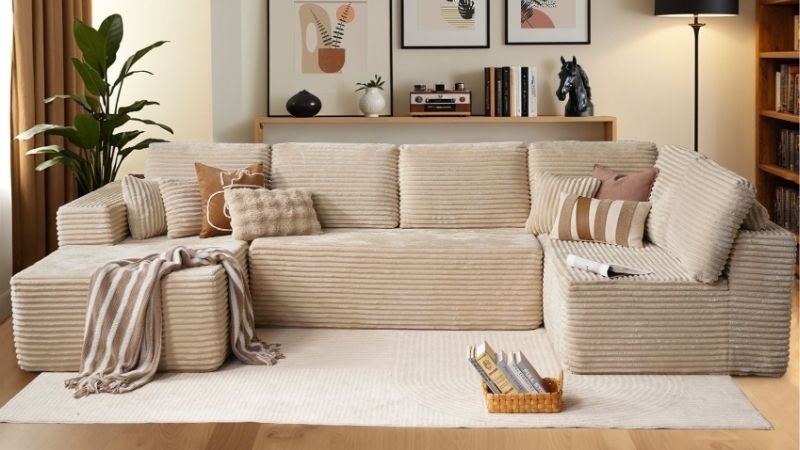
Our comparison uses manufacturers’ published construction, dimensions, and care guidance reviewed in October 2026, not hands-on comfort testing. The named sectionals are examples of different cushion systems, not ranked recommendations or guarantees that an individual shopper will perceive the same firmness. The table separates the seat design from the back fill because they often behave differently.
| Cushion Approach | Manufacturer Example | Published Seat and Back Construction | What to Consider |
|---|---|---|---|
| Foam with loose-fill layers | Sixpenny Neva L-Shape | Seat: 60% foam and 40% loose fill; back: 100% loose fill | Sink-in design; fluff and redistribute loose filling |
| Foam seat and feather-blend back | West Elm Harmony Modular | Seat: fiber-wrapped high-density foam; back: polyester fiber, feather, and down | Soft seat and lofty back; check cover-care restrictions |
| Blend-down foam core | Room & Board Jasper | Seat: resilient foam core with fiber, feather, and down wrap; back: fiber-down blend | Soft wrap around support; gradual settling and feather migration possible |
| Spring-and-down hybrid | Room & Board Linger | Seat: encased coils, foam, fiber, feather, and down; back: fiber-down blend | Plushness with spring response; loose surfaces need care |
| Spring with down alternative | Room & Board Baylor | Seat: encased coils, foam, and microfiber wrap; back: down alternative | Animal-free fill option; do not assume every cover is washable |
The Seat Core Determines How You Sink and Recover
The layer closest to your body creates that first impression of softness. What happens after you settle farther down depends more on the inner support. A seat built from resilient foam wrapped with feathers or fiber may feel pillowy at the surface while resisting a complete collapse. A spring-and-foam system adds another source of response underneath the upholstery.
Sixpenny describes the Neva seat cushion as a layered design with a central foam support layer and loose fill above and below it. Its published composition is 60% foam and 40% loose fill, with a choice of Feather Down or Poly Fill. Those percentages describe this product family, not a universal recipe for comfortable seating.
Room & Board describes Linger as using encased springs surrounded by foam and wrapped in fiber, feather, and down. A shopper comparing Neva and Linger should ask whether the feel of a loose cushion or the rebound of an inner coil matters more. Brand descriptions alone cannot establish which will feel better for a particular body or over years of ownership.
Back Pillows Can Feel Softer Than the Seat
A sectional with upright seat support can still look and feel exceptionally plush if its back cushions contain soft, shifting fill. Back pillows also change how much seat depth remains usable: a thick pillow can position you farther forward even when the frame is deep. Read seat and back specifications as two separate choices rather than treating the whole couch as one firmness grade.
West Elm lists the Harmony Modular seat as fiber-wrapped high-density polyurethane foam but describes the back as 50% polyester fiber, 45% duck feather, and 5% duck down. The brand rates the seat softness at 1 on its own five-point scale, with five the firmest. This is a manufacturer rating, not an independently standardized comparison to other brands.
Room & Board lists Jasper with a blend-down seat around a resilient foam core and a fiber-down back. Its description notes that some feather loss can be normal. If you dislike rearranging back cushions or finding stray feathers, a soft polyester-filled back may suit your routine better than a feather-rich one even if a showroom display looks equally inviting.
Softness Is Different From Seat Depth and Sofa Size
A deep seat makes stretching out easier, but it does not automatically make a cushion soft. Conversely, a plush sofa with an upright, shorter seat can work well for conversation. Check the actual seat depth with its everyday back cushion in place, the seat height, and how your feet land when sitting normally. Overall sofa depth is not a substitute for any of those measurements.
West Elm publishes a 122-inch-wide, 43-inch-depth Harmony Modular configuration with a 20-inch seat depth when the back and lumbar cushions are in place, and a 34-inch depth without them. It also lists a 20-inch seat height for that configuration. These measurements show how the same frame accommodates either an upright posture or deeper lounging simply by changing the cushion arrangement.
Use your own sitting position to decide how much depth is useful. If you normally sit with feet on the floor, a giant lounge platform may require extra lumbar pillows. If you curl up sideways, room across the cushion can matter more. Measure the assembled sectional once before purchase, including its return or chaise, but let the seating experience drive the rest of the decision.
How to Choose a Plush Sectional for Daily Life
Once you know what creates the softness, choose by the job the couch must perform. A movie-night lounger, a daily family seat, and a formal conversation sofa can all benefit from plush cushions, but not from identical cushion depths or maintenance requirements. The examples below describe trade-offs so you can narrow the construction before choosing fabric and layout.
For Movie Nights, Look for Softness With Room to Shift
Choose a yielding seat with enough usable width to curl up without balancing on a narrow cushion edge. Loose back pillows make it easier to change positions, but their thickness affects the sitting depth available with everything in place. If you want an especially relaxed feel, a Neva-style foam-and-loose-fill seat demonstrates the kind of construction to explore.
Be prepared to reshape the cushions after long periods of lounging. Sixpenny explicitly advises regular fluffing for its loose-fill designs; the brand notes that fluffier cushions typically need more upkeep. That is a more useful ownership warning than a generic promise of cloudlike comfort. Avoid assuming a cushion will return to a perfectly tailored shape by itself.
For Daily Sitting, Balance a Soft Surface With Support
If the sofa is your everyday seat for reading, talking, and working on a laptop, prioritize a supportive core beneath the plush top layer. Room & Board’s Linger illustrates a spring-and-down construction intended to feel soft while retaining shape through the coil system. That description is a reason to inspect the model, not a prediction of how it will fit your posture.
During an in-store trial, remain seated for a few minutes, then stand up and observe how the cushion rebounds. Try the corner and armless positions separately, and verify whether the back pillows leave you comfortably supported. A seat that feels delightfully soft for a moment may be less convenient when you need to sit upright through a long evening.
For Families, Examine Fabric Care Before Choosing a Soft Fill
Spills and everyday use make cleanability part of comfort. Before selecting a white or textured fabric, request its actual care instructions and swatch. A zipper on a cushion does not prove that the cover is machine washable, and the instructions for a frame slipcover can differ from those for the cushion insert. Pay particular attention to food stains and moisture near loose-filled cushions.
West Elm’s Harmony guidance calls for prompt blotting, gentle spot cleaning, air drying, and professional help for stubborn stains. Sixpenny recommends professional dry cleaning for many natural slipcover fabrics while allowing cautious machine washing for particular materials under their individual instructions. Neither product should be described simply as universally machine washable.
Ask whether spare covers or inserts can be purchased for the exact configuration and upholstery. A replacement cover is useful only if the fabric, dye lot, and panel pattern match. If children or pets routinely use the couch, a slightly less pillowy material with easier upkeep may be a more enjoyable choice than the softest showroom option.
If You Avoid Feathers, Compare the Actual Alternatives
Down alternative is not a single cushioning formula. Some options use shredded polyester fill, while others pair microfiber or fiber wrap with a core of foam or encased springs. If you prefer not to buy animal-derived cushion fill, check the seat and back components separately rather than trusting one marketing badge or a fabric name.
Sixpenny offers a Neva Poly Fill option instead of its Feather Down fill, while Room & Board describes Baylor with a spring-and-hybrid-down-alternative seat and down-alternative back. Maiden Home also states that down alternative is available by request for The Dune collection. Each example differs in its underlying support, so replacing feathers is not enough to predict a matching feel.
Do not treat feather-free construction as a guarantee against irritation or allergy symptoms, since fabrics, dust, and cleaning products can also matter to individual shoppers. For a preference-based purchase, request the complete fill composition from the manufacturer and confirm that the order records the correct option. Avoid relying on a photograph of an unlabelled display model.
If You Dislike Cushion Maintenance, Favor Shape Recovery
The relaxed, rumpled look seen in photographs often comes from movable, compressible fill. That appearance is intentional for some models, but it is not maintenance-free. Sofas with loose feathers or fiber may need regular fluffing, redistribution, or rotation to keep the surface even. Fixed or foam-dominant seats can reduce that work, although their comfort still depends on the particular core.
Room & Board notes that the Jasper blend-down cushioning softens and settles with use, and Sixpenny warns that its loose fill shifts toward favorite sitting spots. Neither statement alone proves a defect or forecasts a fixed replacement schedule. Ask whether the manufacturer offers replacement inserts and whether flattening or loft loss is covered by the warranty.
Consider the full care routine, including vacuuming seams and under the sectional, keeping covers color-matched, and lifting cushions without straining their seams. If you want a crisp appearance after every use, choose a more tailored construction instead of buying a deliberately casual, high-loft sofa and expecting it to stay perfectly smooth.
For Compact Living Rooms, Keep Plushness Without Excess Bulk
Bulky arms, thick backs, and oversize pillows can consume valuable seating width even when a couch looks inviting. A compact floor plan often benefits from narrower arms and a measured sitting depth rather than maximum frame depth. Room & Board describes Jasper as a smaller-scale sectional with narrow arms and blend-down cushions, illustrating that plush comfort need not mean a giant pit layout.
Use the published assembled measurements for the exact sectional configuration, not the dimensions of a single chair or sofa from the same collection. Check which side the return occupies and whether the corner seat is comfortable when both adjacent cushions are in place. A great sofa should make the room easier to use, not require you to climb around a sprawling chaise.
For buyers who move frequently, confirm how the sections connect, whether they can stand alone, and which legs or connector parts are replaceable. Those checks should take only a short moment compared with testing the sitting feel, but missing hardware can make a plush modular sectional frustrating to relocate.
Frequently Asked Questions
Will a Plush Sectional Couch Lose Its Shape Quickly?
Not necessarily. Cushion fill, inner support, usage, and maintenance all affect its appearance over time. Loose feathers and fiber tend to shift and develop a relaxed look, while an engineered foam or coil core can help retain structure. No manufacturer description can promise how quickly a particular household will notice settling.
Ask about cushion construction, whether inserts can be replaced, and the precise warranty exclusions for ordinary softening. If you want a sofa to look neatly tailored every day, avoid styles advertised for deliberately rumpled or heavily sink-in cushions. Photos taken immediately after cushions are fluffed are not a long-term wear test.
Is a Feather-Down Sectional Softer Than a Foam Sectional?
Not always. Feather-rich wraps can make the surface feel loftier, but foam comes in different densities and firmness levels and may have a soft outer wrap. A foam-core seat with a feather or microfiber layer can combine a yielding first impression with more support beneath. The way the back cushion compresses may be just as noticeable.
Compare construction notes for both seat and back, then sit on an actual or closely related configuration if possible. West Elm’s Harmony and Sixpenny’s Neva are useful examples of distinct internal designs; their manufacturer descriptions should not be read as a cross-brand laboratory ranking of softness.
Can You Wash the Covers on a Plush Sectional?
Only when the maker approves washing for that specific fabric and cover component. Removable does not mean washable. Some upholstered models permit spot cleaning only, while some slipcovered designs allow cautious machine washing or recommend dry cleaning. Washing an unsupported textile may shrink it or change its finish.
Sixpenny’s care instructions differentiate among fabrics and advise cold water, gentle cycles, and air drying when home washing is appropriate; its natural-fabric care often favors dry cleaning. Check the actual order’s fabric card, and do not put loose-fill cushion inserts in the machine without an explicit manufacturer instruction.
How Can You Judge Softness When Shopping Online?
Start with the published seat and back fill, not adjectives such as plush, premium, or cloud. Look for a documented firmness scale, usable seat depth with back pillows installed, photos of the cushions after use, the manufacturer’s care instructions, and a clear return policy for your selected custom configuration.
A showroom trial or fabric and cushion sample can help, but no single online rating predicts personal comfort. Ask the seller whether a seat uses loose fill, wrapped foam, or springs, and whether replacement inserts are available. If the seller cannot answer those basic questions, treat that uncertainty as an important trade-off before paying for a large sectional.
Final Thoughts
A plush sectional couch is most rewarding when the surface feels soft, the core suits how you sit, and the upkeep fits your routine. Compare seat fill and back fill separately, test the usable depth, and read the care label for the actual fabric. Choose spring or foam support with a soft wrap for everyday balance, or loose fill if you welcome its relaxed look and regular fluffing.
