
Key takeaways
- Place a combined electric fireplace TV stand on a stable, level floor along a wall where the screen is comfortable to watch, the heater can breathe, and a suitable outlet is accessible. If your search is about where to place…
Place a combined electric fireplace TV stand on a stable, level floor along a wall where the screen is comfortable to watch, the heater can breathe, and a suitable outlet is accessible. If your search is about where to place tv stand and electric fireplace furniture, distinguish a single integrated cabinet from a separate TV stand and freestanding electric fireplace first. Their placement rules are not interchangeable. The best-looking wall may be the wrong location if furniture blocks the heat outlet or a cord has to cross a walkway.
As an Amazon Associate we earn from qualifying purchases.
By KK Home Furnishings Editorial Team
Choose the Location Before You Move the Fireplace Stand
Begin with the exact fireplace and cabinet manuals, not a generic room-layout diagram. Check where heated air leaves the unit, whether the cabinet needs a gap behind it, how it will connect to power, and whether the television has a suitable resting place. Use the table to eliminate poor locations before deciding which wall looks best.
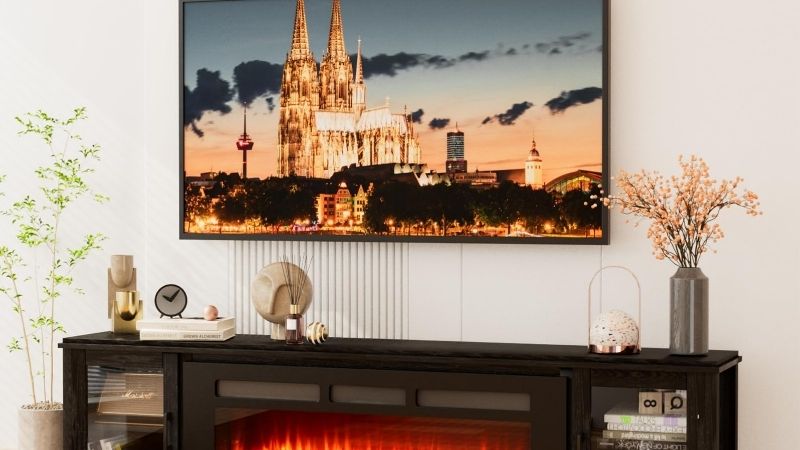
| Placement Check | What to Observe in the Room | Good Candidate | Move Elsewhere If |
|---|---|---|---|
| Heater airflow | Locations of firebox outlets, inlets and model-specific clearances | Required openings remain clear with furniture in place | Curtains, sofa edges or stored items obstruct warm air |
| Wall and floor | Flat support, cabinet footprint and required wall gap | Stable location with room for anchoring when instructed | Uneven flooring or a wall gap cannot be maintained |
| Power connection | Grounded outlet, cord length and electrical instructions | Reachable receptacle without an exposed walking-path cord | Placement depends on an extension cord or overloaded strip |
| Viewing position | Main seat, screen center, glare and head-turning angle | Comfortable sight line without major window reflections | Viewers must crane upward or face persistent glare |
| Room circulation | Door arcs, walkways, side furniture and heater discharge direction | People can pass without touching the hot front or cords | Doors or foot traffic crowd the fireplace face |
| Child and pet safety | Climbing access, reachable controls, TV stability and anchoring | TV and furniture can be secured as recommended | Children can climb unsecured furniture or pull cords |
Check the Fireplace’s Actual Airflow and Clearance Rules
An electric fireplace usually needs no chimney, but that does not mean it can be wedged against any wall or enclosed by anything that fits. Locate the specific firebox outlet and air intake on your unit, then consult the manual’s instructions for the complete assembled cabinet. The phrase “no venting required” in a listing may refer to chimney exhaust rather than permission to block fan openings.
Clearance numbers vary. Ameriwood Home’s assembly booklet for model 1822908COM instructs owners to keep the fireplace TV stand at least one and a half inches from the back wall to allow heater ventilation [Ameriwood Home, 1822908COM assembly instructions, accessed October 2026]. In contrast, a Dimplex manual for DF26 and DF28 fireplace inserts specifies at least one half inch behind the unit and clearance beneath it [Dimplex, DF26/DF28 owner manual]. These examples belong to different appliances, not a universal measurement for every electric fireplace stand.
Notice nearby fabric and furniture as well as the wall. A couch arm pushed in front of the warm-air outlet can invalidate an otherwise attractive layout. CPSC advises a three-foot separation from combustible materials for portable space heaters [CPSC, 2026], but that portable-heater recommendation must not be treated as a substitute for the exact clearance requirements of a listed fireplace insert. Where those requirements are unknown, pause placement until the manual or manufacturer can clarify them.
Plan the Outlet and Cable Path Before the Cabinet Arrives
The electrical outlet should be accessible for the appliance connection without forcing its cord beneath a rug or around a door opening. Electric fireplaces commonly use substantial power while the heater is operating; inspect the actual rating plate and the manual’s instructions for grounded receptacles and circuits. Do not presume that another small entertainment device can share the same connection just because its plug fits.
For portable electric heaters, CPSC specifically recommends a direct wall-outlet connection rather than an extension cord or power strip [CPSC, Keep Warm and Safe This Winter, 2026]. For a fireplace TV stand, obey its model-specific firebox instructions; when these specify a direct wall outlet, a layout requiring an extension is not acceptable. If the only reachable receptacle is behind a shut door, buried under furniture, or damaged, select a different location or consult a licensed electrician about a properly installed outlet rather than improvise the wiring.
Separate the fireplace power cord from low-voltage HDMI, coaxial and network cables as the manufacturer’s routing instructions allow, without pinching any line behind the cabinet. Leave enough access for unplugging and servicing. A wall that requires a tight bend in the power plug or a cord stretched across the room is a poor candidate even when the television faces the sofa perfectly.
Match Screen Height and the Cabinet Footprint to the Seats
Stand at the intended seating area and imagine the television’s center, not just the cabinet’s top. A tall decorative mantel may lift a screen above the most comfortable viewing position; in that case, a shorter cabinet or independently mounted TV may improve the sight line, provided the TV mounting plan follows its own hardware and wall-support instructions. Consider sunlight at the hours you actually watch TV rather than deciding from the room’s appearance at noon.
Use painter’s tape or removable paper markers to outline the assembled cabinet width and depth on the floor before moving heavy furniture. Include enough room for door swings, power plugs, any required rear spacing and heat flow. A corner fireplace cabinet is shaped for a corner; a rectangular TV console pushed diagonally into the same space may waste floor area and make its outlets harder to access.
Some purpose-built corner cabinets have a substantial side-to-side footprint even though they occupy a corner. Real Flame’s Lynette Corner model 1750, for example, publishes assembled dimensions of 56.25 inches long, 34.75 inches wide and 36.25 inches high [Real Flame, Lynette 1750 product specifications, accessed October 2026]. Those are an example of why a corner placement needs measured floor space, not evidence that other corner models share the same proportions.
Six Living Room Placements That Work for Different Homes
After the mechanical and electrical checks, choose a layout that serves the room rather than treating the fireplace as a decorative centerpiece at any cost. The six situations below address physical positioning, not which model to buy. A suitable spot is one that preserves the particular unit’s installation requirements while supporting natural movement and a good view.
Along the Main Wall Across From the Sofa
A clear wall opposite the primary seating position is often the simplest arrangement because the screen sits near the viewers’ natural sight line. Mark where the center of the TV will be when it stands on the cabinet and sit down to check comfort. If the television sits too high on a mantel-like top, reconsider the location or furniture height instead of assuming the fireplace must be centered under the screen.
Check what sits beside the cabinet once the room is furnished. Tall drapes, a bookcase projecting across the firebox outlet, and a sofa pushed too close to the front can defeat the arrangement. Leave the model-required spaces open, and make sure the wall behind the furniture allows prescribed anti-tip hardware to be fitted without obstructing the heater. The visually centered position is only useful if the appliance still operates as designed.
In a Purpose-Built Corner Away From Traffic
A corner can free the longest wall for windows or other furniture and may make TV viewing easier in an L-shaped room. Choose a corner cabinet intended for that position rather than assuming any rectangular fireplace stand can be installed diagonally. The published front width, rear shape and depth determine how far the assembly extends into the floor plan, especially where a door opens nearby.
Before selecting the corner, test two viewing seats, not just the one directly opposite it. A corner location can favor one sofa while forcing another viewer to turn sharply. Also confirm that the power cord reaches a suitable receptacle without running exposed behind the seating group, and that the fireplace’s front or side airflow remains unobstructed by adjoining wall trim or furniture.
On a Short Wall in a Narrow Apartment
In a narrow living room, preserving a safe passage matters more than aligning every furnishing symmetrically. Outline the cabinet’s actual depth on the floor, then walk the route to the kitchen, hallway and balcony door. Factor in drawers or doors that must open, and account for the front of the fireplace when its heater runs. If people would routinely brush the unit, it may not belong on that stretch of wall.
Do not solve a cramped layout by removing prescribed spacing behind the cabinet or by pulling the power cord beneath a rug. A narrower, suitably rated TV console, a different wall, or a wall-mounted television independent of the heater may make better use of a compact room. Placement should preserve the unit’s airflow and electrical requirements, even when those constraints leave fewer decorating options.
On a Wall That Avoids Window Glare and Damp Spots
A window-facing screen may reflect bright afternoon light, while a cabinet placed directly beside long drapes may crowd the heating outlet. Observe reflections at the usual viewing hour and consider whether blinds or a shifted seating arrangement solve the problem without moving the fireplace into an unsafe position. Position the television for visibility, but do not allow a curtain or shade to rest near a heater opening.
Keep the fireplace away from likely splashes, condensation or damp locations unless the exact model is explicitly intended for such conditions. Real Flame’s fireplace installation instructions describe choosing a location away from moisture, drapes, furniture and high-traffic paths and convenient to an existing outlet [Real Flame, firebox installation guide 4192, 2024]. That is a manufacturer example, not blanket permission to put every electric unit near a window or in a humid basement.
Where Children, Pets and Frequent Guests Use the Room
A family gathering spot needs a location that does not encourage climbing or snagged cables. Avoid placing toys, remote controls or enticing decorations above the TV where a child might attempt to reach them. The US Consumer Product Safety Commission recommends anchoring TVs and heavy furniture securely and keeping tempting objects off higher surfaces [CPSC, Anchor It guidance; CPSC, February 2026]. Use restraints and anchor points suitable for the exact TV, cabinet and wall.
Do not put a chair or storage bench next to the cabinet if it creates a convenient climbing step, or place the heater front where pets routinely sleep in its warm-air stream. Select a wall that lets adults supervise the heater and keeps everyday movement away from its discharge zone. Even a secured unit requires attention to hot surfaces and cords when children or pets are present; the presence of an automatic shutoff does not remove those concerns.
When the TV Stand and Electric Fireplace Are Separate Pieces
If you own a freestanding electric fireplace and a different TV cabinet, do not automatically stack one on the other. Unless a product is explicitly engineered and rated to support a television, an electric heater is not a load-bearing TV stand. Treat the two items as separate appliances and furniture: each needs its own positioning and installation instructions, adequate electrical access, and an unobstructed heat-discharge path.
One useful arrangement places the television on the main viewing wall with the freestanding fireplace off to the side, outside the TV’s support footprint and the main walkway. A second option uses adjacent walls when glare or furniture dimensions prevent sharing one wall. Any separate fireplace positioned below or near a wall-mounted TV must satisfy the heater manufacturer’s heat and distance rules as well as the TV manufacturer’s ambient-temperature and mounting limits. Without those approvals, do not assume the combination is safe.
Frequently Asked Questions About Fireplace TV Stand Placement
These answers cover practical installation decisions that remain after you choose a wall and sketch the furniture arrangement. They are not a substitute for the specifications of the exact fireplace, television or anchoring system you own.
Can an Electric Fireplace TV Stand Go Directly Against the Wall?
Not necessarily. Some cabinets require a specific rear gap to circulate air. Ameriwood Home’s 1822908COM assembly instructions require at least one and a half inches behind that model, whereas other fireplace designs publish different clearances. Consult both the cabinet assembly booklet and the firebox owner’s manual rather than choosing a gap from a generic online chart.
Also check the path for plugs, anchors and cable access. A cabinet pushed flush against the wall might pinch a cord or prevent required fixing hardware from reaching the wall. If the manual calls for a gap, preserve it even if a fully flush appearance would look cleaner.
Can I Put a Fireplace TV Stand on Carpet?
Only if the exact cabinet and firebox instructions permit that floor surface and the assembled unit can stand level and stable. Some electric fireplace inserts require unobstructed air circulation beneath them; a Dimplex DF26/DF28 manual specifically cautions against direct placement on carpeting that restricts airflow [Dimplex, DF26/DF28 owner manual]. That insert instruction should not be generalized to every raised media cabinet.
Check whether the cabinet’s feet, base or firebox ventilation openings contact the carpet, and assess tip risk on thick pile. If the manufacturer specifies a solid support platform or prohibits carpet installation, follow that requirement; adding improvised spacers is not a safe substitute.
What if the Best TV Wall Has No Suitable Electrical Outlet?
Choose another location or consult a qualified electrician about an appropriate receptacle before installing the fireplace. Do not choose a layout that depends on running a high-load heating appliance through an extension cord or power strip against its instructions. CPSC’s direct-outlet warning concerns portable heaters, and the appliance manual supplies the instructions for your specific fireplace configuration.
A professional can evaluate circuit capacity and a safe outlet position where local rules allow the work. Avoid hiding heater wiring under rugs, pinching it behind the console or routing it through doorways. The convenience of a centered TV does not justify an unsafe electrical path.
Can a Fireplace TV Stand Sit Beneath a Wall-Mounted Television?
Often it can, provided the TV mount, wall, furniture and fireplace instructions are each satisfied. A wall-mounted television does not add weight to the cabinet top, but the heat outlet may still direct warm air toward the TV or cables. Do not infer that every upward-blowing firebox is compatible with a screen hung closely above it.
Check the firebox manufacturer’s minimum distances and discharge direction and the TV maker’s operating-temperature guidance before settling the screen height. The wall mounting hardware must attach to a suitable structure independently of the media cabinet unless an approved system expressly specifies otherwise.
Final Thoughts
The most reliable place for an electric fireplace TV stand is a stable, measured position that combines a comfortable screen view with the appliance’s real heat, power and anchoring requirements. Plan the outlet and walkway first, confirm wall clearance from the exact manual, then check viewing height from your main seat. For an integrated cabinet, assess the furniture and firebox as one installation; for separate components, do not assume either is designed to support or sit immediately below the other. If a room layout forces blocked airflow, a stretched cord, exposed climbing access or an uncomfortable television height, choose a different position rather than compromising on those limitations.









