Key takeaways
- Measure first: Leave enough clearance for cabinet doors, refrigerator drawers, and nearby traffic. A runner should feel intentional rather than wedged into every available inch.
- Prioritize the backing: Look for a non-slip or rubberized underside, but still use a rug pad when the manufacturer recommends one, especially on smooth tile or vinyl.
- Match the pile to the room: Low-profile rugs are usually best for kitchens because they are easier to vacuum and less likely to interfere with doors or collect food debris.
- Choose a realistic care routine: Machine-washable designs are useful for spill-prone homes, but check the stated washing instructions and allow the rug to dry fully before returning it to the floor.
- Use pattern strategically: Distressed prints, abstracts, and darker colors can disguise everyday crumbs and marks, while lighter solids make a narrow kitchen feel more open.
What's inside
A kitchen runner rug has to do more than soften a hard floor. It needs to fit between cabinets and appliances, stay put near a sink, tolerate crumbs and spills, and avoid making a compact kitchen feel visually crowded. The wrong size can block drawers, catch under doors, or create a tripping point in one of the busiest areas of the home.
This guide focuses on the practical details that matter in small and hardworking kitchens: washable materials, dependable grip, absorbency, proportion, and easy placement. The featured runners cover farmhouse, abstract, neutral, and darker styles, with options for narrow galley kitchens, laundry zones, entryways, and sink-side standing areas.
As an Amazon Associate we earn from qualifying purchases.



How to Choose a/an Kitchen Runner Rug (2026)
- Measure first: Leave enough clearance for cabinet doors, refrigerator drawers, and nearby traffic. A runner should feel intentional rather than wedged into every available inch.
- Prioritize the backing: Look for a non-slip or rubberized underside, but still use a rug pad when the manufacturer recommends one, especially on smooth tile or vinyl.
- Match the pile to the room: Low-profile rugs are usually best for kitchens because they are easier to vacuum and less likely to interfere with doors or collect food debris.
- Choose a realistic care routine: Machine-washable designs are useful for spill-prone homes, but check the stated washing instructions and allow the rug to dry fully before returning it to the floor.
- Use pattern strategically: Distressed prints, abstracts, and darker colors can disguise everyday crumbs and marks, while lighter solids make a narrow kitchen feel more open.
The Best Kitchen Runner Rug (2026)s Reviewed
2×6 Hallway Washable Runner Rug
This vintage-style 2×6 runner brings a softly distressed farmhouse look to a kitchen without demanding too much visual attention. Its washable construction and non-slip backing make it a sensible choice for a sink run, galley kitchen, or narrow passage where everyday spills are unavoidable.
BEQHAUSE Taupe Kitchen Runner
The 24-by-60-inch BEQHAUSE runner is a versatile neutral for kitchens that connect to a laundry room, hallway, or open living area. Taupe is forgiving around crumbs and light splashes, while the super-absorbent, stain-resistant surface is aimed at practical sink-side use rather than purely decorative coverage.
PADOOR Extra Large Two-Piece Set
PADOOR’s set pairs a long 2.5-by-6-foot runner with a smaller mat, giving you more flexibility than a single rug. Use the long piece along cabinets and the compact mat at a prep station, back door, or island; the arrangement is particularly useful when a small kitchen has several separate work zones.
BEQHAUSE Blue Kitchen Runner
This blue version of the BEQHAUSE runner adds color while retaining the useful 24-by-60-inch footprint. It is a good fit for kitchens that need a visual focal point, and the washable, non-slip, absorbent design makes it practical for placement in front of a sink or beside a laundry area.
Ompaa Grey Abstract Runner
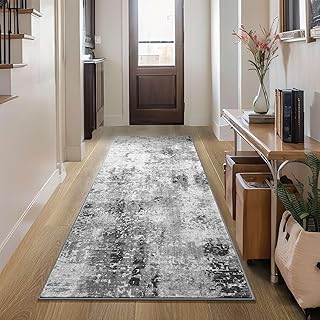
The Ompaa 2×6 runner uses an abstract grey pattern to create texture without the busyness of a high-contrast print. Its soft surface, rubber backing, and washable design suit hallways and bedrooms as well as kitchens, making it a strong choice for open-plan homes where one runner may need to work in more than one location.
Frequently Asked Questions
What is the best runner size for a kitchen?
A 2×6-foot runner works well along a standard cabinet run, while a 20-by-59-inch or 24-by-60-inch mat can be better for a compact sink area. Measure the usable floor, then check that doors and drawers can open without catching the rug.
Should a kitchen runner go in front of the sink?
Yes, provided it has a stable backing and does not create a raised edge that could cause a trip. An absorbent, washable runner can make standing more comfortable and help protect flooring from splashes, but it should be dried promptly if it becomes saturated.
Are washable kitchen rugs worth buying?
For most kitchens, yes. Washability simplifies cleanup after spills and reduces the pressure to keep a rug looking perfect every day. Confirm the care label, use the correct washing cycle, and avoid putting a damp rug back on the floor.
How do I stop a kitchen runner from sliding?
Start with a rug designed with a non-slip backing and place it on a clean, dry floor. If it still shifts, add a thin rug pad suited to your flooring type. Avoid folding or bunching the runner, since those problems can be more hazardous than ordinary movement.
Final Thoughts
For an adaptable neutral, the BEQHAUSE Taupe Kitchen Runner is an easy starting point; the PADOOR two-piece set is the most flexible for kitchens with multiple zones. If style matters as much as function, the distressed 2×6 runner or Ompaa Grey Abstract Runner adds character while keeping cleanup and placement manageable.