Key takeaways
- Power and coverage: Match the heater to the garage’s square footage, ceiling height, insulation, and climate. A compact 120V model suits a workbench zone, while a larger garage may need a dedicated circuit and more powerful equipment.
- Electrical requirements: Check voltage, amperage, outlet type, and circuit capacity before buying. A 240V heater should be installed only where the electrical system can safely support it.
- Heating style: Forced-air heaters warm the space quickly, infrared models heat people and nearby surfaces directly, and radiant ceiling units preserve floor and wall space.
- Placement: Keep portable heaters away from shelving, cardboard, solvents, sawdust, vehicles, and stored fabrics. A wall- or ceiling-mounted design can be useful when floor space is already crowded.
- Safety and controls: Prioritize overheat protection, a stable base, adjustable settings, and a thermostat or timer when available. Never use a garage heater near flammable liquids or in a damp area unless the product is specifically rated for that environment.
What's inside
A garage is one of the hardest rooms to heat well: it has a large air volume, frequent drafts, uninsulated doors, and often a concrete floor that absorbs warmth. A heater that feels effective in a bedroom may struggle in a workshop, while an oversized unit can waste energy or create an uncomfortable hot spot.
This guide compares practical garage-heating options for 2026, from heavy-duty 240V units to compact portable heaters and ceiling-mounted radiant models. The focus is on heating coverage, installation style, controls, safety features, and how each design fits a small-space organization plan.
As an Amazon Associate we earn from qualifying purchases.


How to Choose a/an Space Heater Garage (2026)
- Power and coverage: Match the heater to the garage’s square footage, ceiling height, insulation, and climate. A compact 120V model suits a workbench zone, while a larger garage may need a dedicated circuit and more powerful equipment.
- Electrical requirements: Check voltage, amperage, outlet type, and circuit capacity before buying. A 240V heater should be installed only where the electrical system can safely support it.
- Heating style: Forced-air heaters warm the space quickly, infrared models heat people and nearby surfaces directly, and radiant ceiling units preserve floor and wall space.
- Placement: Keep portable heaters away from shelving, cardboard, solvents, sawdust, vehicles, and stored fabrics. A wall- or ceiling-mounted design can be useful when floor space is already crowded.
- Safety and controls: Prioritize overheat protection, a stable base, adjustable settings, and a thermostat or timer when available. Never use a garage heater near flammable liquids or in a damp area unless the product is specifically rated for that environment.
The Best Space Heater Garage (2026)s Reviewed
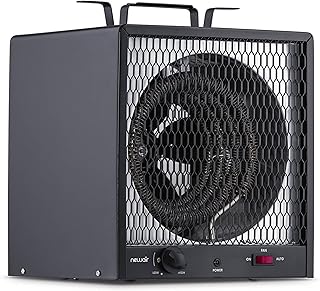
NewAir 240V Electric Garage Heater
The NewAir Electric Space Heater for Garage is built for users who need serious, consistent heat in a shop, shed, warehouse, or larger garage. Its 240V format makes it more suitable for a permanent, high-output setup than a casual plug-in heater, so plan the electrical installation before purchase. For an organized workspace, it can heat the room without occupying valuable floor area with a small portable unit.
Dr. Infrared Portable Heater
The DR. INFRARED HEATER Portable Infrared Indoor and Outdoor Space Heater is a flexible choice for garages, patios, and commercial areas where direct radiant warmth is useful. Its remote control adds convenience when the heater is positioned across the room, although buyers should note that this version does not include a thermostat. It works best as targeted comfort heat near a bench, vehicle, or seating area rather than as a guaranteed whole-garage solution.
Dura Heat EUH1465 Forced-Air Heater
The Dura Heat EUH1465 combines a forced-air design with a pivoting base, making it easy to aim warmth toward a work zone. Its steel body, ceramic heating element, thermostat, and safety shutoff are practical features for a workshop or garage of up to roughly 250 square feet. The yellow finish is easy to spot among tools and storage bins, while the directional airflow helps reduce wasted heat.
Comfort Zone Milkhouse Utility Heater
The Comfort Zone 1500W Milkhouse Style Electric Utility Heater is a straightforward option for smaller garages, workshops, and utility spaces. It offers two heat settings, an adjustable thermostat, and an all-metal design in a compact portable format. This is a sensible pick for warming a single activity area, but its 1500W output is better suited to a modest, reasonably enclosed space than a drafty two-car garage.
Shinic Ceiling-Mounted Radiant Heater
The Shinic Electric Garage Heater uses ceiling-mounted radiant heat to keep the floor clear for cars, cabinets, bikes, and rolling tools. Its 1500W/750W settings, 90-degree rotation, halogen light, and multiple operating modes make it especially useful above a workbench or parking bay. Because it is mounted overhead, installation and clearance planning matter, but the design is attractive for garages where every square foot of floor space is already assigned.
Frequently Asked Questions
What size heater is best for a garage?
There is no single answer because insulation, ceiling height, outdoor temperature, and air leakage all affect performance. Measure the space and follow the manufacturer’s coverage guidance; for larger or poorly insulated garages, a professionally installed 240V unit may be more appropriate than several small heaters.
Are electric heaters safe to use in a garage?
They can be, provided the heater is used exactly as directed and connected to a suitable circuit. Keep at least several feet of clearance around the unit, avoid extension cords unless expressly permitted, and keep gasoline, paint, aerosols, sawdust, and other combustibles away from the heat source.
Is infrared or forced-air heating better?
Infrared heating is efficient for warming people and nearby objects, which makes it useful at a workbench or under a covered area. Forced-air heating raises the surrounding air temperature more quickly and is generally better when you want broader circulation throughout an enclosed garage.
Can I leave a garage heater running overnight?
It is best not to leave a portable garage heater unattended or operating overnight. Turn it off when leaving the space, and use built-in thermostatic or timer controls only as an added convenience—not as a substitute for supervision and proper clearance.
Final Thoughts
The NewAir is the strongest choice for a properly wired, high-output garage setup, while the Dura Heat EUH1465 offers useful directional control for a busy workshop. For preserving floor space, the Shinic ceiling-mounted radiant heater is the most organization-friendly option; the Comfort Zone is a practical budget-sized solution for a smaller enclosed area.