Key takeaways
- Measure the opening: Check width, height, depth, door swing, and rear clearance before ordering. A 15-inch machine still needs room for ventilation and service access.
- Confirm drainage: Some models use a drain pump, while others need a gravity drain or advertise no-drain operation. Match the appliance to your plumbing rather than adapting the room later.
- Balance output and storage: Daily production is only half the story. A generous bin helps during gatherings, while a smaller bin may be perfectly adequate for everyday drinks.
- Choose the right ice: Nugget ice is soft and chewable, whereas crescent or traditional hard ice lasts longer in coolers and cocktails. The best style depends on how your household actually uses ice.
- Plan for upkeep: Self-cleaning programs simplify routine care, but they do not eliminate descaling, wiping, filter checks, or occasional sanitizing.
What's inside
Choosing an ice maker for a compact kitchen is rarely as simple as picking the machine with the highest daily output. A unit can produce plenty of ice yet fail to fit beneath the counter, require an inconvenient drain, or leave too little clearance for ventilation and maintenance. For smaller homes, the installation details matter just as much as capacity.
This guide compares built-in and under-counter ice makers for 2026, with attention to footprint, storage, drainage, ice style, cleaning, and realistic home use. A few portable countertop models are included because they can be the smarter choice when a permanent installation is not practical.
As an Amazon Associate we earn from qualifying purchases.


How to Choose a Built-In Ice Maker (2026)
- Measure the opening: Check width, height, depth, door swing, and rear clearance before ordering. A 15-inch machine still needs room for ventilation and service access.
- Confirm drainage: Some models use a drain pump, while others need a gravity drain or advertise no-drain operation. Match the appliance to your plumbing rather than adapting the room later.
- Balance output and storage: Daily production is only half the story. A generous bin helps during gatherings, while a smaller bin may be perfectly adequate for everyday drinks.
- Choose the right ice: Nugget ice is soft and chewable, whereas crescent or traditional hard ice lasts longer in coolers and cocktails. The best style depends on how your household actually uses ice.
- Plan for upkeep: Self-cleaning programs simplify routine care, but they do not eliminate descaling, wiping, filter checks, or occasional sanitizing.
The Best Built-In Ice Maker (2026)s Reviewed
GE Profile Opal MINI PRO Nugget Ice Maker
The GE Profile Opal MINI PRO is a strong choice for small kitchens that prioritize soft, chewable nugget ice without committing to an under-counter installation. Its side tank, top-fill design, and compact countertop footprint make it especially useful in apartments, beverage stations, and homes where plumbing cannot be changed.
GE Profile Opal Mini Nugget Ice Maker
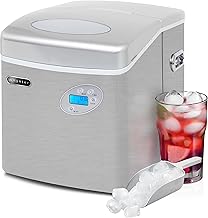
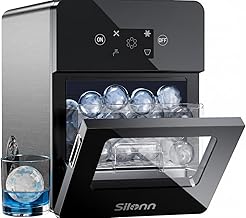
The stone-grey Opal Mini delivers the same appealing nugget-style ice in a streamlined portable format. It is best viewed as a flexible supplement rather than a true built-in replacement, but the 2-pound bin and 36-pound daily production are practical for daily drinks and moderate entertaining.
Mojgar 100-Lb Commercial Under-Counter Ice Maker
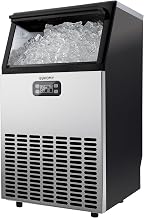
Mojgar’s 15-inch commercial-style machine suits households that regularly host, run a home bar, or want substantial production from a relatively narrow footprint. Its 30-pound storage bin and self-cleaning function are useful advantages, though buyers should carefully verify electrical, ventilation, and drainage requirements before installation.
Mojgar 100-Lb Under-Counter Ice Maker with 33-Lb Storage
This second Mojgar model emphasizes high output and a slightly larger storage capacity in a stainless-steel freestanding design. It makes sense for a busy entertaining area or home bar, but its commercial orientation may be excessive for a small family that only needs a modest supply of ice.
EdgeStar 15-Inch Built-In Ice Maker
The EdgeStar is a tidy option for buyers who want a purpose-built 15-inch appliance with crescent-shaped ice and a 12-pound bin. Its no-drain-required design can simplify placement, making it appealing in remodels or compact beverage centers where adding a drain line would be disruptive.
Frequently Asked Questions
Can a countertop ice maker be installed as a built-in appliance?
Usually, no. Countertop machines need open airflow and are not generally designed for enclosed cabinetry, fixed plumbing, or the heat conditions found beneath a counter. Use them as portable appliances unless the manufacturer specifically approves another installation method.
Does a built-in ice maker need a water line?
Most under-counter models require a dedicated water supply, and many also need a drain. Installation requirements vary, so check the manual for inlet size, drain configuration, electrical needs, and whether a pump is included.
Is a larger daily output always better?
Not necessarily. High-output machines can be valuable for parties, large households, and home bars, but they may cost more to run and occupy more space. For ordinary daily use, a smaller machine with an appropriately sized bin may be easier to live with.
How often should an ice maker be cleaned?
Follow the manufacturer’s schedule, but plan on regular cleaning and descaling, especially in hard-water areas. Empty the bin, wipe food-contact surfaces, and allow the machine to dry thoroughly after cleaning.
Final Thoughts
For a compact, flexible setup, the GE Profile Opal MINI PRO is the standout nugget-ice pick. For a true under-counter installation, the EdgeStar offers a space-conscious approach, while either Mojgar model is better suited to households that need commercial-level production and storage.