Key takeaways
- Diameter: Match the blade diameter to your saw exactly; a 10-inch blade belongs on a 10-inch saw, while a 12-inch blade requires a compatible 12-inch model.
- Tooth count: More teeth generally produce smoother crosscuts, while fewer teeth remove material faster and suit rough sizing or ripping.
- Kerf: A thin-kerf blade wastes less wood and can reduce strain on smaller saws, though it should still be appropriate for your saw’s power and blade guard.
- Tooth grind: An alternate-top-bevel, or ATB, grind is a strong general choice for clean cuts across solid wood, plywood, and trim boards.
- Arbor and material: Confirm the arbor opening before buying, and look for carbide teeth that can be sharpened or replaced rather than disposable stamped-steel teeth.
What's inside
Choosing a miter saw blade can be surprisingly difficult when a compact workshop has to handle everything from delicate trim to rough furniture parts. Tooth count, kerf, arbor size, and blade diameter all affect cut quality, noise, material waste, and whether the blade fits your saw.
This guide focuses on practical options for home furniture projects, with an emphasis on clean crosscuts, manageable dust and debris, and blades that make sense when storage space is limited. We compare fine-finish specialists, versatile multi-packs, and thin-kerf designs so you can match the blade to your saw and your workflow.
As an Amazon Associate we earn from qualifying purchases.


How to Choose Blades For Miter Saw (2026)
- Diameter: Match the blade diameter to your saw exactly; a 10-inch blade belongs on a 10-inch saw, while a 12-inch blade requires a compatible 12-inch model.
- Tooth count: More teeth generally produce smoother crosscuts, while fewer teeth remove material faster and suit rough sizing or ripping.
- Kerf: A thin-kerf blade wastes less wood and can reduce strain on smaller saws, though it should still be appropriate for your saw’s power and blade guard.
- Tooth grind: An alternate-top-bevel, or ATB, grind is a strong general choice for clean cuts across solid wood, plywood, and trim boards.
- Arbor and material: Confirm the arbor opening before buying, and look for carbide teeth that can be sharpened or replaced rather than disposable stamped-steel teeth.
The Best Blades For Miter Saw (2026)s Reviewed
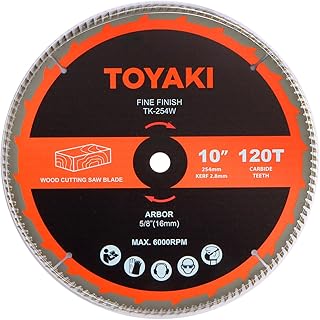
10-Inch 120-Tooth Fine-Finish Blade
This 120-tooth blade is aimed squarely at delicate finish work, where minimizing splintering matters more than cutting speed. It is a sensible choice for narrow trim, veneer-faced panels, and visible furniture edges, provided your 10-inch saw uses the listed 5/8-inch arbor.
WEN BL1080 80-Tooth Ultra-Fine Finish Blade
The WEN BL1080 offers a useful middle ground for home workshops: its 80 teeth are designed for polished crosscuts without making the blade as specialized as a 100- or 120-tooth model. It is well suited to built-ins, cabinet components, and general furniture parts made from plywood or solid lumber.
DEWALT DWA112100 12-Inch 100-Tooth Blade
With a 12-inch diameter and 100-tooth configuration, this DEWALT blade is built for clean, presentation-ready cuts on compatible larger miter saws. It makes the most sense for owners who regularly cut crown molding, wide boards, or furniture components and want a dedicated fine-finish option.
Freud LU91R012 Thin-Kerf 12-Inch Blade
Freud’s LU91R012 combines a thin kerf with a 72-tooth ATB design, helping conserve material while keeping crosscuts smooth. That balance is particularly helpful in a small workspace, where reduced cutting resistance and less waste can matter as much as ultimate surface polish.
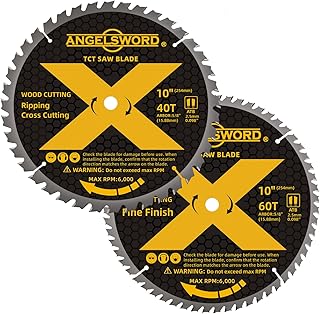
10-Inch 3-Pack: 32T, 60T, and 80T
This three-blade set is practical for furniture makers who do not want one blade handling every task. The 32-tooth blade supports faster rough work, while the 60- and 80-tooth choices let you move toward cleaner finish cuts without needing extra storage for several separate packages.
Frequently Asked Questions
What tooth count is best for a miter saw?
For clean furniture crosscuts, 60 to 100 teeth is a useful range on a 10- or 12-inch blade. Choose fewer teeth when speed and rough sizing matter, and more teeth when cutting trim, plywood, or visible joinery.
Can a table saw blade be used on a miter saw?
Some blades are labeled for both tools, but compatibility is not automatic. Check the blade diameter, arbor size, kerf, rotation direction, and manufacturer guidance, and avoid any blade that is not rated for your saw’s operating speed.
Is a thin-kerf blade better for a small workshop?
Often, yes. A thin-kerf blade removes less material and may require less motor power, which can be helpful with compact saws. It may also flex more easily, so use a well-supported workpiece and make sure the blade is appropriate for the saw.
How can I get cleaner miter saw cuts?
Use a sharp blade suited to the material, support both sides of the workpiece, and let the blade reach full speed before entering the wood. A zero-clearance insert or sacrificial backing board can further reduce tear-out on small parts.
Final Thoughts
For the smoothest dedicated finish work, the 10-Inch 120-Tooth Fine-Finish Blade is the specialist pick, while the WEN BL1080 is a more versatile choice for everyday furniture projects. If you want one compact storage solution for rough and refined cuts, the 10-Inch 3-Pack offers the broadest range; owners of larger saws should consider the DEWALT DWA112100 or Freud LU91R012.