Key takeaways
- Top drawer: daily-use hand tools such as screwdrivers, pliers, a tape measure, and utility knives.
- Middle drawers: wrenches, ratchets, sockets, hex keys, and specialty tools.
- Lower drawers: heavier items, power-tool accessories, clamps, and infrequently used equipment.
- Small compartments: fasteners, blades, bits, adapters, and electrical connectors.
What's inside
A tool chest earns its keep when every item has a predictable home. Without a plan, drawers become heavy, cluttered layers of duplicate pliers, loose sockets, and small hardware that disappears just when you need it. A well-organized chest is safer to use, quicker to restock, and easier to move around a garage or workshop.
This guide explains how to organize a tool chest from a small-space perspective: how to measure drawers, choose dividers, group tools by task, and avoid wasting usable depth. It also covers practical storage upgrades, including tray systems, modular tool boxes, and magnetic socket holders.
As an Amazon Associate we earn from qualifying purchases.



1. Start With a Drawer-by-Drawer Inventory
Empty one drawer at a time and group tools by function rather than by shape alone. A useful starting layout is:
- Top drawer: daily-use hand tools such as screwdrivers, pliers, a tape measure, and utility knives.
- Middle drawers: wrenches, ratchets, sockets, hex keys, and specialty tools.
- Lower drawers: heavier items, power-tool accessories, clamps, and infrequently used equipment.
- Small compartments: fasteners, blades, bits, adapters, and electrical connectors.
As you sort, remove broken tools, duplicates you never use, and items that belong elsewhere. Organization cannot compensate for overcrowding. Keep the tools you reach for most often between waist and shoulder height, where they are easiest to access without bending or stretching.
2. Measure Before Buying Organizers
Measure each drawer’s usable width, depth, and height—not just the outside dimensions of the chest. Account for drawer slides, rounded corners, liners, and any internal lip. Then measure your largest tools, including the handles and ratchet heads that often determine whether a tray will fit.
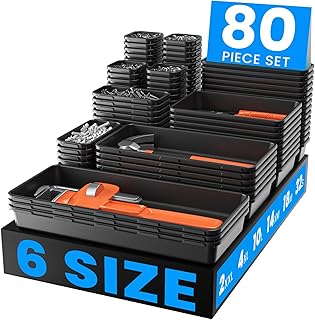
Modular trays are especially useful because they let you fill an irregular drawer without committing to a single molded layout. The A-LuGei 69-piece, five-size organizer is a flexible choice for mixed hand tools and small parts. For a larger collection, the A-LUGEI 80-piece, six-size set is designed to accommodate a broad range of tools. The thicker plastic version is worth considering when trays will be moved frequently or loaded with heavier items.
3. Build Zones That Match How You Work
Arrange tools according to the jobs you perform, not simply alphabetically. For example, keep automotive repair tools together, woodworking accessories in another zone, and household maintenance items in a compact upper drawer. This reduces the number of drawers you open during a project.
Within each zone, place the most-used tools at the front and less common ones behind them. Leave a little breathing room around handles so you can lift an item without disturbing its neighbors. A tray that is technically full but difficult to unload is not efficient storage.
Use consistent orientation wherever possible: handles facing the same direction, wrench sizes progressing in order, and driver bits grouped by type. Visual order makes missing tools obvious and speeds up cleanup.
4. Give Sockets and Small Parts Their Own System
Loose sockets are among the quickest ways to turn a tool chest into a puzzle. Separate SAE and metric sizes, then divide shallow and deep sockets. Store each group in increasing size order and label the tray if the markings are difficult to read.
The EACELIY magnetic socket organizer set is designed for 1/2-inch, 1/4-inch, and 3/8-inch SAE and metric sockets. Its magnetic backing can attach to a steel tool chest or cart, which is useful when drawer space is limited. Check the dimensions and confirm that your socket collection matches the holder’s intended configuration before purchasing; sockets are not included.
For screws, washers, electrical connectors, and other tiny items, use removable compartments rather than scattering them across a drawer. A-LuGei’s 46-piece, five-size set can be useful for smaller mixed collections, including workshop or household parts.
5. Consider When a Chest Is Not Enough
If your chest is already packed, adding another organizer may only create tighter clutter. Move bulky, seasonal, or project-specific equipment into a separate portable system. The Keter Stack N Rolling Tool Box Modular Storage System is a three-piece option with a telescoping handle and all-terrain wheels, making it suited to tools that need to travel between a garage, driveway, or job area.
Keep the main chest as the “working library” and the mobile box as the “project kit.” Return tools to their permanent locations after the job instead of allowing the portable box to become a second junk drawer. This separation preserves both accessibility and capacity.
Tips
- Line drawers with thin, non-slip material so trays stay put when drawers open quickly.
- Label the front edge of trays, especially when several compartments look alike.
- Leave roughly 10 percent of each drawer open for new tools and easier retrieval.
- Photograph the finished layout; the image makes post-project cleanup faster.
Frequently Asked Questions
Should tools be stored by size or by purpose?
Use purpose first, then size within each group. Keeping all tools for a common task together usually saves more time than arranging the entire chest in strict size order.
Are foam inserts better than plastic organizer trays?
Foam inserts provide excellent visual control and can stop tools from shifting, but they take longer to cut and are less adaptable. Plastic trays are easier to rearrange when your collection changes, making them a practical choice for most home workshops.
How do I organize a shallow tool-chest drawer?
Choose low-profile trays, store tools on their sides where safe, and avoid stacking. Use shallow compartments for bits, hex keys, and small hardware, while moving tall tools to a deeper drawer or portable box.
How often should a tool chest be reorganized?
Do a quick reset after each substantial project and a full review every few months. Reorganize whenever a drawer becomes difficult to close, a tool is repeatedly misplaced, or new equipment no longer has a defined home.
Conclusion
The best tool-chest layout is compact, visible, and based on your real working habits. Begin by removing excess, measure every drawer, create task-based zones, and use modular trays to control small tools and parts. Add a dedicated socket system or rolling storage only when it solves a specific capacity problem. A few deliberate decisions will make the entire chest faster to use and easier to maintain.