Key takeaways
- Installation type: Confirm whether the appliance is designed for countertop use or built-in installation. A built-in model needs the correct cabinet opening, trim clearances, and electrical connection; a countertop model should not be enclosed without manufacturer approval.
- Capacity and footprint: Interior volume matters, but so does exterior depth. A 1.0-cubic-foot unit is often easier to place in a compact kitchen, while 1.5- to 1.6-cubic-foot models handle larger dishes and family portions.
- Cooking performance: Look for useful coordination between microwave power, convection baking, broiling, and air frying. Sensor cooking is particularly helpful when you want reliable reheating without guessing time and power levels.
- Electrical and ventilation needs: Built-in units may require a dedicated circuit or a specific plug, and over-the-range models include ventilation systems with measurable airflow. Check these requirements before ordering.
- Daily usability: A clear display, accessible controls, a washable air-fry basket, a practical turntable, and a quiet mode can matter more than an impressive list of preset programs.
What's inside
A wall oven microwave combo with air fry capability can solve several small-kitchen problems at once, but shopping for one is rarely straightforward. Some models are genuine built-in appliances, while others are countertop units that only look like wall-oven solutions in photos. Capacity, ventilation, electrical requirements, controls, and installation depth all matter—especially when every inch of cabinetry is already spoken for.
This guide compares the strongest options for compact kitchens, apartment renovations, and space-conscious cooking zones. I’m focusing on how each model fits into real homes: whether it belongs on a counter or in a cabinet, how versatile its cooking modes are, and which households will get the most value from its air-fry, convection, and microwave functions.
As an Amazon Associate we earn from qualifying purchases.



How to Choose a Wall Oven Microwave Combo With Air Fryer (2026)
- Installation type: Confirm whether the appliance is designed for countertop use or built-in installation. A built-in model needs the correct cabinet opening, trim clearances, and electrical connection; a countertop model should not be enclosed without manufacturer approval.
- Capacity and footprint: Interior volume matters, but so does exterior depth. A 1.0-cubic-foot unit is often easier to place in a compact kitchen, while 1.5- to 1.6-cubic-foot models handle larger dishes and family portions.
- Cooking performance: Look for useful coordination between microwave power, convection baking, broiling, and air frying. Sensor cooking is particularly helpful when you want reliable reheating without guessing time and power levels.
- Electrical and ventilation needs: Built-in units may require a dedicated circuit or a specific plug, and over-the-range models include ventilation systems with measurable airflow. Check these requirements before ordering.
- Daily usability: A clear display, accessible controls, a washable air-fry basket, a practical turntable, and a quiet mode can matter more than an impressive list of preset programs.
The Best Wall Oven Microwave Combo With Air Fryer (2026)s Reviewed
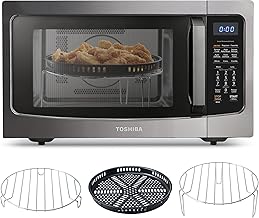
TOSHIBA 4-in-1 Countertop Microwave Oven With Air Fryer
This 1.5-cubic-foot Toshiba is a flexible choice for households that want one countertop appliance to handle reheating, convection baking, broiling, and air frying. Its smart sensor and position-memory turntable make it especially convenient for everyday meals, while the mute function is a thoughtful feature for open-plan kitchens or late-night use.
BLACK+DECKER Over-the-Range Microwave With Air Fryer
The BLACK+DECKER is the most convincing space-saving option for kitchens that need both microwave duty and a replacement for a separate range hood. Its 1.5-cubic-foot interior, convection and bake modes, sensor reheat, and 300 CFM ventilation suit busy cooking areas, although over-the-range installation requires careful attention to mounting height and vent configuration.
AAOBOSI 24-Inch Built-in Microwave Convection Oven
Designed for a more integrated look, the AAOBOSI combines a 1.6-cubic-foot cavity with air frying, convection, sensor cooking, and more than a dozen cooking modes. The drop-down door can feel more natural than a side-hinged microwave when the unit is installed at eye level, but buyers should verify the opening dimensions and electrical requirements before committing to a cabinet layout.
KoolMore Reserve Built-in Microwave Convection Oven
The KoolMore Reserve is a polished built-in option for a remodel where appearance and ergonomics matter. Its soft-close door, sensor cook functions, and 3-in-1 design keep the appliance practical, while the included NEMA 5-20P plug means the electrical plan deserves special attention rather than being treated as an afterthought.
TOSHIBA Air Fryer Combo Microwave
With a compact 1.0-cubic-foot footprint, this Toshiba is a strong fit for small counters, studio kitchens, and secondary food-preparation areas. It offers eight cooking functions, including convection and broil, plus a generous 12.4-inch turntable for its size; choose it when cabinet space is tight and you value versatility over maximum capacity.
Frequently Asked Questions
Can a countertop microwave air-fryer combo be installed in a wall cabinet?
Usually not without explicit manufacturer approval. Countertop units need ventilation space around the cabinet, and enclosing one can cause overheating or create a safety issue. Built-in models are engineered for the clearances and airflow associated with cabinet installation.
Does an air-fryer microwave replace a full-size wall oven?
It can replace many everyday oven tasks, including roasting small portions, crisping frozen foods, and baking modest dishes. However, its cavity is typically smaller, so large baking trays, multiple racks, and holiday-scale cooking may still require a conventional oven.
Are built-in models better for a small kitchen?
They can be, because they preserve counter space and create a cleaner furniture plan. They are not automatically the better value, though: installation costs, cabinet modifications, and electrical work can outweigh the benefit if your kitchen already has a suitable counter location.
What should I measure before buying?
Measure the intended width, height, depth, front clearance, and nearby door or drawer swing. For built-in units, compare those measurements with the manufacturer’s cutout diagram, not just the product’s exterior dimensions. Also confirm outlet location, circuit requirements, and whether ventilation must be routed outdoors.
Final Thoughts
For the broadest countertop functionality, the TOSHIBA 4-in-1 is a well-rounded pick. The BLACK+DECKER is better suited to a range wall that also needs ventilation, while the AAOBOSI and KoolMore Reserve make more sense for a coordinated built-in renovation. If the priority is the smallest practical footprint, the compact TOSHIBA Air Fryer Combo delivers the most utility per inch.