Key takeaways
- Tooth count: Choose roughly 60 to 80 teeth for clean plywood crosscuts and finished panels; 40-tooth blades are more useful when speed and general-purpose cutting matter.
- Tooth geometry: Alternating-top-bevel teeth typically produce smooth cuts across plywood veneers, while a combination profile offers a better compromise between ripping and crosscutting.
- Kerf and power: A thin-kerf blade can reduce strain on compact saws, but confirm that its plate is appropriate for your machine and that it remains stable during long cuts.
- Arbor and size: Match the blade diameter and 5/8-inch arbor specification to your saw. Never rely on an adapter or blade that exceeds the saw’s rated diameter or speed.
- Material and maintenance: Carbide-tipped teeth are the practical choice for plywood. Keep the blade clean, support large sheets, and replace it when burning or wandering continues after cleaning.
What's inside
Choosing a plywood blade is less straightforward than simply counting teeth. A blade that leaves a clean edge on a cabinet panel may cut too slowly for repeated rough sizing, while an aggressive ripping blade can leave splintered veneer, fuzzy melamine, or chipped laminate. In a compact workshop, the wrong blade also creates extra sanding, wasted material, and unnecessary storage clutter.
This guide focuses on table-saw-friendly blades that balance edge quality, cutting speed, arbor compatibility, and practical versatility. It covers fine-finish options for furniture parts, multipurpose sets for small shops, and buying details that matter when your table saw shares limited space with other tools.
As an Amazon Associate we earn from qualifying purchases.


How to Choose a/an Table Saw Blades For Plywood (2026)
- Tooth count: Choose roughly 60 to 80 teeth for clean plywood crosscuts and finished panels; 40-tooth blades are more useful when speed and general-purpose cutting matter.
- Tooth geometry: Alternating-top-bevel teeth typically produce smooth cuts across plywood veneers, while a combination profile offers a better compromise between ripping and crosscutting.
- Kerf and power: A thin-kerf blade can reduce strain on compact saws, but confirm that its plate is appropriate for your machine and that it remains stable during long cuts.
- Arbor and size: Match the blade diameter and 5/8-inch arbor specification to your saw. Never rely on an adapter or blade that exceeds the saw’s rated diameter or speed.
- Material and maintenance: Carbide-tipped teeth are the practical choice for plywood. Keep the blade clean, support large sheets, and replace it when burning or wandering continues after cleaning.
The Best Table Saw Blades For Plywood (2026)s Reviewed
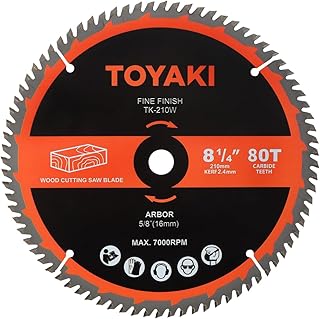
8-1/4-Inch 80-Tooth Ultra-Fine Finish Blade
This compact, high-tooth-count blade is a strong match for smaller table saws and furniture work where edge quality matters more than maximum feed speed. Its 5/8-inch arbor and broad compatibility with miter and circular saws make it especially useful in a space-conscious workshop, though its fine tooth spacing is better suited to controlled cuts than thick-sheet production work.
KENDO 10-Inch 40T/60T Blade Set
The KENDO two-pack is a sensible choice for buyers who want one compact storage solution for two cutting jobs. Use the 40-tooth blade for faster general-purpose ripping and the 60-tooth option for plywood, MDF, and laminate finish cuts; it is a practical setup for occasional furniture building without buying several specialized blades.
Benchmark Abrasives 8-1/2-Inch 60-Tooth Blade
Benchmark Abrasives’ 60-tooth blade is sized for smaller saws while still offering a finish-oriented tooth count for plywood, hardwood, and MDF panels. It fits the needs of a home furniture maker who wants cleaner edges from a compact machine, especially when the workpiece is supported well on both sides of the cut.
10-Inch 80-Tooth Fine-Finish Wood Blade
This 80-tooth blade is aimed at precise crosscutting and smooth visible edges, making it a good candidate for cabinet components, shelving, and plywood parts that will receive minimal edge treatment. Check the saw’s maximum RPM before installation, and expect to feed more deliberately than you would with a lower-tooth-count blade.
FOXBC 10-Inch 80-Tooth Ultra-Finish Blade
The FOXBC blade emphasizes a clean finish on wood and plywood, which can reduce the amount of handwork after cutting. Its standard 5/8-inch arbor suits many full-size table saws, but its dense tooth pattern is best reserved for finish cuts rather than forcing it through long, heavy rips.
Frequently Asked Questions
What tooth count is best for plywood on a table saw?
A 60-tooth blade is a useful all-around choice for clean plywood cuts, while an 80-tooth blade can produce a smoother edge on visible furniture parts. A 40-tooth blade is usually preferable when you need faster ripping or a more versatile general-purpose setup.
Should I use an 80-tooth blade for every plywood cut?
Not necessarily. High-tooth-count blades excel at finish cuts but remove material more slowly and can load up if pushed aggressively. For breaking down full sheets or making repeated long rips, a lower-tooth-count combination blade may be more efficient.
How can I prevent plywood tear-out?
Use a sharp finish blade, keep the plywood firmly supported, and cut with the good face oriented appropriately for your saw. A zero-clearance insert, painter’s tape along the cut line, and a steady feed rate can further reduce splintering.
Can a table-saw blade also be used on a circular or miter saw?
Only when the blade diameter, arbor, tooth design, and RPM rating are compatible with that specific saw. Always follow the tool manufacturer’s instructions and never exceed the saw’s maximum blade diameter or speed.
Final Thoughts
For compact furniture workshops, the 8-1/4-inch 80-tooth blade is a convenient fine-finish pick, while the KENDO 40T/60T set offers the most flexible single-storage solution. For a full-size table saw dedicated to polished plywood edges, the FOXBC or 10-inch 80-tooth blade is worth considering.