Key takeaways
- Battery platform: Choose a saw that matches batteries you already own, if possible. Starting a new platform adds significant cost, while a second battery keeps work moving on larger projects.
- Cutting capacity: An 8-1/4-inch blade is easier to store and handles most furniture components. A 10-inch blade offers deeper cuts and broader accessory compatibility but usually increases weight and footprint.
- Stand and storage: Look for quick-folding legs, solid wheels, and a compact folded profile. A good stand should let one person move the saw without rearranging the entire workshop.
- Fence accuracy: A rigid, easy-to-adjust fence matters more than headline RPM. Check for smooth locking, minimal flex, and enough rip capacity for sheet goods and cabinet parts.
- Power expectations: Cordless saws excel where outlets are inconvenient, but runtime varies with stock thickness and blade condition. For long production sessions, a corded model may still be the more practical choice.
What's inside
Choosing a table saw for a compact workshop is less about chasing the biggest motor and more about controlling clutter, setup time, and storage. A saw that delivers excellent cuts but occupies half the garage—or requires a long extension cord across a busy room—can quickly become a poor fit for home furniture projects.
This guide compares portable battery-powered options with a few worthwhile corded alternatives, because the best choice depends on your workspace, material sizes, and tolerance for charging and battery costs. I’m focusing on portability, stand design, cutting capacity, dust management, and how sensibly each saw fits into a small-space workflow.
As an Amazon Associate we earn from qualifying purchases.




How to Choose a Cordless Table Saw (2026)
- Battery platform: Choose a saw that matches batteries you already own, if possible. Starting a new platform adds significant cost, while a second battery keeps work moving on larger projects.
- Cutting capacity: An 8-1/4-inch blade is easier to store and handles most furniture components. A 10-inch blade offers deeper cuts and broader accessory compatibility but usually increases weight and footprint.
- Stand and storage: Look for quick-folding legs, solid wheels, and a compact folded profile. A good stand should let one person move the saw without rearranging the entire workshop.
- Fence accuracy: A rigid, easy-to-adjust fence matters more than headline RPM. Check for smooth locking, minimal flex, and enough rip capacity for sheet goods and cabinet parts.
- Power expectations: Cordless saws excel where outlets are inconvenient, but runtime varies with stock thickness and blade condition. For long production sessions, a corded model may still be the more practical choice.
The Best Cordless Table Saws (2026) Reviewed
RYOBI ONE+ HP 8-1/4-Inch Compact Table Saw
The RYOBI ONE+ HP brushless table saw is a sensible small-shop choice, particularly for homeowners already invested in the ONE+ battery system. Its compact footprint and included batteries make it approachable for shelving, trim components, and furniture repairs, while the 8-1/4-inch blade keeps storage manageable. It is not the first choice for constant full-sheet work, but it is easy to bring out and put away.
FLEX 24V 8-1/4-Inch Table Saw Kit
FLEX’s FX7211-1H pairs a brushless motor with a 6.0Ah stacked lithium battery and rapid charger, giving it a more serious cordless setup than many compact competitors. The kit is appealing for makers who want strong mobility without giving up useful jobsite capacity. Its larger battery can add weight, so plan a dedicated storage spot rather than treating it as an ultra-light bench tool.
DEWALT FLEXVOLT 60V MAX 8-1/4-Inch Table Saw
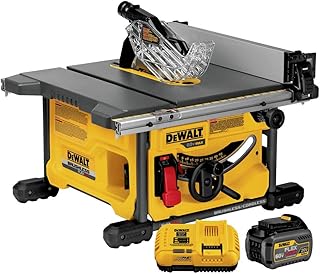
The DEWALT FLEXVOLT DCS7485T1 is one of the strongest options for users who need cordless freedom but still expect confident ripping performance. Its FLEXVOLT battery system is especially useful for demanding cuts and can fit into a wider DEWALT tool collection. For a compact furniture workshop, the trade-off is cost and the need to store both the saw and its substantial battery safely.
DEWALT 15 Amp 8-1/4-Inch Compact Jobsite Table Saw
The DEWALT DWE7485 is corded, not cordless, but deserves consideration when your workbench is near a dependable outlet. It offers a compact form, useful rip capacity, and a familiar jobsite format without battery runtime concerns. For a dedicated indoor workspace, this can be a better value than a battery kit, provided its cord can be routed safely away from walkways.
DEWALT 10-Inch Table Saw with Rolling Stand
The DEWALT DWE7491RS is also corded, yet its 10-inch blade, rolling stand, and generous 32-1/2-inch rip capacity make it a compelling alternative for larger furniture panels. It is the least storage-friendly option here, but the integrated rolling stand helps one person reposition it. Choose it when cutting capacity matters more than keeping every tool shelf-sized.
Frequently Asked Questions
Are cordless table saws powerful enough for furniture making?
Yes, for many home projects. Battery saws can handle plywood, dimensional lumber, and common hardwood parts when paired with a sharp, appropriate blade. Their limitations become more noticeable during repeated thick cuts or long production sessions.
Is an 8-1/4-inch table saw large enough?
For most furniture work, yes. An 8-1/4-inch saw is easier to carry and store, while still offering enough depth for typical boards and sheet goods. A 10-inch model is preferable when you regularly cut thicker stock or want access to a broader range of blades.
Do I need a folding stand?
Not necessarily, but a folding stand is valuable in a small space. It turns the saw into a tool you can set up for a project and then collapse against a wall. If you work at a permanent bench, a compact saw body may be more useful than a wheeled stand.
Should I buy cordless or corded?
Choose cordless when portability, outdoor work, or outlet-free setup is central to your projects. Choose corded when the saw will live near power and run for extended periods. The SKIL TS6307-00 is another corded 10-inch option with a folding stand, while the DEWALT DWE7485 keeps the footprint smaller.
Final Thoughts
The RYOBI ONE+ HP is a practical pick for compact workshops and existing ONE+ owners, while the FLEX 24V is better suited to users seeking a more substantial cordless kit. For maximum cordless cutting confidence, the DEWALT FLEXVOLT stands out; if your saw can stay near an outlet, the DEWALT DWE7485 or larger DWE7491RS may deliver better long-session value.