Key takeaways
- Tooth count: Use 24–40 teeth for faster ripping, 40–60 teeth for general-purpose work, and 60–80 teeth for smoother crosscuts and finish cuts.
- Cutting task: Ripping follows the wood grain, while crosscutting runs across it. Combination or paired blades are useful when a small shop cannot spare room for a large blade collection.
- Arbor fit: Confirm that the blade has the correct 5/8-inch arbor for your saw. A proper fit is essential for safe, stable operation.
- Kerf and power: A thin-kerf blade can reduce waste and make life easier for compact saws, while a full-kerf blade may offer greater rigidity on powerful machines.
- Material compatibility: Carbide-tipped blades are the practical choice for plywood, hardwood, softwood, and common furniture-board materials. Avoid using wood blades on metal or masonry.
What's inside
Choosing a 10-inch table saw blade is less straightforward than it looks. Tooth count, carbide quality, kerf width, arbor size, and the type of cut you make all affect the result. A blade that excels at fast ripping may leave rough edges on furniture parts, while an ultra-fine blade can cut beautifully but work slowly through thick stock.
This guide focuses on practical choices for home workshops and furniture projects, especially where storage space, tool versatility, and clean results matter. We compare dependable 10-inch blades for ripping, crosscutting, and fine finishing so you can match one blade—or a compact two-blade setup—to the work you actually do.
As an Amazon Associate we earn from qualifying purchases.



How to Choose a 10 Inch Table Saw Blades (2026)
- Tooth count: Use 24–40 teeth for faster ripping, 40–60 teeth for general-purpose work, and 60–80 teeth for smoother crosscuts and finish cuts.
- Cutting task: Ripping follows the wood grain, while crosscutting runs across it. Combination or paired blades are useful when a small shop cannot spare room for a large blade collection.
- Arbor fit: Confirm that the blade has the correct 5/8-inch arbor for your saw. A proper fit is essential for safe, stable operation.
- Kerf and power: A thin-kerf blade can reduce waste and make life easier for compact saws, while a full-kerf blade may offer greater rigidity on powerful machines.
- Material compatibility: Carbide-tipped blades are the practical choice for plywood, hardwood, softwood, and common furniture-board materials. Avoid using wood blades on metal or masonry.
The Best 10 Inch Table Saw Blades (2026)s Reviewed
DEWALT DWA11040 40-Tooth Fine Finish Blade
The DEWALT DWA11040 is a sensible all-rounder for a compact workshop that needs one blade to handle varied furniture tasks. Its 40-tooth layout balances efficient cutting with a cleaner edge than a coarse ripping blade, making it useful for shelves, panels, trim, and general project work.
FOXBC 80-Tooth Ultra-Finish Blade
The FOXBC 10-inch, 80-tooth blade is aimed at highly polished cuts in wood, particularly when minimizing splintering is more important than speed. It suits visible edges, veneered panels, and detailed joinery, although its dense tooth pattern is better reserved for moderate feed rates and thinner material.
WEN BL1080 80-Tooth Ultra-Fine Finish Blade
WEN’s BL1080 is another finish-focused option, with 80 carbide-tipped teeth for smooth crosscuts and refined work on table and miter saws. It is a strong fit for small-space makers who want one specialized blade for final sizing, picture-frame parts, cabinet components, and other appearance-critical cuts.
WEN BL1060 60-Tooth Fine-Finish Blade
The WEN BL1060 occupies a useful middle ground between speed and surface quality. Its 60-tooth design is well suited to home furniture projects where you want cleaner cuts than a general-purpose blade provides without the slower feed rate of an ultra-fine 80-tooth model.
Luckyway 10-Inch Two-Pack, 60T and 32T
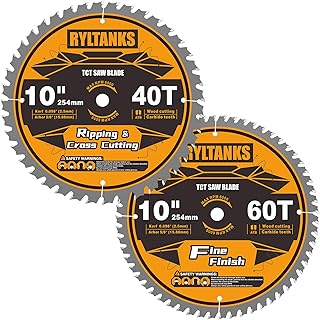
Luckyway’s two-blade set offers a practical solution for workshops with limited storage. The 32-tooth blade can take on faster ripping and rougher dimensioning, while the 60-tooth blade is better for cleaner crosscuts and finish work. Together, they cover more tasks than a single specialty blade.
Frequently Asked Questions
Is a 10-inch blade standard for a table saw?
Ten-inch blades are common on full-size and compact jobsite table saws, but compatibility still depends on the saw’s arbor, maximum blade diameter, guard clearance, and manufacturer specifications. Check the manual before buying or installing a blade.
Is a higher tooth count always better?
No. More teeth generally produce smoother cuts, but they also remove material more slowly and can be less suitable for fast ripping. For many furniture makers, a 40- or 60-tooth blade is the most flexible starting point.
Can one blade handle both ripping and crosscutting?
Yes, a general-purpose blade can handle both jobs, especially in plywood and ordinary solid wood. However, using separate ripping and finishing blades often improves efficiency and edge quality while extending the useful life of each blade.
How often should a table saw blade be replaced?
Replace or sharpen a blade when cuts become noticeably rough, burning appears despite proper setup, or the saw requires unusual force. Clean pitch and resin first, since buildup can mimic a dull blade. Damaged or missing carbide teeth warrant immediate replacement.
Final Thoughts
For a compact workshop, the DEWALT DWA11040 is a strong general-purpose choice, while the WEN BL1060 offers a useful step up in finish quality. If you want broader coverage without storing several blades, Luckyway’s 32T-and-60T two-pack is a practical pairing for everyday furniture construction.