Key takeaways
- Tooth count: Lower counts generally remove material quickly for ripping, while 60- and 80-tooth blades are better suited to smoother crosscuts and finished edges.
- Kerf: A thin-kerf blade can reduce waste and place less demand on a compact saw, but confirm that its design suits your machine and material.
- Arbor size: Most 10-inch table saws use a 5/8-inch arbor, but verify your saw’s specifications before ordering.
- Cutting task: Choose a general-purpose blade for mixed work, a ripping blade for long grain cuts, or a fine-finish blade for visible furniture parts.
- Storage: In a small shop, a two- or three-blade set can be more practical than several individual blades, provided you have a safe place to keep the extras protected.
What's inside
Choosing a table saw blade is rarely as simple as picking the highest tooth count. In a compact workshop, one blade may need to handle hardwood shelving, plywood panels, trim pieces, and occasional rough stock—without creating excess dust, tear-out, or a storage problem. The wrong blade can also make a capable saw feel underpowered.
This guide focuses on practical blade choices for home furniture projects, where clean edges, dependable carbide teeth, and useful versatility matter more than flashy specifications. We compare finish-focused, general-purpose, and multi-blade options so you can match the blade to your cutting routine and keep your small workspace organized.
As an Amazon Associate we earn from qualifying purchases.


How to Choose a/an 10 Table Saw Blades (2026)
- Tooth count: Lower counts generally remove material quickly for ripping, while 60- and 80-tooth blades are better suited to smoother crosscuts and finished edges.
- Kerf: A thin-kerf blade can reduce waste and place less demand on a compact saw, but confirm that its design suits your machine and material.
- Arbor size: Most 10-inch table saws use a 5/8-inch arbor, but verify your saw’s specifications before ordering.
- Cutting task: Choose a general-purpose blade for mixed work, a ripping blade for long grain cuts, or a fine-finish blade for visible furniture parts.
- Storage: In a small shop, a two- or three-blade set can be more practical than several individual blades, provided you have a safe place to keep the extras protected.
The Best 10 Table Saw Blades (2026)s Reviewed
FOXBC 10-Inch 80-Tooth Ultra Finish Blade
The FOXBC 80-tooth blade is aimed at projects where edge quality takes priority, such as cabinet components, tabletops, and veneered panels. Its dense tooth pattern is best reserved for controlled cuts rather than fast ripping, making it a sensible dedicated finish blade for a small furniture shop.
DEWALT 10-Inch 40-Tooth Fine Finish Blade
DEWALT’s DWA11040 offers a useful middle ground for makers who do not want to swap blades constantly. Its 40-tooth layout is suited to everyday crosscuts and general woodworking, while the carbide construction makes it a practical choice for a frequently used home saw.
WEN BL1080 10-Inch 80-Tooth Blade
The WEN BL1080 is another finish-oriented option, designed for clean cuts on woodworking stock and compatible with both table and miter saw applications. It makes the most sense when your projects emphasize visible edges and you are willing to trade cutting speed for a smoother result.
WEN BL1060 10-Inch 60-Tooth Fine-Finish Blade
With 60 teeth, the WEN BL1060 sits between a fast general-purpose blade and an ultra-fine finishing blade. That balance can be especially useful in a compact workspace, where one dependable blade needs to cover furniture panels, trim, and moderate crosscutting without taking up extra storage space.
10-Inch 40T/60T Two-Pack Blade Set
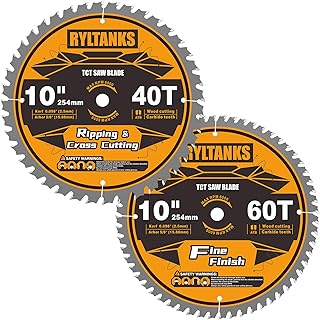
This two-pack pairs a 40-tooth blade for ripping and crosscutting with a 60-tooth blade for finer work. For beginners building a small but capable blade collection, the set offers a straightforward way to separate rougher cuts from presentation surfaces while keeping the tool cabinet uncluttered.
Frequently Asked Questions
Is a 40-tooth blade suitable for furniture making?
Yes. A quality 40-tooth blade can handle many everyday furniture tasks, particularly when you need a versatile option for ripping and crosscutting. For highly visible edges or delicate plywood, a 60- or 80-tooth blade may leave a cleaner finish.
Should I use an 80-tooth blade for ripping boards?
Usually, no. An 80-tooth blade is designed more for fine finishing and can cut more slowly during long rips. A lower-tooth or general-purpose blade is typically more efficient for breaking down solid wood before switching to a finish blade.
Can these 10-inch blades fit every table saw?
Not necessarily. Check the saw’s permitted blade diameter, arbor size, maximum kerf, and any clearance requirements. Many 10-inch table saws use a 5/8-inch arbor, but the manufacturer’s specifications should always take precedence.
How should I store spare saw blades in a small workshop?
Keep blades in their original packaging, a dedicated blade case, or a wall-mounted holder with the teeth shielded. Store them flat or securely supported, away from moisture, and avoid stacking loose blades where carbide teeth can strike one another.
Final Thoughts
For a focused finish blade, the FOXBC 80-tooth and WEN BL1080 are strong candidates; for a more flexible everyday option, the DEWALT 40-tooth blade is easier to justify. If you want efficient coverage with minimal storage, the 40T/60T two-pack gives a small workshop a useful starting set.