Key takeaways
- Tooth count and what you’re cutting: Eighty teeth handles hardwood crosscuts and plywood cleanly while clearing chips well; one hundred teeth is the choice for veneered panels, melamine shelving, and thin trim where tear-out on the underside is the enemy. Above 3/4-inch thick hardwood, a 100-tooth blade can burn if you feed it too slowly.
- Grind geometry: Look for ATB (alternate top bevel) on general fine work — the angled teeth act like knives slicing wood fibers rather than chiseling them. Hi-ATB grinds go further for laminates. Triple-chip grinds belong on man-made board and aluminum, not on solid walnut.
- Plate quality and kerf: A tensioned, laser-cut plate with expansion slots stays flat under heat, and flat plates are the difference between a square shoulder and one that drifts. Thin-kerf blades ask less of an underpowered 15-amp saw but flex more; standard kerf tracks straighter if your saw has the muscle.
- Carbide grade and resharpenability: Micrograin carbide holds an edge through more feet of hardwood before it starts crushing fibers. Check whether the teeth are thick enough to be professionally resharpened — a blade you can regrind twice costs less per year than two disposable ones.
- Arbor fit and noise: Confirm the 1-inch arbor matches your saw and that any reducer bushing is included. In an apartment, blades with anti-vibration slots and copper plugs are noticeably quieter, which matters more than most spec sheets admit.
What's inside
Building furniture for a compact apartment means every cut shows. A floating shelf that sits eight inches from eye level, a drawer front in a closet-turned-office, a bench seat wedged into a bay window — these pieces get looked at up close, every day, from angles that a garage workbench never gets judged from. And when your shop is a balcony, a hallway, or a folding table in the living room, you don’t have the luxury of a wide belt sander or a router table waiting to bail you out. The cut off the miter saw has to be the finished edge.
That puts an unusual amount of pressure on a single consumable: the blade. A coarse 24-tooth framing blade will get you through a 1×8 in half a second and leave splintered fibers that take twenty minutes of hand sanding to rescue. A properly ground fine-finish blade leaves a surface you can go straight to oil or paint. This guide covers the twelve-inch blades worth putting on a compound miter saw for furniture-grade work, what actually separates a good one from a cheap one, and how to match tooth count to the material stacked in your closet.
As an Amazon Associate we earn from qualifying purchases.




How to Choose a 12 Miter Saw Blade For Fine Cuts (2026)
- Tooth count and what you’re cutting: Eighty teeth handles hardwood crosscuts and plywood cleanly while clearing chips well; one hundred teeth is the choice for veneered panels, melamine shelving, and thin trim where tear-out on the underside is the enemy. Above 3/4-inch thick hardwood, a 100-tooth blade can burn if you feed it too slowly.
- Grind geometry: Look for ATB (alternate top bevel) on general fine work — the angled teeth act like knives slicing wood fibers rather than chiseling them. Hi-ATB grinds go further for laminates. Triple-chip grinds belong on man-made board and aluminum, not on solid walnut.
- Plate quality and kerf: A tensioned, laser-cut plate with expansion slots stays flat under heat, and flat plates are the difference between a square shoulder and one that drifts. Thin-kerf blades ask less of an underpowered 15-amp saw but flex more; standard kerf tracks straighter if your saw has the muscle.
- Carbide grade and resharpenability: Micrograin carbide holds an edge through more feet of hardwood before it starts crushing fibers. Check whether the teeth are thick enough to be professionally resharpened — a blade you can regrind twice costs less per year than two disposable ones.
- Arbor fit and noise: Confirm the 1-inch arbor matches your saw and that any reducer bushing is included. In an apartment, blades with anti-vibration slots and copper plugs are noticeably quieter, which matters more than most spec sheets admit.
The Best 12 Miter Saw Blade For Fine Cuts (2026)s Reviewed
ANGELSWORD 12-Inch 100T Fine Finish, 2 Pack
Two 100-tooth blades at a price most brands charge for one makes this the practical pick for anyone building a full room’s worth of shelving, since you can rotate to a fresh blade the moment the first starts fuzzing edges. Cut quality on birch ply and pine trim is genuinely clean; just feed steadily through thicker hardwood to avoid scorch marks.
DEWALT DWA112100 100-Tooth Fine Finish
The benchmark for trim and furniture crosscuts, with a stiff plate that holds a true 90 degrees through miter after miter and carbide that stays sharp well past where budget blades start tearing. If you only own one finish blade and you care about repeatable joints, this is the one to buy.
WEN BL1280 80-Tooth Fine Finish
Eighty teeth is the sweet spot for mixed work — clean enough for exposed edges on oak and maple, but with sufficient gullet space to clear chips in 4/4 stock without heat buildup. It also runs happily on a table saw, which is useful when your one machine has to do everything.
WEN BL1200 100-Tooth Ultra-Fine Finish
A carbide-tipped 100-tooth blade that punches above its price on melamine and pre-finished plywood, the two materials most likely to chip out on a compact-storage build. Pair it with a zero-clearance insert or sacrificial backer for near-flawless bottom faces.
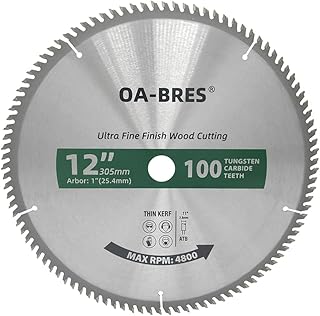
12-Inch 100-Tooth ATB TCT Ultra Fine Finish
A straightforward 1-inch-arbor ATB blade that delivers the slicing action fine crosscuts need, with a plate that runs smooth and quiet enough for evening work in a shared building. A sensible spare to keep alongside your primary blade.
Frequently Asked Questions
Is 100 teeth always better than 80?
No. More teeth means a finer surface but slower chip evacuation and more heat. Use 100T for sheet goods, veneer, and trim under 3/4 inch; drop to 80T for thicker hardwood crosscuts.
Can I use a fine-finish miter blade on my table saw?
For crosscuts and sheet goods, yes, provided the arbor size matches. Avoid ripping solid lumber with a high-tooth-count blade — it will bog and burn.
How do I stop tear-out on the bottom edge?
Back the workpiece with a sacrificial strip or add a zero-clearance auxiliary fence, and let the blade reach full speed before contact. Blade quality alone won’t fix an unsupported fiber.
When does a blade need replacing?
Watch for burning, increased feed pressure, fuzzy edges, or chipped carbide tips. Sharp blades can often be resharpened once or twice before retirement.
Final Thoughts
For furniture-grade cuts in a small space, the DEWALT DWA112100 is the blade to buy if you want one reliable performer, the WEN BL1280 is the smarter all-rounder when your saw handles both trim and thicker hardwood, and the ANGELSWORD 100T two-pack is the best value for a long build where a fresh edge halfway through pays for itself. Anyone splitting time between rough breakdown and finish work should also keep the ANGELSWORD 40T/60T combo pack on the shelf.