Key takeaways
- Tank orientation: Vertical tanks claim roughly a two-foot square of floor and stack their bulk upward, which is what you want beside a workbench or in a utility nook. Horizontal tanks are more stable and slide under a bench or shelf, but they eat wall length. Measure the gap you actually have before you pick a shape.
- Noise in decibels, not adjectives: Anything above 90 dB is unpleasant in an enclosed garage and impossible in an apartment building. Models rated near 78 dB let you run a nail gun without warning the neighbors. “Ultra quiet” on a listing means nothing without a number attached.
- Mobility hardware: Wheels and a balanced handle turn a permanent fixture into something you roll out for an afternoon and tuck back after. Check wheel diameter if you’ll cross a door threshold or a gravel driveway; small hard casters stall on both.
- CFM at 90 PSI: This single figure decides which tools you can run. Roughly 4 CFM covers brad nailers, tire work, and blow-off duties. Impact wrenches and orbital sanders want 5 CFM and up, and a ten-gallon tank will cycle constantly trying to feed them.
- Oil-free versus oil-lubricated: Oil-free pumps skip the maintenance and can be stored on their side or moved without worrying about spills, which matters in tight quarters. They’re louder and wear out sooner, but for weekend use the tradeoff is usually worth it.
What's inside
A ten-gallon tank sits at an awkward point in most homes. It’s too big to stash in a closet, too useful to leave at the hardware store, and it always seems to land in the exact spot where you wanted to park the bikes. If you live with a single-car garage, a shared basement corner, or a balcony that doubles as a workshop, the question isn’t just how much air a compressor makes. It’s whether the machine earns the square footage it occupies.
This guide looks at ten-gallon compressors through that lens: footprint shape, noise you can live with through a shared wall, and whether the thing can be wheeled out of the way when the room needs to be a room again. I’ve grouped the picks below by the kind of space they suit, with notes on where each one falls short. A couple of alternatives outside the ten-gallon class made the cut too, because sometimes the right answer is smaller or bigger than what you came looking for.
As an Amazon Associate we earn from qualifying purchases.



How to Choose a 10 Gallon Air Compressor (2026)
- Tank orientation: Vertical tanks claim roughly a two-foot square of floor and stack their bulk upward, which is what you want beside a workbench or in a utility nook. Horizontal tanks are more stable and slide under a bench or shelf, but they eat wall length. Measure the gap you actually have before you pick a shape.
- Noise in decibels, not adjectives: Anything above 90 dB is unpleasant in an enclosed garage and impossible in an apartment building. Models rated near 78 dB let you run a nail gun without warning the neighbors. “Ultra quiet” on a listing means nothing without a number attached.
- Mobility hardware: Wheels and a balanced handle turn a permanent fixture into something you roll out for an afternoon and tuck back after. Check wheel diameter if you’ll cross a door threshold or a gravel driveway; small hard casters stall on both.
- CFM at 90 PSI: This single figure decides which tools you can run. Roughly 4 CFM covers brad nailers, tire work, and blow-off duties. Impact wrenches and orbital sanders want 5 CFM and up, and a ten-gallon tank will cycle constantly trying to feed them.
- Oil-free versus oil-lubricated: Oil-free pumps skip the maintenance and can be stored on their side or moved without worrying about spills, which matters in tight quarters. They’re louder and wear out sooner, but for weekend use the tradeoff is usually worth it.
The Best 10 Gallon Air Compressor (2026)s Reviewed
VEVOR 10 Gallon Oil-Free Compressor
At 78 dB with 5.3 CFM at 90 PSI, this is the rare compressor you can run in a basement without clearing the house. The output is genuinely strong for the class, making it my default recommendation for anyone doing spray finishing or tire work in a shared building.
Stark USA 3.5HP 10 Gallon Horizontal
The horizontal tank tucks under a workbench or shelving unit, reclaiming vertical space you can use for storage. Adjustable pressure and a healthy 8.37 CFM rating make it the most capable option here, though it demands more floor length than the vertical models.
Albott 10 Gallon Vertical Wheeled
A copper motor and a wheeled vertical tank at 115 PSI max, built for tire inflation and light pneumatic work. The smallest footprint of the corded picks, which makes it the sensible choice for a corner you can’t afford to lose.
Craftsman 10 Gallon Portable (CMXECXA0331042)
Four CFM at 90 PSI and 150 PSI max, with the parts availability and warranty support that comes with a name brand. It’s the safe pick if you’d rather not gamble on a lesser-known label for a tool you’ll keep for a decade.
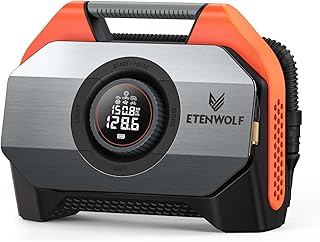
ETENWOLF VORTEX S6 Cordless Inflator
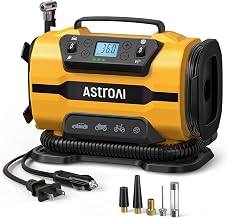
If your list is tires, sports balls, and air mattresses, a tank compressor is the wrong tool. This dual-cylinder cordless unit with a 19200 mAh battery lives in a drawer and handles all of it, with a 100% duty cycle and an LED light for roadside work.
Frequently Asked Questions
Can I run an impact wrench off a ten-gallon tank?
Briefly, yes, for lug nuts and short bursts. Sustained use will outrun the pump and leave you waiting on recovery cycles. If impact work is routine, step up to a larger tank like the Craftsman 26 gallon.
How much clearance does a compressor need?
Leave at least six inches on all sides for airflow, and more if the intake faces a wall. Compressors pull in a lot of air and heat up fast in a tight cabinet.
Do I need a 240V outlet?
No. Every model here runs on standard 120V household power. Just avoid sharing the circuit with other heavy draws, since startup surge can trip a breaker.
Will an apartment neighbor hear it?
Through a shared wall, a 90 dB compressor is obvious and disruptive. A 78 dB model reads more like a loud appliance. Even then, keep it off floors that transmit vibration and stick to daytime hours.
Final Thoughts
For most tight spaces, the VEVOR 10 Gallon strikes the best balance between real output and noise you can live with. If you can give up wall length instead of floor area, the Stark USA horizontal delivers more air and disappears under a bench. And if the job list never gets past tires and inflatables, the ETENWOLF VORTEX S6 solves the problem without claiming any floor at all.