Key takeaways
- Airflow over pressure ratings: Nearly everything advertises 150 PSI, which tells you little. CFM is the number that determines whether a light truck tire takes two minutes or twelve. Dual-cylinder pumps in the 7 to 12 CFM range handle 35-inch tires without straining; single-cylinder units suit daily-driver pickups and SUVs.
- Stowed footprint, not box dimensions: Measure the compressor with hose and clamps packed, then compare it to the space you actually have. A unit that lies flat in a 4-inch-tall drawer is worth more in a small home than one that only fits standing upright in a corner.
- Cord and hose management: Look for integrated wraps, hose channels, or molded case cavities. Loose 10-foot power leads with alligator clips are the single biggest reason inflators end up as garage clutter rather than stored tools.
- Power source and cable length: Cordless models free you from the battery terminal, which matters if you park in a tight space or on the street. Corded 12V units run indefinitely but need enough lead to reach the far rear tire. Dual-power AC/DC models double as household pumps for mattresses and sports gear.
- Case quality and stackability: A rigid case with a flat lid can sit under a shelf or bear weight in a truck bed. Soft bags slump and waste vertical space. Treat the case as part of the purchase, not packaging.
What's inside
Every gear-heavy household eventually runs into the same wall: the tools you need most are the ones you have nowhere to put. A truck tire inflator is a perfect example. It has to be strong enough to move real air through a 33-inch tire, yet it also has to disappear into a cab console, a bench drawer, or the six inches of clearance behind a mudroom cabinet. Buy on power alone and you end up with a suitcase-sized pump living permanently on the garage floor, tangled in its own hose.
This guide looks at the current crop of heavy-duty 12V inflators through a storage-first lens: how compactly each one packs down, whether the hose and cords coil without a fight, how the included case behaves on a shelf, and whether the unit earns the cubic space it claims. Performance still matters, and we cover CFM, duty cycle, and gauge quality below, but the recommendations here favor pumps that stow as gracefully as they inflate.
As an Amazon Associate we earn from qualifying purchases.


How to Choose a Truck Tire Air Compressor (2026)
- Airflow over pressure ratings: Nearly everything advertises 150 PSI, which tells you little. CFM is the number that determines whether a light truck tire takes two minutes or twelve. Dual-cylinder pumps in the 7 to 12 CFM range handle 35-inch tires without straining; single-cylinder units suit daily-driver pickups and SUVs.
- Stowed footprint, not box dimensions: Measure the compressor with hose and clamps packed, then compare it to the space you actually have. A unit that lies flat in a 4-inch-tall drawer is worth more in a small home than one that only fits standing upright in a corner.
- Cord and hose management: Look for integrated wraps, hose channels, or molded case cavities. Loose 10-foot power leads with alligator clips are the single biggest reason inflators end up as garage clutter rather than stored tools.
- Power source and cable length: Cordless models free you from the battery terminal, which matters if you park in a tight space or on the street. Corded 12V units run indefinitely but need enough lead to reach the far rear tire. Dual-power AC/DC models double as household pumps for mattresses and sports gear.
- Case quality and stackability: A rigid case with a flat lid can sit under a shelf or bear weight in a truck bed. Soft bags slump and waste vertical space. Treat the case as part of the purchase, not packaging.
The Best Truck Tire Air Compressors (2026), Reviewed
OlarHike 12000mAh Cordless Tire Inflator
The most storage-friendly pick here: no battery clamps, no trailing power lead, and a body small enough to live in a center console or a shallow entry-bench cubby. Its 12000mAh pack handles topping off four truck tires between charges, though it works best as a maintenance tool rather than a bead-seating workhorse.
ALL-TOP Dual Cylinder 12.35 CFM Kit
This is the serious option for 4×4 and RV owners airing down and back up regularly, and its airflow is genuinely in a different class from consumer inflators. Plan for it, though: the kit needs dedicated shelf or cargo-box space, so it suits a garage with real storage more than a compact apartment setup.
ALL-TOP 7.06 CFM Portable Inflator Kit
The smarter compromise for most truck owners, delivering strong dual-outlet performance in a package that fits a standard shelf without dominating it. It inflates a light truck tire quickly while packing down into a case you can slide behind a storage tote.
AstroAI T4 Heavy Duty Truck Tire Inflator
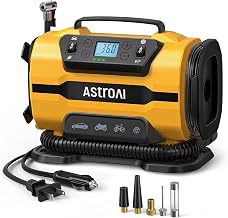
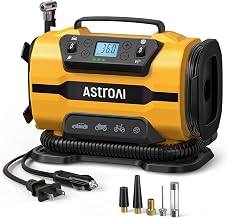
A well-executed 120 PSI unit with auto shutoff and an LED work light, which makes it dependable for roadside use in the dark. The tidy hose routing and squared-off case are what set it apart here, as it stacks cleanly and stays put in a truck bed toolbox.
GSPSCN 12V Dual Cylinder Metal Air Pump
Metal construction and dual cylinders give it a duty cycle that outlasts most plastic-bodied rivals, and the included adapters cover air beds and sports gear alongside tires. The trade-off is weight, so store it low rather than on a high shelf.
Frequently Asked Questions
How much CFM does a truck tire actually need?
For 31 to 33-inch tires, 3 to 5 CFM is workable. Above 33 inches, or if you air down for trails, target 6 CFM or more. Higher airflow also means less heat buildup and fewer forced cool-down breaks.
Are cordless inflators strong enough for trucks?
For pressure top-ups and slow leaks, yes. For refilling a fully deflated 35-inch tire, a 12V corded pump wired to the battery is the more reliable choice.
Where should I store an inflator in a small home?
Keep it in the vehicle if you can, since a truck’s under-seat space or bed box is storage you already own. Indoors, a low shelf near the door beats a deep closet, because accessibility determines whether the tool gets used.
Can these run off a household outlet?
Only dual-power models like the AstroAI 12V/120V unit. Everything else needs a 12V source, either the battery terminals or a high-amperage socket.
Final Thoughts
For most truck owners balancing capability against limited storage, the ALL-TOP 7.06 CFM kit hits the sweet spot, offering real off-road airflow in a case that fits ordinary shelving. Choose the OlarHike cordless model if console-sized convenience matters more than raw speed, and step up to the ALL-TOP 12.35 CFM dual-cylinder kit if you have the space and regularly air down oversized tires.