Key takeaways
- Blade span vs. your footprint: A 20-inch fan suits balconies, single-person tents, and porches under roughly 60 square feet. Step up to 21 inches for a covered deck seating two or three. The 31.5-inch class is built for larger gazebos and open canopies where air has room to spread — in a compact space it just creates turbulence.
- Battery capacity against real runtime: Treat mAh as a rough hours-per-charge signal. A 20,000mAh cell typically covers an evening on medium; 40,000mAh handles a full camping weekend or several patio sessions before recharging. Match capacity to your access to outlets, not to the biggest number on the box.
- Solar as a supplement, not a substitute: Models with included panels extend runtime meaningfully in direct sun, which matters for sheds, chicken coops, and anywhere you’d rather not carry a fan indoors nightly. Under a shade canopy, expect the panel to trickle-charge at best.
- Hanging hardware and clearance: Check whether an extension hook ships in the box. Low porch ceilings and tent ridgelines need different drops, and an included extension saves you a hardware-store trip. Confirm the hook point can carry the fan’s weight before you commit.
- Light quality if it’s your only fixture: Dimmable output with an adjustable color range (roughly 3000K to 6500K) lets one unit handle task lighting and evening ambiance. In a space with no other overhead fixture, that flexibility is worth more than raw lumens.
What's inside
Renters and small-home dwellers run into the same wall every summer: the balcony, the sunroom, the screened porch, the pop-up gazebo — none of them have a ceiling junction box, and none of them are worth calling an electrician over. Running an extension cord across a 40-square-foot patio defeats the purpose of the space, and a floor fan eats the only square footage you had. Overhead air is the answer, but conventional overhead air requires wiring you don’t have and can’t add.
Battery-powered ceiling fans solve this by moving the entire mechanism — motor, LED panel, power source — into a single unit that hangs from a hook. In tight spaces, that vertical relocation is the whole point: you reclaim the floor and get airflow where it actually circulates. This guide covers six models worth considering in 2026, what the specs mean in practice, and how to pick the one that fits your ceiling height, your square footage, and how long you actually need it to run.
As an Amazon Associate we earn from qualifying purchases.



How to Choose a Battery Powered Ceiling Fan No Wiring (2026)
- Blade span vs. your footprint: A 20-inch fan suits balconies, single-person tents, and porches under roughly 60 square feet. Step up to 21 inches for a covered deck seating two or three. The 31.5-inch class is built for larger gazebos and open canopies where air has room to spread — in a compact space it just creates turbulence.
- Battery capacity against real runtime: Treat mAh as a rough hours-per-charge signal. A 20,000mAh cell typically covers an evening on medium; 40,000mAh handles a full camping weekend or several patio sessions before recharging. Match capacity to your access to outlets, not to the biggest number on the box.
- Solar as a supplement, not a substitute: Models with included panels extend runtime meaningfully in direct sun, which matters for sheds, chicken coops, and anywhere you’d rather not carry a fan indoors nightly. Under a shade canopy, expect the panel to trickle-charge at best.
- Hanging hardware and clearance: Check whether an extension hook ships in the box. Low porch ceilings and tent ridgelines need different drops, and an included extension saves you a hardware-store trip. Confirm the hook point can carry the fan’s weight before you commit.
- Light quality if it’s your only fixture: Dimmable output with an adjustable color range (roughly 3000K to 6500K) lets one unit handle task lighting and evening ambiance. In a space with no other overhead fixture, that flexibility is worth more than raw lumens.
The Best Battery Powered Ceiling Fan No Wiring (2026)s Reviewed
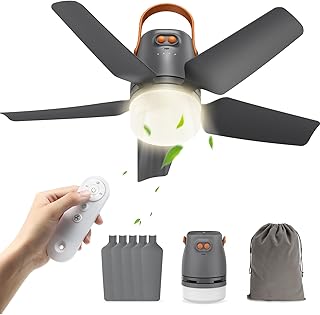
20″ Portable Outdoor Ceiling Fan with Light & Remote (20000mAh)
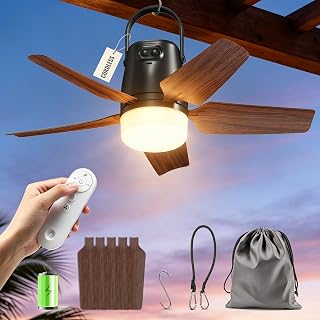
The most broadly useful pick for compact outdoor spaces — the 20-inch span moves air across a small patio or gazebo without overwhelming it, and the farmhouse styling reads more like a fixture than a gadget. Umbrella and canopy mounting make it easy to move between a balcony and a campsite.
21″ Portable Ceiling Fan with Light & Remote (20400mAh)
A modest bump in blade span that translates to noticeably better coverage on a mid-sized deck, with the same portability profile. The integrated hanging design and remote make it a sensible default for anyone splitting use between home and travel.
Gazebo Outdoor Ceiling Fan Light 31.5″ (40000mAh)
Built for scale: four wind speeds, double the battery capacity of the 20-inch class, and a 3000K–6500K dimmable range that lets it serve as the sole light source in a large canopy or pop-up tent. Overkill for a balcony, exactly right for a full-size gazebo.
Canopy Fan 20″ with Extension Hook (20000mAh)
The extension hook is the differentiator here — it solves the low-ceiling and awkward-ridgeline problem that trips up other models. Straightforward controls make it a good choice if you want something a guest or family member can operate without instruction.
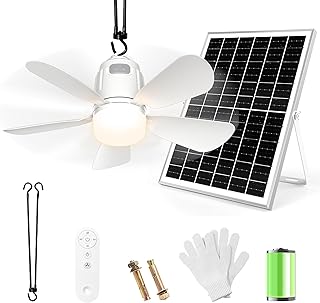
Gliztech Solar Ceiling Fan Light (20000mAh, 30W Solar)
The 30W panel makes this the strongest option for locations you’d rather not service manually — sheds, coops, detached porches. In consistent sun it functions close to a permanent installation without a single wire run.
Frequently Asked Questions
How long will one of these run per charge?
Expect roughly 6 to 10 hours on a 20,000mAh model at medium speed with the light off, and considerably less at maximum speed with full brightness. The 40,000mAh units roughly double that. Running the LED continuously is usually the bigger drain.
Can I hang one on a low porch ceiling?
Yes, provided you have a rated hook or joist anchor. Keep blades at least seven feet from the floor where people walk. Models shipping with an extension hook give you more control over the final drop.
Are they safe to leave outdoors?
These are designed for covered outdoor use — patios, gazebos, screened porches. They are not weatherproof. Bring the unit in ahead of rain, and store it indoors over winter to protect the battery.
Do the solar panels replace charging?
Only in strong, direct sunlight. Treat solar as runtime extension rather than a full replacement for USB charging, especially if the fan hangs under shade.
Final Thoughts
For most balconies, small patios, and screened porches, the 20-inch 20000mAh fan hits the right balance of coverage, weight, and price. If your space is larger or you need a single unit to handle both air and light in a gazebo or tent, the 31.5-inch 40000mAh model earns the upgrade. And for permanent-feeling placement in a shed or detached porch, the Gliztech solar option gets closest to a wired install without touching a wire.