Key takeaways
- Hammer mode vs. SDS: A hammer drill/driver handles anchor holes up to about 1/2″ in block and brick and still drives screws. An SDS rotary hammer hits far harder and eats poured concrete for breakfast, but it won’t replace your driver. Pick based on whether concrete is occasional or constant.
- Impact rate (BPM/IPM): This number, usually 27,000 to 36,000, tells you how fast the mechanism strikes. Higher rates clear dense aggregate more smoothly, which matters most when you hit rebar-adjacent hard spots mid-hole.
- All-metal keyless chuck: Masonry bits shed dust and vibrate hard. A metal chuck body holds concentricity over time; plastic-shelled chucks develop slip and start walking your bits off-center.
- Battery strategy: Bare tools cost dramatically less if you already own a 20V platform. If you don’t, buy the kit — a two-battery kit means you finish the shelf install in one session instead of waiting on a charger.
- Size and weight in tight quarters: Measure the space you’ll actually work in. Drilling behind a toilet, inside a closet, or above a stair landing rewards a compact head length far more than another 100 in-lbs of torque.
What's inside
In a small apartment, the wall is the only real estate you have left. Floating shelves above the sofa, a wall-mounted desk, a pegboard over the washer, a bed frame that anchors instead of taking up floor space — every one of those upgrades stops dead the moment your drill bit meets a concrete or cinder block wall. And in condos, converted lofts, garden-level units, and anything built after the 1950s, that is exactly what sits behind the paint. A standard drill/driver will polish a shiny gray circle into the surface and burn out trying.
What you need is percussion: a hammer function that chips the masonry while the bit rotates, so the hole advances instead of glazing over. This guide covers six cordless hammer drills worth considering in 2026, with an eye toward the kind of work small-space dwellers actually do — a dozen anchor holes for a shelving run, not a day of demolition. I’ve broken down what specs matter for masonry, which tools earn their footprint in a closet-sized toolbox, and where you can save money without regretting it on hole number three.
As an Amazon Associate we earn from qualifying purchases.



How to Choose a Cordless Hammer Drill For Concrete (2026)
- Hammer mode vs. SDS: A hammer drill/driver handles anchor holes up to about 1/2″ in block and brick and still drives screws. An SDS rotary hammer hits far harder and eats poured concrete for breakfast, but it won’t replace your driver. Pick based on whether concrete is occasional or constant.
- Impact rate (BPM/IPM): This number, usually 27,000 to 36,000, tells you how fast the mechanism strikes. Higher rates clear dense aggregate more smoothly, which matters most when you hit rebar-adjacent hard spots mid-hole.
- All-metal keyless chuck: Masonry bits shed dust and vibrate hard. A metal chuck body holds concentricity over time; plastic-shelled chucks develop slip and start walking your bits off-center.
- Battery strategy: Bare tools cost dramatically less if you already own a 20V platform. If you don’t, buy the kit — a two-battery kit means you finish the shelf install in one session instead of waiting on a charger.
- Size and weight in tight quarters: Measure the space you’ll actually work in. Drilling behind a toilet, inside a closet, or above a stair landing rewards a compact head length far more than another 100 in-lbs of torque.
The Best Cordless Hammer Drill For Concrete (2026)s Reviewed
DEWALT 20V MAX SDS Rotary Hammer (DCH273B)
This is the tool for anyone facing poured concrete, structural columns, or a long run of wedge anchors, and its three modes let you switch to rotation-only when you’re through the hard stuff. Note it’s sold bare, so it makes sense only if you’re already invested in DEWALT 20V batteries.
DCK 20V Brushless Hammer Drill (KDJZ05-13)
At 36,000 BPM and 531 in-lbs, this is the most aggressive percussion figure in the group short of going full SDS, and the 4.0Ah battery keeps you drilling through a full afternoon of bracket installs. The 22+1+1 clutch also makes it genuinely usable as an everyday driver for flat-pack assembly.
CRAFTSMAN V20 Hammer Drill Kit (CMCD711C2)
The safest first hammer drill for a renter or new homeowner: two batteries, a charger, a 1/2″ chuck, and a parts-and-service network you can walk into. It won’t out-hit the brushless entries, but for anchor holes in brick and block it does the job without drama.
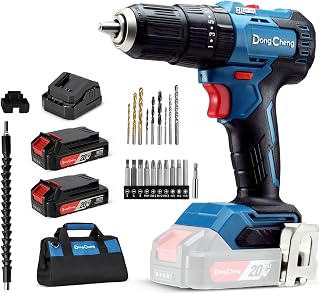
Dong Cheng 20V Brushless Impact Drill
A well-balanced brushless option with 443 in-lbs, 27,000 IPM, and a two-battery kit at a friendlier price than the name brands. The metal keyless chuck is the detail that convinces me here — it’s the part budget drills usually cheap out on.
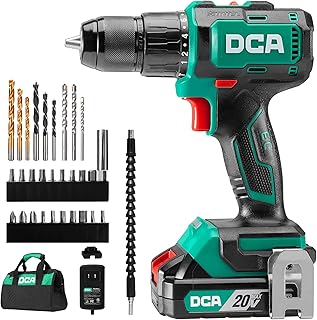
DCA 20V Brushless Hammer Drill (ADJZ2055i)
The compact pick. Its short body slides into cabinet interiors and stud bays where a full-size drill simply won’t rotate, and 492 in-lbs is plenty for tapcons and sleeve anchors. The 2.0Ah battery keeps weight down, though you’ll want a spare for bigger projects.
Frequently Asked Questions
Do I really need a hammer drill for concrete, or can I use a regular drill?
For a few small holes in soft brick or mortar joints, a good drill with a masonry bit can limp through. For poured concrete, cinder block webbing, or anything more than a couple of holes, you need percussion — otherwise you’re just heating the bit.
What’s the difference between a hammer drill and a rotary hammer?
A hammer drill uses two ridged plates that click against each other, producing many light taps. A rotary hammer uses a piston mechanism for far heavier blows and takes SDS bits. Hammer drills are more versatile; rotary hammers are faster in hard concrete.
Can I buy a bare tool if I already own DEWALT batteries?
Yes, and it’s the smartest money in this category. Besides the DCH273B, there are third-party options like the 968 in-lb brushless hammer drill built for DEWALT 20V MAX packs, which gives you a second drill for the cost of a nice bit set.
Which anchors should I use for shelves on a concrete wall?
Sleeve anchors or concrete screws (Tapcon-style) for most shelf brackets, and wedge anchors for heavy wall-mounted desks or fold-down beds. Match your bit diameter exactly to the anchor spec, and vacuum the hole before setting — dust is the leading cause of anchors that pull loose.
Final Thoughts
If concrete is a recurring part of your projects, the DEWALT DCH273B is the honest answer, provided you already own the batteries. For most small-space renovators drilling brick and block for shelving and wall storage, the DCK KDJZ05-13 gives you the hardest hit and longest runtime in a single kit, while the CRAFTSMAN CMCD711C2 remains the easiest, lowest-risk entry point if this is your first hammer drill.