Key takeaways
- Measure the rail before the room: A 24-inch bar suits a galley run over a sink or a single counter stretch. Anything past 6 feet needs a real ceiling span and usually a second mounting point, so map the rail against your actual joist layout, not the room’s total width.
- Match head count to task zones, not room size: Count the spots you genuinely need lit — prep counter, sink, cooktop, pantry door — and buy that many heads plus one. Extra heads on a short rail crowd together and create hot spots instead of even coverage.
- Check the bulb situation up front: Integrated LED kits install faster and sit slimmer against a low ceiling. E26 or GU10 sockets let you swap warmth and brightness later, which matters if you rent or if the kitchen doubles as a workspace.
- Prioritize head rotation range: Look for heads that pivot vertically and swivel horizontally. In a narrow kitchen you will often need to aim almost sideways at a backsplash or an open shelf, and limited-travel heads simply will not reach.
- Confirm the dimmer and track type: H-type track is the most common standard in the US and the easiest to expand. If you want dimming, verify the kit supports it and that your wall switch is a compatible LED dimmer, since pairing the wrong two produces flicker.
What's inside
In a compact kitchen, lighting does double duty. It has to make the counter usable for actual knife work, and it has to keep the room from feeling like a corridor. The trouble is that most small kitchens were wired for exactly one ceiling box, usually dead center, which throws a single pool of light onto the floor and leaves you chopping in your own shadow. Recessed cans solve it, but they mean cutting drywall and hiring an electrician. Under-cabinet strips help the counter and do nothing for the walkway, the sink, or that awkward pantry corner.
Track lighting is the workaround that people with limited square footage keep coming back to, because it turns one existing junction box into four, six, or twelve aimable light sources. You mount a rail, you point each head where the work actually happens, and you skip the ceiling surgery entirely. This guide covers the kits worth installing in 2026, what to check before you buy, and how to match head count and rail length to a room that does not have space to spare.
As an Amazon Associate we earn from qualifying purchases.



How to Choose a Kitchen Track Lighting (2026)
- Measure the rail before the room: A 24-inch bar suits a galley run over a sink or a single counter stretch. Anything past 6 feet needs a real ceiling span and usually a second mounting point, so map the rail against your actual joist layout, not the room’s total width.
- Match head count to task zones, not room size: Count the spots you genuinely need lit — prep counter, sink, cooktop, pantry door — and buy that many heads plus one. Extra heads on a short rail crowd together and create hot spots instead of even coverage.
- Check the bulb situation up front: Integrated LED kits install faster and sit slimmer against a low ceiling. E26 or GU10 sockets let you swap warmth and brightness later, which matters if you rent or if the kitchen doubles as a workspace.
- Prioritize head rotation range: Look for heads that pivot vertically and swivel horizontally. In a narrow kitchen you will often need to aim almost sideways at a backsplash or an open shelf, and limited-travel heads simply will not reach.
- Confirm the dimmer and track type: H-type track is the most common standard in the US and the easiest to expand. If you want dimming, verify the kit supports it and that your wall switch is a compatible LED dimmer, since pairing the wrong two produces flicker.
The Best Kitchen Track Lighting (2026)s Reviewed
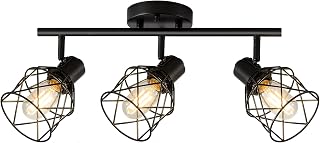
3-Light Farmhouse Kitchen Track Lighting
Three heads on a short bar is the honest answer for a genuinely small kitchen or a breakfast nook, and the standard E26 base means you can dial in a warm 2700K bulb for evening or push cooler for prep work. The farmhouse finish reads as a fixture rather than shop lighting, which helps in open-plan spaces where the kitchen is visible from the sofa.
VANoopee 12-Light Kit with 13FT Rails
This is the kit for an L-shaped or wraparound layout where one rail has to serve two walls, and the 13 feet of track gives you room to spread heads across both legs. CRI90+ and five selectable color temperatures mean you can render food colors accurately at the counter and drop to a softer tone over the eating area on the same circuit.
LED 4-Light Track Kit, 24.8″
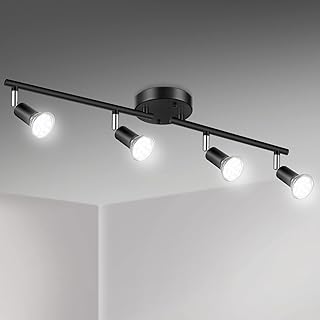
At under 25 inches, this compact bar is the one I recommend when the only available ceiling real estate sits between a soffit and a cabinet run. The included 5000K GU10 bulbs are bright and neutral for task work, and swapping them later costs a few dollars if daylight white feels too clinical.
KEESFU 6-Light Modern Track Lighting
Six rotatable heads in a matte black industrial profile cover a standard kitchen ceiling without demanding a second fixture, and the same bar works well in a laundry alcove or entry where you need directional light in tight quarters. The heads hold their aim once set, which matters more than it sounds when you are adjusting them from a step stool.
AUQUEE 8-Light Track Lighting Fixtures
Eight heads gives you the most granular control on this list, so you can light a peninsula, a sink, and a pantry from a single run. Bulbs are not included, so budget for eight GU10s and pick your wattage and color temperature deliberately rather than accepting whatever ships in the box.
Frequently Asked Questions
Can I install track lighting myself?
If you are replacing an existing ceiling fixture and the box is rated for the weight, most people can handle it with the breaker off and an hour of patience. New wiring, a new junction box, or any doubt about the box rating means calling a licensed electrician.
How many heads do I need for a small kitchen?
Four to six covers most kitchens under 100 square feet. Fewer than four leaves shadow gaps at the corners; more than six on a short rail tends to overlight the center and waste heads.
Will track lighting make a low ceiling feel lower?
A slim, low-profile rail in a finish that matches or blends with the ceiling largely disappears. Aiming a head or two upward at the ceiling or a wall also lifts the perceived height by adding bounced light.
What color temperature works best in a kitchen?
3000K to 4000K is the practical range — warm enough to feel like a home, cool enough to see what you are cooking. Multi-color-temperature kits let you avoid committing.
Final Thoughts
For most compact kitchens, the KEESFU 6-Light hits the balance of coverage, footprint, and price without overthinking it. If your layout wraps a corner, the VANoopee 12-Light with 13-foot rails is the more capable choice, and for the tightest ceiling runs the 24.8-inch LED 4-Light Kit fits where nothing else will.