Key takeaways
- Folded footprint: Measure your actual storage slot before shopping. Rolling stands that collapse to roughly the width of a hand truck can wheel into a gap beside shelving, while fixed-leg stands demand permanent floor real estate you may not have.
- Rip capacity vs. bulk: A 32-inch rip capacity lets you break down plywood for cabinet carcasses without an outfeed helper, but it widens the machine considerably. If you mostly cut hardwood boards under 24 inches, a compact model saves meaningful space.
- Blade size and cut depth: Ten-inch blades handle 3-1/2 inches of material at 90 degrees, enough for stacked stock and thick legs. An 8-1/4-inch saw trims weight and size but limits you on anything beyond nominal two-by lumber.
- Dust management: Indoor and garage work means fine dust settles on everything you own. Look for a shrouded blade area and a standard 2-1/2-inch port that mates with a shop vac, and plan to connect it every single time.
- Setup and teardown time: Count the steps honestly. A saw that deploys with one foot pedal and a tug gets used on weeknights; one requiring bolts and leveling gets used twice a year.
What's inside
Most DIY furniture builders don’t have a dedicated shop. They have a corner of the garage that also holds bikes, a car that needs to fit back in by evening, or a basement with a low ceiling and one usable outlet. That reality shapes the table saw decision far more than horsepower specs do. A saw that cuts beautifully but can’t be moved, tucked away, or set up in under five minutes ends up unused, and an unused saw is worse than no saw at all because it’s occupying floor space you can’t spare.
This guide approaches table saws from a footprint-first perspective. I’ve evaluated six popular jobsite and portable models on how they behave in tight quarters: stand design and folded dimensions, rip capacity relative to overall bulk, dust control in enclosed rooms, and how quickly they transition between stored and ready. Below you’ll find the picks, a practical buying checklist, honest reviews of the top five, and answers to the questions that come up most often from people building furniture in shared spaces.
As an Amazon Associate we earn from qualifying purchases.



How to Choose a Table Saw For Diyer (2026)
- Folded footprint: Measure your actual storage slot before shopping. Rolling stands that collapse to roughly the width of a hand truck can wheel into a gap beside shelving, while fixed-leg stands demand permanent floor real estate you may not have.
- Rip capacity vs. bulk: A 32-inch rip capacity lets you break down plywood for cabinet carcasses without an outfeed helper, but it widens the machine considerably. If you mostly cut hardwood boards under 24 inches, a compact model saves meaningful space.
- Blade size and cut depth: Ten-inch blades handle 3-1/2 inches of material at 90 degrees, enough for stacked stock and thick legs. An 8-1/4-inch saw trims weight and size but limits you on anything beyond nominal two-by lumber.
- Dust management: Indoor and garage work means fine dust settles on everything you own. Look for a shrouded blade area and a standard 2-1/2-inch port that mates with a shop vac, and plan to connect it every single time.
- Setup and teardown time: Count the steps honestly. A saw that deploys with one foot pedal and a tug gets used on weeknights; one requiring bolts and leveling gets used twice a year.
The Best Table Saw For Diyer (2026)s Reviewed
DEWALT DWE7491RS 10-Inch with Rolling Stand
This is the benchmark for anyone building furniture in a garage bay, pairing a 32-1/2-inch rip capacity with a rolling stand that folds vertically and parks against a wall. The rack-and-pinion fence stays square through repeated adjustments, which matters when you’re cutting matching cabinet parts across multiple sessions.
SKIL TS6307-00 15 Amp Portable Jobsite Saw
SKIL’s folding-stand model undercuts the DEWALT on price while offering a genuinely useful feature for cramped spaces: a rack-and-pinion fence and an integrated dust port that pulls cleanly with a shop vac. The stand folds flat enough to slide behind a workbench, and the whole assembly is manageable for one person to reposition.
DEWALT DWE7485 8-1/4-Inch Compact Saw
At roughly 54 pounds, this is the saw for apartment dwellers, basement shops, and anyone who stores tools on a shelf rather than the floor. You give up cut depth and some rip width, but for building tables, shelves, and casework from dimensional lumber it handles the work without dominating the room.
SKIL SPT99-11 Worm Drive Table Saw
The worm-drive gearing delivers noticeably more torque through dense hardwoods and thick stock, making it the strongest cutter here for serious furniture work. It’s the heaviest and least portable option, so choose it only if you have a semi-permanent spot to leave it standing.
10-Inch 5000 RPM Saw with 36 x 25-Inch Tabletop
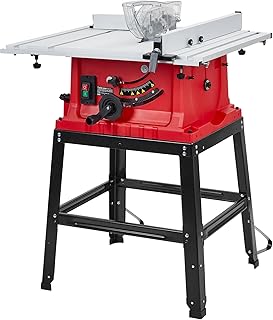
The oversized tabletop provides real support for wide panels without an auxiliary table, and the included protective cover is a thoughtful touch for dusty storage areas. Fit and finish trail the name brands, so budget time for initial fence and blade alignment before your first project cut.
Frequently Asked Questions
Can I use a table saw in a small garage?
Yes, provided you plan for infeed and outfeed clearance rather than just the machine footprint. Position the saw so long cuts run toward the open garage door, and use a rolling stand so you can angle it as needed.
Is a 10-inch saw necessary for furniture building?
Not always, but it helps. Ten-inch blades cut deep enough for thick table legs and stacked joinery, while 8-1/4-inch saws cover most sheet goods and standard lumber at a real savings in weight and storage volume.
How do I control dust indoors?
Connect a shop vac to the dust port every time and add a small collection bag or box beneath the saw for what escapes. A cheap box fan with a furnace filter taped to it handles the airborne fines that settle on finished work.
Do I need a cabinet saw eventually?
Most DIY furniture builders never do. A well-tuned jobsite saw with a quality blade and a good crosscut sled produces furniture-grade joinery; the upgrade path is usually better blades and jigs, not a bigger machine.
Final Thoughts
For most DIYers building furniture in shared or limited space, the DEWALT DWE7491RS is the best overall balance of capacity, accuracy, and genuinely compact storage, with the SKIL TS6307-00 delivering nearly the same practicality for less money. If your storage slot is a shelf rather than a wall, the compact DEWALT DWE7485 is the honest choice, and the SKIL SPT99-11 rewards anyone with room to leave a torque-heavy saw standing ready.