Key takeaways
- Measure the tuck, not the chair: The number that matters is seat height versus your table apron. Most tables clear 28–29 inches underneath; a 17–18 inch seat height with no arms will slide fully under, reclaiming a foot of floor per chair.
- Stackability over style: If you host occasionally but live small daily, a chair that stacks four-high in a closet corner beats a chair that looks better but lives permanently in your walkway. ADDE and similar molded-seat designs are built for this.
- Weight matters more than you think: A chair you move often should be under 10 pounds. Heavy hardwood frames feel reassuring in a showroom and become a chore when you’re rearranging for guests or vacuuming.
- Upholstery vs. wipeability: Fabric seats add real comfort for long dinners and double duty as desk chairs, but in a kitchen-adjacent dining nook, consider whether you’ll actually spot-clean them. Beige fabric shows what beige fabric shows.
- Foot protection is not optional: Small rooms mean chairs drag across the same six square feet repeatedly. Check for included floor glides or budget for felt pads immediately — this is what separates a rental deposit returned from one withheld.
What's inside
Dining chairs are the piece of furniture people underestimate most. In a compact apartment, four chairs can eat more visual and physical space than the table they surround — and once you factor in a chair that needs 18 inches of clearance behind it to slide out, a 400-square-foot studio starts feeling like a puzzle with a missing piece. The temptation is to buy whatever matches the table, then live with the consequences: bulky frames that block a walkway, seats too wide to tuck under an apron, or stackable chairs that wobble the moment someone leans back.
This guide approaches IKEA-style dining seating from a small-space perspective: what actually tucks in, what stacks, what survives being moved twice a week, and what earns its footprint. I’ve included genuine IKEA classics alongside a few comparable upholstered sets worth considering when you want more comfort than a bare wood shell provides. Each pick is evaluated on footprint, stackability, and how it behaves in a room that’s doing three jobs at once.
As an Amazon Associate we earn from qualifying purchases.




How to Choose a Ikea Dining Chairs (2026)
- Measure the tuck, not the chair: The number that matters is seat height versus your table apron. Most tables clear 28–29 inches underneath; a 17–18 inch seat height with no arms will slide fully under, reclaiming a foot of floor per chair.
- Stackability over style: If you host occasionally but live small daily, a chair that stacks four-high in a closet corner beats a chair that looks better but lives permanently in your walkway. ADDE and similar molded-seat designs are built for this.
- Weight matters more than you think: A chair you move often should be under 10 pounds. Heavy hardwood frames feel reassuring in a showroom and become a chore when you’re rearranging for guests or vacuuming.
- Upholstery vs. wipeability: Fabric seats add real comfort for long dinners and double duty as desk chairs, but in a kitchen-adjacent dining nook, consider whether you’ll actually spot-clean them. Beige fabric shows what beige fabric shows.
- Foot protection is not optional: Small rooms mean chairs drag across the same six square feet repeatedly. Check for included floor glides or budget for felt pads immediately — this is what separates a rental deposit returned from one withheld.
The Best Ikea Dining Chairs (2026)s Reviewed
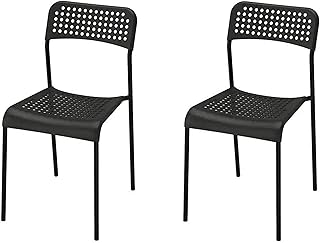
IKEA ADDE Chair, Black (Pack of 2)
The ADDE remains the reference point for small-space dining seating: roughly seven pounds, fully stackable, and narrow enough that four fit around a 30-inch round table without touching. It’s firm rather than plush, so pair it with a seat cushion if dinners run long, but nothing else in this price range disappears as efficiently.
IKEA ADDE Chair (Pack of 2, White)
Functionally identical to the black version, with one practical advantage in tight quarters: white reads lighter and visually recedes against pale walls, which keeps a small dining area from feeling crowded by four dark silhouettes. The tradeoff is that scuffs on the frame show sooner.
IKEA Ingolf Chair, White
Ingolf is the choice when you want warmth rather than minimalism — solid pine, a gently shaped seat, and a spindle back that suits farmhouse and Scandinavian setups equally. It doesn’t stack and it’s noticeably heavier than ADDE, so treat it as a permanent resident rather than flexible seating.
CHUN YI Upholstered Dining Chairs, Set of 4
The curved backrest here does real work: it supports the lumbar region well enough that these function as occasional desk chairs, which is genuinely useful when your dining table is also your office. The wooden legs and compact profile keep them from feeling bulky despite the padding.
COLAMY Wooden Dining Chairs, Set of 4
COLAMY splits the difference between comfort and structure — a padded seat over a solid frame with foot pegs that add lateral stability, which matters on uneven apartment flooring. The seat depth is generous, so measure your table clearance before committing.
Frequently Asked Questions
Will IKEA dining chairs fit a non-IKEA table?
Usually, yes. IKEA seat heights cluster around 17–18 inches, which pairs correctly with standard 29–30 inch dining tables from any manufacturer. The variable to check is apron depth, since some non-IKEA tables have thicker underframes that reduce tuck-in clearance.
How many chairs actually fit a small dining table?
Allow 22–24 inches of table edge per person. A 36-inch round table seats three comfortably and four tightly; a 48-inch round handles four with room to move. Armless chairs let you push these numbers slightly.
Are stackable chairs sturdy enough for daily use?
Modern stackable designs handle typical daily loads fine, but they’re engineered for vertical stability rather than leaning back. If someone in your household habitually tips their chair, choose a four-leg wooden frame instead.
Do upholstered dining chairs work in small apartments?
They can, with one caveat: padding adds two to four inches of depth per chair, which compounds across four seats. If your clearance behind the table is under 30 inches, prioritize a slim profile over cushioning.
Final Thoughts
For genuinely tight spaces, the IKEA ADDE remains hard to beat — light, stackable, and priced so that buying four doesn’t sting. If you want warmth and permanence in a small dining nook, the Ingolf delivers solid-wood character without excessive bulk, and the CHUN YI set is the pick when your dining chairs need to double as workspace seating for hours at a time.