Key takeaways
- Measure tank height before anything else: Run a tape from the floor to the highest point of your tank lid, then add two inches of lift clearance so you can actually remove the lid for repairs. Most cabinets advertise 33 to 34 inches of opening — comfortable for standard tanks, tight for taller comfort-height or dual-flush models.
- Check the flush lever and supply line: Side-mounted handles and angled shut-off valves are what actually kill installations. Confirm the cabinet’s interior opening is wider than your toilet’s widest point, including the tank’s side profile, not just the bowl.
- Insist on FSC-certified MDF or solid wood: MDF with a properly sealed laminate handles bathroom humidity better than cheap particleboard, which absorbs moisture at the edges and delaminates. FSC certification also signals a manufacturer paying attention to material sourcing generally.
- Treat the anti-tip bracket as mandatory: These units are tall, narrow, and top-heavy once loaded. Every cabinet here ships with a wall anchor — use it, and locate a stud or use a proper drywall toggle rather than the plastic plug in the box.
- Balance closed and open storage: Doors hide medications and cleaning products; open shelves keep folded towels and decor visible and reachable. A hybrid layout gives you both without forcing the whole unit into one mode.
What's inside
The wall above your toilet is the most reliably wasted square footage in an American bathroom. In a 40-square-foot half bath or a rental with one shallow vanity drawer, that vertical column between the tank lid and the ceiling represents roughly six cubic feet of storage that most people leave completely empty — while stacking backup toilet paper on the floor and keeping cleaning supplies under the kitchen sink two rooms away.
Over-the-toilet cabinets solve this, but the category is crowded with units that ignore the actual constraints of the space: tanks that are taller than advertised clearances, flush handles that collide with side panels, and particleboard that swells within a year of steam exposure. This guide covers the six units worth your money in 2026, what separates a cabinet that lasts from one that sags, and how to measure your bathroom before you commit.
As an Amazon Associate we earn from qualifying purchases at no extra cost to you. Product prices and availability are accurate as of the date shown and are subject to change.


🛒 Best Price Today on Amazon
Prime members get fast, free shipping on everything above, plus member-only deals. New members get a 30-day free trial — cancel anytime.
How to Choose an Over The Toilet Storage Cabinet (2026)
- Measure tank height before anything else: Run a tape from the floor to the highest point of your tank lid, then add two inches of lift clearance so you can actually remove the lid for repairs. Most cabinets advertise 33 to 34 inches of opening — comfortable for standard tanks, tight for taller comfort-height or dual-flush models.
- Check the flush lever and supply line: Side-mounted handles and angled shut-off valves are what actually kill installations. Confirm the cabinet’s interior opening is wider than your toilet’s widest point, including the tank’s side profile, not just the bowl.
- Insist on FSC-certified MDF or solid wood: MDF with a properly sealed laminate handles bathroom humidity better than cheap particleboard, which absorbs moisture at the edges and delaminates. FSC certification also signals a manufacturer paying attention to material sourcing generally.
- Treat the anti-tip bracket as mandatory: These units are tall, narrow, and top-heavy once loaded. Every cabinet here ships with a wall anchor — use it, and locate a stud or use a proper drywall toggle rather than the plastic plug in the box.
- Balance closed and open storage: Doors hide medications and cleaning products; open shelves keep folded towels and decor visible and reachable. A hybrid layout gives you both without forcing the whole unit into one mode.
The Best Over The Toilet Storage Cabinet (2026)s Reviewed
Spirich Over The Toilet Storage Cabinet with Doors
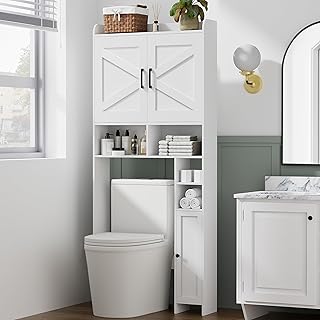
The adjustable crossbar is the detail that earns this one its place — it lets you tune the frame to your toilet’s footprint rather than hoping the fixed dimensions cooperate. Beadboard doors, FSC-certified MDF construction, and 33.3 inches of tank clearance make it the safest default recommendation for a standard-height toilet in a traditional or transitional bathroom.
UTEX Over The Toilet Storage Cabinet
UTEX gives you the most usable clearance in this group at 34 inches, which buys real margin if you have a comfort-height toilet or a thick decorative lid. The mix of enclosed cabinet space and open shelving is well proportioned, and the shelves adjust to accommodate tall bottles rather than forcing you to lay them down.
Spurgehom Over Toilet Arch Cabinet
The arched profile softens what is otherwise a very boxy category, and the wood construction reads warmer than painted MDF in a bathroom with natural light. Freestanding with an anti-tipping kit included, it’s the pick when you want the storage to look intentional rather than utilitarian.
Extra Tall Cabinet with 4 Open Shelves and 2 Barn Doors
This is the maximum-capacity option — four open shelves above a barn-door cabinet means you can consolidate towels, backup paper, and cleaning supplies into a single footprint. The extra height demands a ceiling of at least eight feet and a genuinely secure wall anchor, but no other unit here holds as much.
IFGET Arched Cabinet with Acrylic Doors
Fluted acrylic doors over natural oak give this cabinet a designer look that costs considerably more in a showroom, and the translucent panels keep a small bathroom from feeling walled off. Storage volume is modest, so treat it as a styling piece with useful capacity rather than a bulk-storage solution.
Frequently Asked Questions
Do I have to anchor it to the wall?
Yes. A loaded cabinet at this height and depth has a genuinely dangerous tipping moment, particularly around children. Anchoring takes ten minutes and is the single most important step in the installation.
Will it fit a comfort-height toilet?
Often, but verify. Measure your tank lid height and compare it to the stated clearance — the UTEX at 34 inches and the taller open-shelf units give you the most room to work with.
Can these go in a rental?
Generally yes. Freestanding designs need only a small anchor screw, which patches with a dab of spackle at move-out. Check your lease for language about wall penetrations.
How long does assembly take?
Plan on 45 to 90 minutes with a screwdriver and a level. Assemble the unit outside the bathroom, then walk it into position over the toilet.
Final Thoughts
For most bathrooms, the Spirich cabinet is the smart default — the adjustable crossbar handles fixture variation better than fixed-frame competitors, and the build quality justifies the price. Choose the UTEX if your toilet runs tall and you need every inch of that 34-inch clearance, or the IFGET arched cabinet with acrylic doors if the unit needs to look like a design decision rather than a storage compromise.