Key takeaways
- Folded footprint first: Measure your storage slot before you shop. A rolling stand that collapses to roughly the depth of a bicycle can tuck behind a car or beside shelving; a fixed-leg saw claims that floor space permanently.
- Rip capacity per inch: Sheet goods drive this number. A 32-inch rip capacity lets you break down a plywood panel down the middle without a helper, and the best designs achieve it with a sliding table that retracts when idle.
- One-person mobility: Look for large wheels, a single-lever fold, and a balanced lift point. If you have to wrestle the saw out of storage, you’ll stop using it — the fastest way to abandon a project.
- Dust containment: In a shared or enclosed space, a shrouded blade and a 2-1/2-inch dust port connected to a shop vac matters more than raw horsepower. It’s the difference between sawing indoors and not.
- Setup repeatability: A saw you store is a saw you re-deploy constantly. Rack-and-pinion fences, positive bevel stops, and a flat cast tabletop mean your fence lands square every time without recalibration.
What's inside
Anyone building furniture in a one-car garage, a balcony, or a corner of a spare bedroom knows the real constraint isn’t skill or budget — it’s square footage. A table saw is the one tool that makes clean, repeatable furniture joinery possible, and it’s also the tool most likely to swallow your floor plan. Full-size cabinet saws are non-negotiable space hogs. What small-space woodworkers actually need is a saw that cuts like a serious machine and then disappears against a wall when the sawdust settles.
This guide looks at 2026’s best table saw deals through a storage-first lens: how compact the saw folds, how easily one person can move it, how much rip capacity you get per inch of footprint, and how well it contains dust in a room you also live in. Every pick below is a portable or jobsite-class saw, which means it’s designed to be stowed — not parked permanently in the middle of your shop.
As an Amazon Associate we earn from qualifying purchases.



How to Choose a Table Saw for a Small Space (2026)
- Folded footprint first: Measure your storage slot before you shop. A rolling stand that collapses to roughly the depth of a bicycle can tuck behind a car or beside shelving; a fixed-leg saw claims that floor space permanently.
- Rip capacity per inch: Sheet goods drive this number. A 32-inch rip capacity lets you break down a plywood panel down the middle without a helper, and the best designs achieve it with a sliding table that retracts when idle.
- One-person mobility: Look for large wheels, a single-lever fold, and a balanced lift point. If you have to wrestle the saw out of storage, you’ll stop using it — the fastest way to abandon a project.
- Dust containment: In a shared or enclosed space, a shrouded blade and a 2-1/2-inch dust port connected to a shop vac matters more than raw horsepower. It’s the difference between sawing indoors and not.
- Setup repeatability: A saw you store is a saw you re-deploy constantly. Rack-and-pinion fences, positive bevel stops, and a flat cast tabletop mean your fence lands square every time without recalibration.
The Best Table Saw Deals (2026), Reviewed
DEWALT DWE7491RS 10-Inch with Rolling Stand
This is the benchmark for cramped shops: 32-1/2 inches of rip capacity from a saw that folds onto a wheeled stand and rolls into a closet-width gap. The rack-and-pinion fence is precise enough for cabinet doors and drawer boxes, which is why it stays the default recommendation for furniture builders without a dedicated shop.
SKIL TS6307-00 10-Inch Portable Jobsite Saw
SKIL’s folding-stand model delivers 10-inch capability at a friendlier price, and the integrated stand collapses flat rather than pivoting into an awkward footprint. The rack-and-pinion fence and generous dust port make it a strong first serious saw for someone graduating from a circular saw and a straightedge.
DEWALT DWE7485 8-1/4-Inch Compact
The compact DEWALT is the pick when storage is measured in inches, not feet — it’s light enough to lift onto a bench with one hand and store vertically on a shelf. The smaller blade limits you to about 2-1/2 inches of cut depth, which covers virtually all furniture stock but rules out thick slab work.
DOVAMAN DTS10A 10-Inch with Stand
A copper-motor 10-inch saw with a one-side extendable table, the DTS10A gives you 3.35 inches of cut at 90 degrees and expands only when a wide panel demands it. It’s a sensible value play for hobbyists who want full-depth crosscuts without committing full-time floor space.
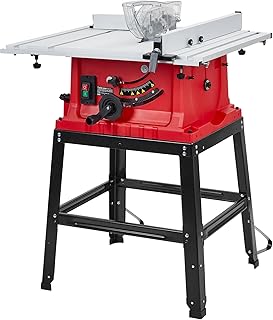
10-Inch 5000 RPM Saw with Stand and Protective Cover
The 36 x 25-inch tabletop is unusually generous for this price tier, giving you real support under a workpiece instead of a cramped island. The included protective cover is a genuine small-space feature — it keeps dust off the arbor while the saw sits in a garage or utility room between projects.
Frequently Asked Questions
Can I use a table saw indoors in an apartment?
With caveats. Connect the dust port to a shop vac with a fine filter, work over a drop cloth, and check your lease and noise hours. Many apartment woodworkers do rough cuts outdoors and reserve the saw for joinery.
Is an 8-1/4-inch blade enough for furniture?
Usually, yes. Most furniture uses stock under 1-1/2 inches thick, well within an 8-1/4-inch saw’s range. You’ll only feel the limit ripping thick hardwood or beveling deep material.
Do I need a rolling stand or is a folding stand fine?
If the saw lives more than a few feet from where you work, wheels win. Folding stands store slimmer but require lifting the whole assembly each time.
How much clearance do I actually need to rip plywood?
Plan for roughly eight feet of infeed and outfeed along the blade line. A driveway, an open garage door, or a hallway can supply that temporarily even if the saw stores in a closet.
Final Thoughts
If you want one saw that handles real furniture work and still surrenders your floor space, the DEWALT DWE7491RS is the strongest all-around choice in 2026. Tighter storage points to the DEWALT DWE7485 compact, while the SKIL TS6307-00 hits the best balance of 10-inch capacity, fence quality, and price for a first serious saw.