Key takeaways
- Unplug the unit, empty the ice bin, and drain the reservoir completely using the drain plug on the base.
- Refill the reservoir with cold water to the fill line, then add your cleaner per the label — typically one tablet or 4 oz of liquid.
- Plug in and run the self-clean cycle. No self-clean button? Run one full ice-making cycle, then discard the ice.
- Drain the solution, refill with fresh water, and run two rinse cycles. Discard all ice from both.
- Wipe the bin, lid, and door gasket with a damp cloth, then leave the lid open for an hour to dry.
What's inside
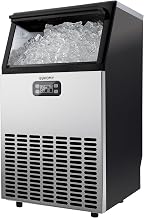
An ice maker is one of the few appliances that runs a full water cycle through itself every day and then hands the result straight to your mouth. In a compact kitchen, that machine is often wedged between the toaster and the coffee grinder, pulling tap water through a pump, over an evaporator plate, and into a bin that sits at room temperature with the lid closed. Mineral scale builds on the cold surfaces, biofilm forms in the reservoir, and within a few months the cubes start tasting faintly like the inside of a garden hose. Slower harvest cycles, cloudy cubes, and clumping are all the same message: the water path needs attention.
Below is a practical cleaning method that works for countertop, nugget, undercounter, and refrigerator-integrated units, plus what actually matters when you choose a cleaner. You’ll learn why nickel-safe formulas are non-negotiable, how to run a descale cycle without flooding your counter, how to handle the parts a descaler can’t reach, and how often to repeat the whole thing based on your water. If you’ve been cleaning with vinegar and wondering why the scale keeps coming back, this will explain that too.
As an Amazon Associate we earn from qualifying purchases.




Use a Nickel-Safe Descaler, Not a Household Acid
The evaporator plate inside most ice makers is nickel-plated, and standard citric or phosphoric acid cleaners will strip that plating over repeated use. Once it’s compromised, cubes stick, harvest cycles lengthen, and the plate corrodes. Purpose-built products state “nickel safe” on the label because they’re buffered for exactly this surface. The Affresh Ice Machine Cleaner is the widely available liquid option and targets hard water and mineral deposits specifically. For higher-volume or commercial-adjacent machines, the Nickel Safe 1 gal Ice Maker & Machine Cleaner is food-grade, USDA-authorized, and meets Manitowoc spec GES-6, which is the benchmark most manufacturers reference in their own service documentation. Vinegar is too weak on scale and too aggressive on plating to be a reasonable substitute.
Tablets vs. Liquid: A Storage Question as Much as a Cleaning One
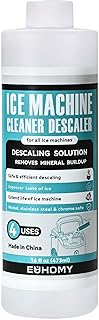
Both formats work. The difference matters most if your storage is tight. A gallon jug needs shelf depth and a stable footing; a blister pack of tablets slides into a drawer organizer next to your dishwasher pods. The ACTIVE Ice Machine Cleaner Descaler tablets cover Frigidaire, Opal, GE Profile, and KitchenAid units and give you roughly a year of monthly cleanings in a package the size of a paperback. The 36-pack Ice Machine Cleaner Descaler Tablets stretch that further if you own two machines or clean quarterly across a household. Tablets also remove the guesswork of measuring, which is genuinely useful when you’re cleaning at arm’s length over a sink. If you’d rather dose liquid, the EUHOMY Ice Machine Cleaner Descaler gives four uses per 16 oz bottle and doubles as a descaler for single-serve coffee machines, so one bottle covers two appliances and one shelf slot.
The Cleaning Cycle, Step by Step
- Unplug the unit, empty the ice bin, and drain the reservoir completely using the drain plug on the base.
- Refill the reservoir with cold water to the fill line, then add your cleaner per the label — typically one tablet or 4 oz of liquid.
- Plug in and run the self-clean cycle. No self-clean button? Run one full ice-making cycle, then discard the ice.
- Drain the solution, refill with fresh water, and run two rinse cycles. Discard all ice from both.
- Wipe the bin, lid, and door gasket with a damp cloth, then leave the lid open for an hour to dry.
Handle the Bin and Gasket Separately
A descaler circulates through the water path, which means it never touches the two places mold actually appears: the bin walls above the waterline and the rubber gasket around the lid or door. These need mechanical cleaning. Warm water with a drop of dish soap and a soft cloth is sufficient; a soft-bristle brush helps with the gasket channel. Skip abrasive pads, which scratch the plastic and give biofilm more surface to grip. Dry everything before closing the lid, because a sealed damp bin is the single most common source of that musty smell people blame on their tap water.
Set a Frequency Based on Your Water
Manufacturers generally suggest cleaning every three to six months. That’s a reasonable floor, but hard water changes the math considerably. If you see white residue in your kettle or spots on glassware, move to monthly — the 24 Ice Maker Cleaner Tablets multipacks compatible with all major brands are priced for exactly that cadence. Softened or filtered water buys you a quarterly schedule. Machines that sit unused for weeks need a clean before you restart them regardless of your water, because stagnant reservoir water grows bacteria faster than running water ever will.
Tips
- Clean on a day you don’t need ice. A full cycle plus two rinses takes two to three hours end to end.
- Place the machine on a boot tray or shallow baking sheet during cleaning to catch drain overflow on a crowded counter.
- Store your cleaner and a dedicated microfiber cloth in one small bin near the machine so the task never requires hunting for supplies.
- If cubes come out cloudy immediately after cleaning, run one more rinse cycle — that’s residual solution, not scale.
Frequently Asked Questions
Can I use bleach in my ice maker?
No. Bleach damages nickel plating and internal seals, and rinsing it fully from a sealed water path is difficult. Sanitize with a food-grade product intended for ice machines instead.
Do descaler tablets and liquids clean equally well?
Yes, assuming both are nickel-safe and dosed correctly. Choose based on storage space and how much you value pre-measured dosing.
Why does my ice smell bad right after cleaning?
Almost always the bin gasket or the bin itself, neither of which the descale cycle reaches. Hand-wash both and let them air-dry fully.
Is it safe to use ice-maker descaler in a coffee machine?
Some are formulated for both — the EUHOMY bottle explicitly covers single-serve coffee and espresso machines. Check the label rather than assuming.
Conclusion
Clean ice comes down to three habits: a nickel-safe descaler run through the water path on a schedule matched to your water hardness, hand-cleaning the bin and gasket that the cycle can’t reach, and drying everything before you close the lid. Pick the format that fits your storage — tablets for drawers, liquid if you’re already descaling a coffee machine — and the whole job becomes a twenty-minute setup you barely think about.