Key takeaways
- Tooth configuration: A 50-tooth combination grind is a versatile middle ground, while alternating-top-bevel teeth generally produce cleaner crosscuts. Combination patterns with a dedicated flat-top tooth can clear sawdust effectively during ripping.
- Kerf width: Thin-kerf blades remove less material and can reduce strain on smaller saws. Confirm that the blade is compatible with your riving knife, splitter, and saw adjustments before switching from a standard 1/8-inch kerf.
- Arbor and clearance: Most 10-inch table saws use a 5/8-inch arbor, but verify your model. The blade must also have sufficient clearance for its plate, teeth, and any dado or guard configuration you use.
- Cutting materials: Carbide-tipped teeth are the practical choice for solid wood, plywood, MDF, and common furniture panels. Coatings that resist resin buildup are useful when cutting construction lumber or coated sheet goods.
- Workshop fit: In a small space, choose one dependable all-purpose blade rather than several specialized blades you rarely have room to store. A stable, low-vibration blade is easier to live with and safer to use repeatedly.
What's inside
Choosing a table saw blade for a compact workshop can be surprisingly difficult. A 10-inch combination blade needs to rip boards efficiently, crosscut cleanly, fit the saw’s arbor and guard system, and avoid wasting precious motor power. Thin-kerf options can be especially helpful in smaller spaces, but tooth geometry, plate thickness, and blade stability matter just as much as the advertised tooth count.
This guide compares leading 10-inch combination blades for furniture building, shelving, cabinetry, and general home-shop work. The focus is practical: how each blade balances ripping, crosscutting, cut quality, material compatibility, and value when one blade must handle most of the jobs on a compact table saw.
As an Amazon Associate we earn from qualifying purchases.




How to Choose a 10-Inch Combination Table Saw Blade (2026)
- Tooth configuration: A 50-tooth combination grind is a versatile middle ground, while alternating-top-bevel teeth generally produce cleaner crosscuts. Combination patterns with a dedicated flat-top tooth can clear sawdust effectively during ripping.
- Kerf width: Thin-kerf blades remove less material and can reduce strain on smaller saws. Confirm that the blade is compatible with your riving knife, splitter, and saw adjustments before switching from a standard 1/8-inch kerf.
- Arbor and clearance: Most 10-inch table saws use a 5/8-inch arbor, but verify your model. The blade must also have sufficient clearance for its plate, teeth, and any dado or guard configuration you use.
- Cutting materials: Carbide-tipped teeth are the practical choice for solid wood, plywood, MDF, and common furniture panels. Coatings that resist resin buildup are useful when cutting construction lumber or coated sheet goods.
- Workshop fit: In a small space, choose one dependable all-purpose blade rather than several specialized blades you rarely have room to store. A stable, low-vibration blade is easier to live with and safer to use repeatedly.
The Best 10-Inch Combination Table Saw Blade (2026)s Reviewed
Diablo D1050X Combination Saw Blade
The Diablo D1050X is a strong all-rounder for home furniture projects, pairing 50 ATB teeth with a thin .098-inch kerf. Its Perma-Shield coating helps limit friction and material buildup, while the 15-degree hook angle offers a useful balance between controlled feeding and efficient stock removal. It is a particularly sensible choice for compact saws that benefit from a lighter cutting load.
CMT Orange Tools 256.050.10
CMT’s 256.050.10 uses a 50-tooth combination grind with both ATB and flat-top geometry, making it well suited to mixed ripping and crosscutting. Its .102-inch kerf and carbide-tipped teeth should appeal to makers who want a versatile blade with a slightly more substantial feel than an ultra-thin model. It is a good fit for repeated work in solid wood and plywood.
Freud LU83R010 Industrial Combination Blade
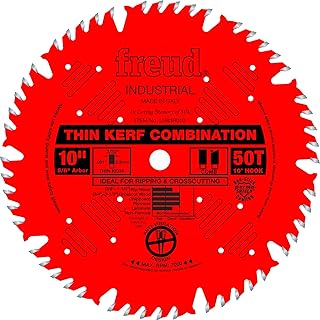
The Freud LU83R010 combines a thin kerf with a TiCo high-density carbide blend and laser-cut anti-vibration slots. That design aims to keep the blade steady through longer cuts, which can make a noticeable difference when breaking down panels or preparing furniture parts. It is a well-rounded upgrade for users who want smoother operation without moving to a dedicated ripping or crosscutting blade.
ATB Combination Table Saw Blade US1048ATBFK
This USA-made 48-tooth ATB blade uses a standard 1/8-inch kerf and a 5/8-inch arbor, giving it a familiar setup for many full-size and benchtop saws. Its tooth count favors clean crosscuts while retaining enough capacity for ripping typical furniture stock. Choose it when cut smoothness and conventional blade compatibility matter more than minimizing motor load.
10-Inch 50-Tooth Thin-Kerf Combination Blade
This 50-tooth ATB blade is designed as a practical general-purpose option for hardwood and plywood. Its thin kerf can help a smaller saw maintain momentum, while the nonstick coating is useful when working with resinous lumber or adhesive-coated panels. It is best viewed as a capable everyday blade for makers who want broad material coverage at a modest cutting width.
Frequently Asked Questions
Is a 50-tooth blade good for both ripping and crosscutting?
Yes. A 50-tooth combination blade is often the most convenient single-blade solution for a home workshop. It will not usually match a dedicated ripping blade for speed or a fine crosscut blade for the cleanest edges, but it handles both tasks well enough for many furniture projects.
Should I choose a thin-kerf blade for a compact table saw?
Often, yes. A thin-kerf blade removes less wood, which may reduce the load on a smaller motor and make feeding easier. Check the manufacturer’s guidance and make sure the riving knife or splitter matches the blade’s kerf.
Can these blades cut plywood and MDF?
Most carbide-tipped combination blades can cut plywood and MDF, but sheet goods can dull teeth faster than clean solid wood. Support large panels carefully, use dust collection, and inspect the blade if edges begin to splinter or burn.
When should I use an 80-tooth blade such as the FOXBC 10-Inch Table Saw Blade?
An 80-tooth blade is better suited to fine-finish crosscuts and appearance-critical edges than aggressive ripping. The FOXBC model can be useful for trim, veneered panels, and final sizing, but it is less efficient as the only blade in a small workshop.
Final Thoughts
For most home furniture makers, the Diablo D1050X is an excellent compact-shop starting point because it combines a thin kerf with versatile 50-tooth performance. The Freud LU83R010 is a compelling choice when vibration control and premium construction are priorities, while the CMT Orange Tools 256.050.10 suits users who prefer a robust combination grind for varied stock. Keep a fine-finish blade such as the FOXBC nearby if polished crosscuts are part of your regular workflow.