Key takeaways
- Footprint versus capacity: A sled’s base is usually twice its cut width, so a 13″ capacity sled still eats roughly 30″ of bench. In a shallow shop, size to the widest cut you actually make monthly, not the widest you can imagine.
- Runner material and fit: Aluminum and UHMW plastic both ride the standard 3/4″ x 3/8″ miter slot, but UHMW glides without wax and shrugs off humidity swings that make wood runners bind in an unheated garage.
- Storage profile: Look for a low fence and a flat base with somewhere to hang it. Tall fences and protruding blade guards make a sled awkward to slide behind a workbench or under a stair.
- Zero-clearance and small-part safety: A sled with a zero-clearance kerf and a hold-down or guard keeps thin offcuts from tipping into the blade — the single biggest reason to use a sled on small stock.
- Adjustability you’ll actually use: A sliding stop block for repeat cuts and a squarable fence are worth more than extra features. Confirm the fence can be trued with the five-cut method rather than being permanently fixed.
What's inside
A table saw in a one-car garage or a basement corner rarely gets the luxury of a dedicated outfeed table, and that constraint shows up in the cuts. Freehand crosscuts against the miter gauge drift, small offcuts vanish into the throat plate, and every repeat cut turns into a measure-mark-hope cycle that eats an afternoon. The sled solves this by turning the saw into a fixed-fence machine, but sleds also take up wall space, hang on hooks, and get dragged in and out of tight quarters — which means footprint and storage matter almost as much as accuracy.
This guide looks at crosscut sleds through that lens: how much bench real estate they demand, whether they store flat, how quickly they set up on a shared bench, and how they hold a true 90° after being knocked around a crowded shop. Below you’ll find picks ranging from ready-to-run MDF platforms to compact small-parts jigs and bare runner kits for anyone who’d rather build to their own dimensions.
As an Amazon Associate we earn from qualifying purchases.



How to Choose a/an Cross Cut Sled For Table Saw (2026)
- Footprint versus capacity: A sled’s base is usually twice its cut width, so a 13″ capacity sled still eats roughly 30″ of bench. In a shallow shop, size to the widest cut you actually make monthly, not the widest you can imagine.
- Runner material and fit: Aluminum and UHMW plastic both ride the standard 3/4″ x 3/8″ miter slot, but UHMW glides without wax and shrugs off humidity swings that make wood runners bind in an unheated garage.
- Storage profile: Look for a low fence and a flat base with somewhere to hang it. Tall fences and protruding blade guards make a sled awkward to slide behind a workbench or under a stair.
- Zero-clearance and small-part safety: A sled with a zero-clearance kerf and a hold-down or guard keeps thin offcuts from tipping into the blade — the single biggest reason to use a sled on small stock.
- Adjustability you’ll actually use: A sliding stop block for repeat cuts and a squarable fence are worth more than extra features. Confirm the fence can be trued with the five-cut method rather than being permanently fixed.
The Best Cross Cut Sled For Table Saw (2026)s Reviewed
Rockler Small Parts Crosscut Sled
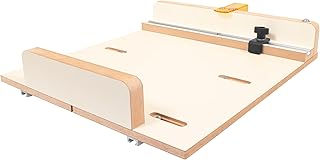
Built specifically for the cuts most likely to hurt you — short blocks, thin strips, drawer parts — with zero-clearance support that keeps offcuts fully supported through the kerf. Its modest footprint makes it the sled to reach for when you don’t want to clear the whole bench.
Fulton MDF Crosscut Sled
A straightforward MDF platform that arrives ready to square and run, giving you a flat, stable reference surface without a weekend build. MDF adds weight and can swell in damp storage, so keep it off a concrete floor if your shop isn’t climate controlled.
Precision Right-Angle Crosscut Sled (16″ x 18″)
At roughly 16″ x 18″, this is the compact option, pairing aluminum miter slot runners with an adjustable stop and a transparent guard for line-of-sight on repeat cuts. Ideal for small-shop work where the sled needs to hang on a nail when it’s done.
POWERTEC 71403 Crosscut Sled Kit
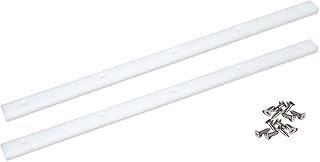
Supplies the runners, fence hardware, and fasteners while you cut the base to whatever size your saw and shop can accommodate. That flexibility is the point: you set the capacity and the storage profile instead of inheriting someone else’s.
Standard 3/4″ x 3/8″ Runner Crosscut Sled
A 13.2″ max cut width covers cabinet rails, face frames, and shelf ends while staying manageable in a tight space, and the standard runners fit most DeWalt, Ridgid, and Skil saws. Verify your miter slot dimensions before ordering, since T-slot saws need runner modification.
Frequently Asked Questions
Do I need a crosscut sled if I already have a miter gauge?
A miter gauge supports the workpiece from behind at a single point; a sled carries the entire piece on a moving base with a fence in front of the blade. The result is far less drift on wide stock and much safer handling of short pieces.
Will a sled fit my portable jobsite saw?
Most do, provided the saw has standard 3/4″ x 3/8″ miter slots. Measure slot width, depth, and whether it’s a T-slot, then check that the sled’s base clears the saw’s fence rails and any front bevel handle.
Aluminum or UHMW plastic runners?
Aluminum is rigid and dimensionally stable; UHMW slides more smoothly and doesn’t need lubricant. For unheated shops, UHMW handles seasonal humidity better than wood and won’t corrode in a damp garage the way bare steel can.
How do I square the fence?
Use the five-cut method: make four cuts around a square offcut, measure the taper on the fifth, and divide the error by four to calculate the fence adjustment. Recheck it once a season or after any hard knock.
Final Thoughts
For most small shops, the compact 16″ x 18″ precision sled hits the best balance of accuracy, adjustable stop, and storable footprint, while the Rockler Small Parts Sled earns permanent bench space for the short and narrow cuts that make a table saw nervous work. If you’d rather size the base to your own bench and wall, the POWERTEC 71403 kit gives you the hardware and leaves the dimensions to you.