Key takeaways
- Tooth count: Higher tooth counts generally produce smoother crosscuts, while lower counts remove material faster and suit rougher cuts or ripping. For furniture work, 60 to 80 teeth is a useful starting range.
- Blade purpose: Match the blade to the material and cut. Fine-finish wood blades are ideal for visible edges, while combination blades are more flexible when one tool handles several jobs.
- Kerf: A thin kerf can reduce waste and may require less power, which is helpful with smaller saws. However, the blade must remain stable and compatible with your saw.
- Tooth design: Alternate-top-bevel designs are common for clean wood crosscuts. Triple-chip grind blades are often better suited to laminates or nonferrous materials, but check the manufacturer’s intended use.
- Fit and safety: Verify the 10-inch diameter, 5/8-inch arbor where applicable, rotation direction, and saw limitations. Disconnect power before changing blades and use eye and hearing protection.
What's inside
Choosing a miter saw blade for furniture projects can feel surprisingly complicated. Tooth count, kerf, blade geometry, and material all affect whether a cut is clean and controlled—or leaves splintered edges, burn marks, and extra sanding. A blade that excels at crosscutting trim may be a poor choice for breaking down boards or cutting aluminum.
This guide focuses on practical choices for compact workshops and home furniture makers. We compare fine-finish, general-purpose, and specialty blades, with attention to the cuts most people make on a miter saw: trim, shelving, cabinet parts, hardwood components, and occasional nonferrous metal work. Always confirm arbor size and maximum blade diameter before buying.
As an Amazon Associate we earn from qualifying purchases.


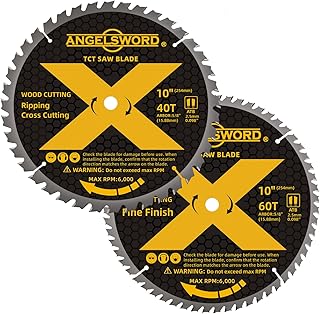
How to Choose a/an 10 Miter Saw Blades (2026)
- Tooth count: Higher tooth counts generally produce smoother crosscuts, while lower counts remove material faster and suit rougher cuts or ripping. For furniture work, 60 to 80 teeth is a useful starting range.
- Blade purpose: Match the blade to the material and cut. Fine-finish wood blades are ideal for visible edges, while combination blades are more flexible when one tool handles several jobs.
- Kerf: A thin kerf can reduce waste and may require less power, which is helpful with smaller saws. However, the blade must remain stable and compatible with your saw.
- Tooth design: Alternate-top-bevel designs are common for clean wood crosscuts. Triple-chip grind blades are often better suited to laminates or nonferrous materials, but check the manufacturer’s intended use.
- Fit and safety: Verify the 10-inch diameter, 5/8-inch arbor where applicable, rotation direction, and saw limitations. Disconnect power before changing blades and use eye and hearing protection.
The Best 10 Miter Saw Blades (2026)s Reviewed
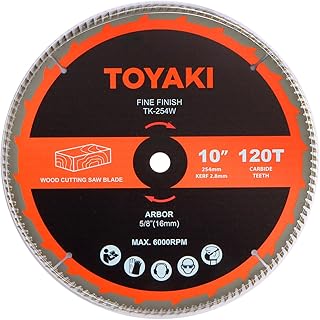
10-Inch 120-Tooth Fine-Finish Blade
This high-tooth-count blade is aimed at exceptionally clean cuts in furniture components, trim, and delicate stock. It makes the most sense when minimizing tear-out matters more than cutting speed, particularly on finished edges that will be visible after assembly.
WEN BL1080 80-Tooth Ultra-Fine Finish Blade
The WEN BL1080 is a strong all-around option for makers who want a polished crosscut without moving into an extremely specialized blade. Its 80-tooth layout suits face frames, molding, and small cabinet parts, while the carbide-tipped construction is intended for repeat use in workshop projects.
WEN BL1060 60-Tooth Fine-Finish Blade
The WEN BL1060 occupies a practical middle ground: smoother than a coarse general-purpose blade, but typically faster and less demanding than a very high-tooth-count model. It is a sensible choice for a compact shop handling both furniture joinery and everyday dimensional lumber.
US1080-MTR 80-Tooth Miter Saw Blade
With an 80-tooth configuration and geometry optimized for crosscuts and miters, the US1080-MTR is tailored to the kind of angled, visible cuts common in furniture and trim work. Its stated 1/8-inch kerf may appeal to users who want a balance between material conservation and a steady cut.
10-Inch 120-Tooth TCG Aluminum Blade
This blade is the specialty pick for projects that occasionally include aluminum alongside wood. Its triple-chip-grind design and 120-tooth layout are geared toward controlled, fine work, but users should follow the manufacturer’s material guidance and never assume a wood blade is suitable for metal.
Frequently Asked Questions
Is a higher tooth count always better for furniture?
No. More teeth can improve crosscut smoothness, but they may cut more slowly and can be less suitable for ripping. Choose based on the cut, material, and finish quality required.
Can these blades fit any 10-inch miter saw?
Not automatically. Confirm the arbor diameter, blade diameter, kerf, and your saw’s manual before installation. A blade can be the correct size yet still be incompatible with the arbor or manufacturer’s limits.
What blade should a beginner buy first?
A 60-tooth or 80-tooth fine-finish blade is usually the most versatile starting point for home furniture projects. It handles common crosscuts and miters while producing edges that require less cleanup.
How can I reduce tear-out on plywood and hardwood?
Use a sharp, appropriate fine-finish blade, support the workpiece securely, and let the saw reach full speed before cutting. A slower, controlled feed and a sacrificial backing board can further improve the exit edge.
Final Thoughts
For a compact furniture workshop, the WEN BL1080 is a well-rounded fine-finish choice, while the WEN BL1060 offers useful flexibility for everyday work. Choose the 120-tooth fine-finish blade when edge quality is the priority, and reserve the TCG aluminum option for projects that genuinely include compatible nonferrous metal.