Key takeaways
- Tooth count: 80 teeth handles hardwood crosscuts, plywood, and mitered case sides with clean edges. Push to 100 teeth for veneered panels, melamine shelving, and anything where the cut face becomes a finished surface. Below 60 teeth, you are cutting framing lumber, not furniture.
- Kerf width: Thin-kerf blades take less bite, which lets an underpowered or older saw hold speed through 4/4 oak. The tradeoff is more deflection on long bevels. If your saw is 15 amps and healthy, a full-kerf blade tracks straighter through thick stock.
- Arbor and plate flatness: Nearly all 12-inch blades use a 1-inch arbor, but plate quality varies more than the spec sheet suggests. A blade that arrives with even slight runout will chatter on the return stroke of a slider and leave witness marks you will find only after finish goes on.
- Grind geometry: ATB (alternate top bevel) shears wood fibers cleanly and is the right choice for crosscuts and miters. Hi-density carbide holds that bevel longer, which means fewer trips out to get a blade sharpened, a real consideration if your shop is also your garage or balcony.
- One blade or two: A single 100-tooth blade is slow through construction lumber and dulls faster if you abuse it. A combo pack lets you leave a 40-tooth on the saw for rough breakdown and swap to the fine blade for final cuts, which is often smarter than storing two separate blade purchases.
What's inside
A 12-inch miter saw is a big machine in a small shop, and the blade that came bolted to it was never meant to do fine work. Manufacturers ship a general-purpose blade so the saw can frame a wall out of the box. If you are building a floating shelf, a bench seat that tucks under a window, or a wall-mounted desk for a room that measures nine feet across, that stock blade will leave you sanding tearout you should never have had to sand in the first place. In a compact workspace, that matters more than it sounds: there is no room to hide a rough cut behind a wide reveal, and no room to store scrap while you re-cut it.
This guide is written for people making furniture in tight quarters, where every cut is visible and every do-over costs bench space. Below are six 12-inch blades worth bolting onto a sliding or non-sliding miter saw in 2026, plus a short buying framework covering tooth count, kerf, arbor fit, and when a two-blade rotation beats a single high-tooth finish blade. Prices and current availability are shown in the cards.
As an Amazon Associate we earn from qualifying purchases.


How to Choose a/an 12-Inch Miter Saw Blades (2026)
- Tooth count: 80 teeth handles hardwood crosscuts, plywood, and mitered case sides with clean edges. Push to 100 teeth for veneered panels, melamine shelving, and anything where the cut face becomes a finished surface. Below 60 teeth, you are cutting framing lumber, not furniture.
- Kerf width: Thin-kerf blades take less bite, which lets an underpowered or older saw hold speed through 4/4 oak. The tradeoff is more deflection on long bevels. If your saw is 15 amps and healthy, a full-kerf blade tracks straighter through thick stock.
- Arbor and plate flatness: Nearly all 12-inch blades use a 1-inch arbor, but plate quality varies more than the spec sheet suggests. A blade that arrives with even slight runout will chatter on the return stroke of a slider and leave witness marks you will find only after finish goes on.
- Grind geometry: ATB (alternate top bevel) shears wood fibers cleanly and is the right choice for crosscuts and miters. Hi-density carbide holds that bevel longer, which means fewer trips out to get a blade sharpened, a real consideration if your shop is also your garage or balcony.
- One blade or two: A single 100-tooth blade is slow through construction lumber and dulls faster if you abuse it. A combo pack lets you leave a 40-tooth on the saw for rough breakdown and swap to the fine blade for final cuts, which is often smarter than storing two separate blade purchases.
The Best 12-Inch Miter Saw Blades (2026)s Reviewed
DEWALT 12″ 100-Tooth Fine Finish (DWA112100)
This is the default recommendation for anyone building furniture on a DEWALT or comparable 12-inch saw: the tooth grind is consistent, the plate runs flat, and crosscuts in maple come off the saw needing nothing more than a light scuff. It is not the blade for ripping framing stock, and it should not be treated as one.
Diablo D1280X 12″ 80-Tooth
Freud’s hi-density carbide is the practical sweet spot, giving you finish-grade cuts in hardwood and plywood while retaining enough gullet clearance to move through 2x material without bogging. If you keep only one blade on the saw, this is the most versatile of the group.
DEWALT 12″ Combo Pack, 40T & 60T (DWA112CMB)
The best value here for a small shop, because it covers two jobs with one purchase and one storage slot. The 40-tooth breaks down rough lumber quickly, the 60-tooth handles most joinery cuts cleanly, and you spend your finish blade’s life only on the cuts that need it.
FOXBC 12″ 100-Tooth Polished Finish
A strong budget alternative to the DEWALT 100-tooth, with a polished plate that reduces friction and pitch buildup in resinous softwoods. Expect slightly shorter carbide life, which is a fair trade if you are cutting a handful of projects a year rather than working daily.
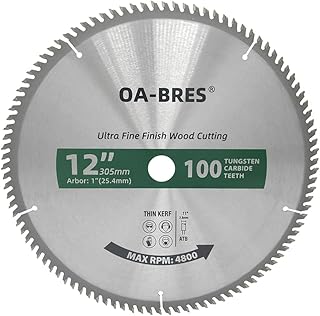
12″ 100-Tooth ATB TCT Ultra Fine Finish
Worth considering when you need a dedicated panel blade for veneered plywood and melamine and do not want to burn through a premium blade doing it. Check runout when it arrives and keep feed pressure light; treated gently, it produces genuinely clean edges.
Frequently Asked Questions
Does a higher tooth count always mean a better cut?
Only in the right material. High tooth counts excel at crosscuts and sheet goods but clear chips poorly in thick or wet stock, which causes burning. Match tooth count to the cut, not to price.
Can I use a 12-inch blade on a 10-inch saw?
No. The blade will not fit the guard or arbor housing, and forcing the issue is genuinely dangerous. Blade diameter must match your saw’s rating exactly.
How often should a finish blade be sharpened?
For hobby-level furniture work, once every year or two is typical. The tell is not calendar time but performance: increased tearout, visible burn marks, or the saw sounding like it is working harder through familiar stock.
Do stainless steel blades outperform carbide-tipped ones?
Carbide-tipped is what matters for edge retention. Body material affects corrosion resistance and rigidity, which is useful if your shop is damp, but the carbide teeth do the actual cutting.
Final Thoughts
For most people building furniture in a small space, the Diablo D1280X is the blade to buy first because it handles both breakdown and finish cuts without a swap. If your work skews toward veneered panels and visible miters, the DEWALT DWA112100 delivers the cleanest surfaces of the group, and the DEWALT DWA112CMB combo pack is the smartest choice if you would rather rotate two purpose-built blades than compromise with one.