Key takeaways
- Stored footprint, not table size: Measure the saw folded, not deployed. A rolling stand that collapses to a 12-inch-deep profile can park behind a car door; a fixed benchtop unit needs permanent shelf real estate plus a surface to clamp to.
- Rip capacity you’ll genuinely use: A 32-inch rip capacity is wonderful for full sheets of plywood, but sheet goods also need a 4-foot outfeed zone. If your shop is 10 feet deep, a 24-inch capacity paired with a track saw for breakdown cuts is the smarter combination.
- Dust management: In a garage that doubles as storage, sawdust settles on everything you own. Look for a shrouded blade and a standard 2-1/2-inch port that mates with a shop vac, and budget for the hose in your total cost.
- Fence quality above all: A fence that drifts out of parallel makes clean furniture joinery impossible and creates kickback risk. Rack-and-pinion systems track squarer than single-lock fences and are worth the price jump for a first saw.
- Safety hardware included: Riving knife, blade guard, anti-kickback pawls, and a push stick should ship in the box. Beginners have the least intuition about where their hands are, so the guarding matters most at exactly this stage.
What's inside
Buying your first table saw in a small home is a spatial problem before it’s a woodworking problem. You’re weighing a 200-pound cast iron cabinet saw against the reality of a one-car garage that also stores bikes, a chest freezer, and holiday bins. Most beginners overspend on cutting capacity they’ll never use, then discover the machine permanently blocks the path to the water heater. The saw that actually gets used is the one you can wheel out, cut on, and tuck away in under five minutes.
This guide looks at beginner-friendly 10-inch table saws through a footprint-first lens: how they fold, how they roll, how much clearance they demand on all four sides, and whether they can live vertically against a wall between projects. I’ve included both established jobsite models and the newer budget benchtop units flooding the market, with honest notes on where each makes sense for someone building furniture in a tight space.
As an Amazon Associate we earn from qualifying purchases.




How to Choose a Table Saw For Beginner Woodworker (2026)
- Stored footprint, not table size: Measure the saw folded, not deployed. A rolling stand that collapses to a 12-inch-deep profile can park behind a car door; a fixed benchtop unit needs permanent shelf real estate plus a surface to clamp to.
- Rip capacity you’ll genuinely use: A 32-inch rip capacity is wonderful for full sheets of plywood, but sheet goods also need a 4-foot outfeed zone. If your shop is 10 feet deep, a 24-inch capacity paired with a track saw for breakdown cuts is the smarter combination.
- Dust management: In a garage that doubles as storage, sawdust settles on everything you own. Look for a shrouded blade and a standard 2-1/2-inch port that mates with a shop vac, and budget for the hose in your total cost.
- Fence quality above all: A fence that drifts out of parallel makes clean furniture joinery impossible and creates kickback risk. Rack-and-pinion systems track squarer than single-lock fences and are worth the price jump for a first saw.
- Safety hardware included: Riving knife, blade guard, anti-kickback pawls, and a push stick should ship in the box. Beginners have the least intuition about where their hands are, so the guarding matters most at exactly this stage.
The Best Table Saw For Beginner Woodworker (2026)s Reviewed
DEWALT DWE7491RS with Rolling Stand
The rack-and-pinion fence on this saw is the single biggest accuracy upgrade a beginner can buy, and the foldable rolling stand means it leaves the wall only when you’re cutting. The 32-1/2-inch rip capacity handles sheet goods if you have the outfeed room, and the whole assembly tips back and rolls on wheels like a hand truck.
SKIL TS6307-00 Portable Jobsite Saw
SKIL’s folding stand collapses flat enough to slide into a narrow gap between shelving and a wall, and the integrated rack-and-pinion fence punches well above the price. The onboard storage for the miter gauge and wrenches solves the classic small-shop problem of accessories disappearing into a junk drawer.
15 Amp Compact Benchtop Saw with 36T Blade
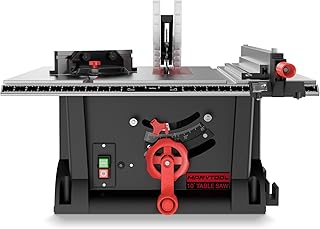
This compact benchtop unit is the pick if your workspace is a folding table you set up in a spare bedroom or on a balcony, since there’s no stand to store and it lifts one-handed. Expect to check the fence for square before each session, and treat the included 36-tooth blade as a starting point rather than a finish-cut blade.
10-Inch Multifunctional Saw with Stand and Push Stick
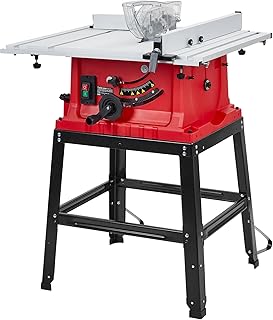
A reasonable entry point that bundles the stand and push stick so you’re not making a second order before your first cut. The 0-45 degree bevel and 5000 RPM motor cover most beginner furniture work, though the stand is less rigid than the DEWALT and benefits from being placed on a flat concrete floor.
10-Inch Saw with Stand and Protective Cover
The 36 x 25-inch tabletop gives you meaningfully more support for wider panels than most saws at this price, and the protective cover matters in a shared garage where dust and moisture are constants. Good value for someone cutting mostly dimensional lumber and plywood strips rather than chasing cabinet-shop tolerances.
Frequently Asked Questions
How much clearance does a table saw actually need?
Plan for the length of your longest workpiece in front of and behind the blade, plus roughly two feet of side clearance. For a small shop, a saw positioned in the middle of the floor during use and rolled back afterward is more realistic than a dedicated station.
Can I use a table saw in an apartment or basement?
Yes, with a benchtop model, aggressive dust collection, and awareness of noise. A 15 amp saw needs a dedicated 15 or 20 amp circuit, so avoid running it on the same circuit as a space heater or freezer.
Should I upgrade the blade right away?
The stock blade on nearly every saw here is a general-purpose compromise. A 40 or 50-tooth combination blade costs modestly and improves crosscut quality more than any other single change.
Is a table saw or a track saw better for a first tool?
A track saw wins for breaking down full sheets in tight spaces; a table saw wins for repeatable narrow rips and joinery. For furniture building, most people eventually own both, but the table saw does more of the work.
Final Thoughts
If you have room for a rolling stand and want a saw that won’t limit you in three years, the DEWALT DWE7491RS is the clearest choice, with the SKIL TS6307-00 close behind at a lower price and a slightly friendlier folded footprint. For genuinely tight quarters where nothing can stay set up, the 15 Amp compact benchtop saw is the honest answer: less capable, but it fits on a shelf, and a saw you can store is a saw you’ll use.