Key takeaways
- Start at the lowest level: Basements and ground floors hold the highest moisture load, so anchor your primary unit near the bottom of the stairwell where rising air passes it. A single well-placed machine downstairs often drops humidity a full floor above by intercepting air before it climbs.
- Give it breathing room on all sides: Dehumidifiers pull air in and push it out, so pressing one against a wall or wedging it between furniture chokes performance. Plan for six to twelve inches of clearance, which matters enormously when you’re working with a narrow hallway or a crowded laundry nook.
- Chase the drain, not the outlet: Continuous gravity drainage beats emptying a tank twice a day, so favor spots near a floor drain, utility sink, or sump pit. If your ideal location has no drain, choose a model with a larger reservoir and accept the tradeoff.
- Match capacity to the whole zone, not one room: A 34-pint unit rated for 2,500 square feet handles an open basement or a full upstairs landing with bedrooms branching off it. Undersizing forces the compressor to run constantly, which costs more than buying the right size once.
- Respect the noise floor near bedrooms: Anything above 45 decibels becomes intrusive in a sleeping space. If the unit lives on the second floor, prioritize a quiet mode and a timer so it works while nobody’s listening.
What's inside
Two-story homes fight a losing battle with physics. Warm, moisture-laden air climbs the stairwell and collects upstairs while the basement holds cool, damp air that never moves. That leaves most homeowners with a puzzling problem: one floor smells musty, the other feels clammy, and a single dehumidifier parked in the wrong corner barely touches either. If you’ve been shuffling a unit from room to room hoping something clicks, placement is almost certainly the issue, not the machine.
This guide approaches the question the way someone who plans tight footprints would: where does a dehumidifier actually earn its floor space in a two-level home, and which models are built to sit there quietly for months. Below you’ll find placement strategy, the specs that matter for multi-floor coverage, and honest reviews of six units sized for basements, bedrooms, and everything in between.
As an Amazon Associate we earn from qualifying purchases.




How to Choose a Place To Put Dehumidifier In 2 Story House (2026)
- Start at the lowest level: Basements and ground floors hold the highest moisture load, so anchor your primary unit near the bottom of the stairwell where rising air passes it. A single well-placed machine downstairs often drops humidity a full floor above by intercepting air before it climbs.
- Give it breathing room on all sides: Dehumidifiers pull air in and push it out, so pressing one against a wall or wedging it between furniture chokes performance. Plan for six to twelve inches of clearance, which matters enormously when you’re working with a narrow hallway or a crowded laundry nook.
- Chase the drain, not the outlet: Continuous gravity drainage beats emptying a tank twice a day, so favor spots near a floor drain, utility sink, or sump pit. If your ideal location has no drain, choose a model with a larger reservoir and accept the tradeoff.
- Match capacity to the whole zone, not one room: A 34-pint unit rated for 2,500 square feet handles an open basement or a full upstairs landing with bedrooms branching off it. Undersizing forces the compressor to run constantly, which costs more than buying the right size once.
- Respect the noise floor near bedrooms: Anything above 45 decibels becomes intrusive in a sleeping space. If the unit lives on the second floor, prioritize a quiet mode and a timer so it works while nobody’s listening.
The Best Place To Put Dehumidifier In 2 Story House (2026)s Reviewed
4500 Sq. Ft Quilt Compressor Dehumidifier
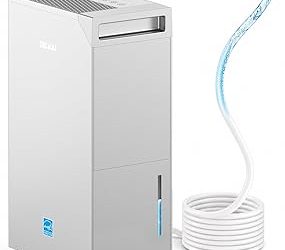
With coverage stretching to 4,500 square feet, this is the unit to install at the base of the stairs when you want one machine influencing both floors. Intelligent humidity control lets it idle rather than cycle hard, and the included drain hose makes a permanent basement placement genuinely hands-off.
34 Pint 2500 Sq.Ft Dehumidifier with Drain Hose
The 40dB rating is the headline here, quiet enough to sit on a second-floor landing without competing with conversation or sleep. Three modes and a 24-hour timer give you real control over when it runs, though the 0.53-gallon tank means you’ll want that hose connected for unattended operation.
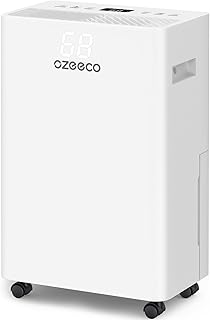
ozeeco 34 Pint Dehumidifier with Ionizer
Child lock and ultra-quiet operation make this the sensible pick for a hallway outside kids’ bedrooms or a finished attic room. The ionizer adds a modest freshening effect that helps in closed spaces where air simply sits, and the compact tank suits spots where a hose isn’t practical for short runs.
KNKA 2500 Ft² 34 Pint Dehumidifier
The dry-clothes function earns this one a spot in a second-floor laundry area or utility closet, where damp fabric is the actual moisture source. Three modes plus a 24-hour timer cover most scheduling needs, and the white finish disappears against typical interior walls.
2500 Ft² 34 Pint Large Room Compressor Dehumidifier
A straightforward compressor unit that does the fundamentals well, which is exactly what you want in a garage, basement corner, or under-stair alcove. No frills to fuss over, just steady extraction with a hose port for set-and-forget drainage.
Frequently Asked Questions
Should I put the dehumidifier upstairs or downstairs?
Downstairs first, near the stairwell. Moisture originates and pools at the lowest level, and treating it there prevents damp air from migrating upward. Add a second smaller unit upstairs only if bedrooms still read above 55% humidity.
Can one dehumidifier handle both floors?
Sometimes, if the stairwell is open and you buy generously. A high-capacity model rated well above your square footage stands a real chance. Closed doors and separate HVAC zones make two units the more reliable answer.
How close to a wall can it sit?
Keep at least six inches clear on the intake and exhaust sides, more if the manual specifies it. Corners are usually the worst choice despite being the most tempting spot in a tight room.
Does running it near a stairwell create a draft?
Not meaningfully. The airflow is gentle and localized, and positioning it near the stairwell actually helps by treating air already in motion rather than fighting a stagnant pocket.
Final Thoughts
For most two-story homes, the 4500 Sq. Ft Quilt Compressor unit downstairs does the heaviest lifting with room to spare, and pairing it with the 40dB 34-Pint model on the upper floor covers bedrooms without noise complaints. If your trouble spot is a laundry area or utility closet, the KNKA 34-Pint and its dry-clothes mode is the more targeted buy.