Key takeaways
- Match amps to your engine, not the box art: Peak amp numbers look impressive on the label, but the displacement rating is the honest figure. A 2000A unit rated for 5L gas engines handles a compact sedan comfortably; diesel trucks and V8s need the 3000A-and-up tier with a matching diesel spec.
- Check the inflator’s PSI and auto-shutoff: Anything below 120 PSI struggles with truck tires. Auto-off is the feature that lets you set a target pressure and walk away instead of standing there squinting at a gauge, which matters more than the raw ceiling number.
- Watch the watt-hours, not just the amps: Battery capacity determines how many starts and inflations you get before recharging. A 37Wh pack is a one-emergency tool; 88.8Wh gives you room to inflate four tires and still crank an engine.
- Plan the storage shape: Some units are squat bricks that stack neatly on a shelf; others are long and awkward with cables that refuse to coil. Look for integrated cable channels or a fitted case if the unit is sharing space with anything else.
- Consider recharge speed and self-discharge: 65W USB-C input means you can top the pack off with a laptop charger instead of hunting for a proprietary brick. Low self-discharge matters just as much, since this is a tool that sits unused for months at a time.
What's inside
The trunk of a small car and the closet of a small apartment have the same problem: everything you own has to justify its footprint. A jump starter is easy to justify, right up until you realize you also need a tire inflator, and now two bulky plastic cases are competing for the same shelf. Combo units solve that math by folding both jobs into one object, which is why they have become the default recommendation for anyone whose storage plan is measured in inches rather than square feet.
This guide looks at the 2026 crop of jump starter and air compressor hybrids through that lens: how much power you actually get per cubic inch, whether the inflator is a real tool or a token feature, and how each unit behaves when it lives in a hall closet or under a stairwell instead of a three-car garage. Below you will find the models worth clearing space for, plus the specs that matter when you are choosing between them.
As an Amazon Associate we earn from qualifying purchases.




How to Choose a Jump Start And Air Compressor (2026)
- Match amps to your engine, not the box art: Peak amp numbers look impressive on the label, but the displacement rating is the honest figure. A 2000A unit rated for 5L gas engines handles a compact sedan comfortably; diesel trucks and V8s need the 3000A-and-up tier with a matching diesel spec.
- Check the inflator’s PSI and auto-shutoff: Anything below 120 PSI struggles with truck tires. Auto-off is the feature that lets you set a target pressure and walk away instead of standing there squinting at a gauge, which matters more than the raw ceiling number.
- Watch the watt-hours, not just the amps: Battery capacity determines how many starts and inflations you get before recharging. A 37Wh pack is a one-emergency tool; 88.8Wh gives you room to inflate four tires and still crank an engine.
- Plan the storage shape: Some units are squat bricks that stack neatly on a shelf; others are long and awkward with cables that refuse to coil. Look for integrated cable channels or a fitted case if the unit is sharing space with anything else.
- Consider recharge speed and self-discharge: 65W USB-C input means you can top the pack off with a laptop charger instead of hunting for a proprietary brick. Low self-discharge matters just as much, since this is a tool that sits unused for months at a time.
The Best Jump Start And Air Compressor (2026)s Reviewed
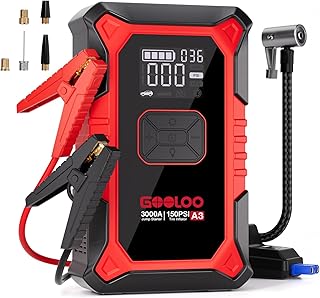
GOOLOO A3 3000A Jump Starter with Air Compressor
The A3 hits the sweet spot for most households: 3000A covers 9L gas and 6.5L diesel engines, and the 150 PSI inflator with auto-off is genuinely useful rather than decorative. Its compact case and tidy cable storage make it one of the easier units to slot into a crowded closet shelf.
WOLFBOX MV16A 3000A Jump Starter with Air Compressor
A 59.2Wh pack paired with a 160 PSI compressor gives this one the highest inflation ceiling in the group, useful if you are topping off trailer or light truck tires. The 65W fast charging means a dead unit is back to usable in under an hour, which reduces the temptation to leave it plugged in permanently.
WOLFBOX MV24 4000A Jump Starter
At 88.8Wh and 4000A, the MV24 is the pick for 10L gas or diesel engines and for anyone who wants headroom rather than a bare-minimum rating. The LED display takes the guesswork out of remaining charge, though the larger pack does ask for a full shelf slot rather than a glovebox.
ANCEL BS300 Permanently Connected Jump Starter
This one solves the storage problem by eliminating it: the supercapacitor unit mounts under the hood and stays connected, delivering 1000A of start assist on demand with battery health monitoring. Its -40°F to 176°F operating range makes it the most reliable option in genuinely harsh climates, with the tradeoff that it does not inflate tires.
WOLFBOX MV10A 2000A Jump Starter with Air Compressor
The smallest of the group at 37Wh, the MV10A is built for compact cars up to 5L and fits comfortably in a door pocket or seat-back organizer. The 150 PSI inflator is the same class as the larger models, so you are trading battery capacity for footprint rather than compressor quality.
Frequently Asked Questions
How often should I recharge a jump starter that I never use?
Top it off every three to six months. Lithium packs slowly self-discharge, and a unit sitting at 20% will not start a cold engine when you finally need it. Pair the reminder with a seasonal chore you already do.
Can these inflate more than car tires?
Yes, most handle bicycle tires, sports balls, and air mattresses with the included nozzle adapters, though inflating anything large will drain the pack fast. Treat high-volume items as a bonus rather than the primary use case.
Is a permanently connected system better than a portable one?
It depends on what you value. A mounted supercapacitor unit like the BS300 is always ready and takes zero storage space, but it serves one vehicle and does not inflate tires. Portable units are more versatile across cars, bikes, and household needs.
Where is the best place to store one in a small home?
A high shelf in an interior closet beats a car trunk in extreme climates, since heat accelerates lithium degradation. If you keep it in the vehicle, use a footwell or under-seat spot rather than the trunk floor where it slides around.
Final Thoughts
For most buyers, the GOOLOO A3 delivers the best balance of power, inflator quality, and shelf-friendly size, while the WOLFBOX MV24 is the one to choose if you drive a larger engine and want capacity to spare. If your storage situation is truly zero-tolerance, the ANCEL BS300 sidesteps the problem entirely by living under the hood.