Key takeaways
- Dock footprint versus runtime: Self-emptying bases free you from daily bin duty but claim 12 to 18 inches of wall space and need vertical clearance for the exhaust. In a small home, measure the spot before you buy, or choose a bare charging base and empty the onboard bin yourself.
- Height clearance: Anything above 3.5 inches tall will stall at your sofa skirt and bed frame. Slim profiles around 2.85 inches reach the dust that actually accumulates, which is the whole point in a home where storage lives under the furniture.
- Navigation type: LiDAR mapping handles cluttered, furniture-dense rooms far better than random bounce patterns, and lets you draw no-go zones around pet bowls, cable nests, and plant corners. Random-path bots still work fine in one or two open rooms.
- Suction matched to flooring: Hard floors and low-pile rugs are satisfied by 2,000Pa. Medium-pile carpet with a shedding dog wants 6,000Pa or more, plus a brushroll designed to shed tangled hair rather than bank it.
- Noise and scheduling: If your living room doubles as an office or bedroom, check the decibel rating and confirm the app supports scheduled runs so cleaning happens while you’re out.
What's inside
In a 500-square-foot apartment, every appliance has to earn its footprint. That’s the quiet frustration behind robot vacuum shopping right now: the market has pivoted hard toward mop-hybrid machines with docking towers the size of a nightstand, water tanks to refill, dirty-water tanks to dump, and pads that need rinsing before they start to smell. If you’ve got hardwood you already damp-mop by hand, or wall-to-wall carpet where a mop is useless, you’re paying a premium in both dollars and floor space for a feature you’ll disable in week two.
This guide covers vacuum-only robots and vacuum-first machines worth buying in 2026, judged on the criteria that actually matter in tight quarters: dock volume, clearance under furniture, noise in a room you also sleep in, and whether the thing can navigate a studio full of chair legs without getting stuck. I’ve flagged which picks suit renters with no storage closet and which are better for larger multi-room homes.
As an Amazon Associate we earn from qualifying purchases.




How to Choose a Robot Vacuum Without Mop (2026)
- Dock footprint versus runtime: Self-emptying bases free you from daily bin duty but claim 12 to 18 inches of wall space and need vertical clearance for the exhaust. In a small home, measure the spot before you buy, or choose a bare charging base and empty the onboard bin yourself.
- Height clearance: Anything above 3.5 inches tall will stall at your sofa skirt and bed frame. Slim profiles around 2.85 inches reach the dust that actually accumulates, which is the whole point in a home where storage lives under the furniture.
- Navigation type: LiDAR mapping handles cluttered, furniture-dense rooms far better than random bounce patterns, and lets you draw no-go zones around pet bowls, cable nests, and plant corners. Random-path bots still work fine in one or two open rooms.
- Suction matched to flooring: Hard floors and low-pile rugs are satisfied by 2,000Pa. Medium-pile carpet with a shedding dog wants 6,000Pa or more, plus a brushroll designed to shed tangled hair rather than bank it.
- Noise and scheduling: If your living room doubles as an office or bedroom, check the decibel rating and confirm the app supports scheduled runs so cleaning happens while you’re out.
The Best Robot Vacuum Without Mop (2026)s Reviewed
eufy 11S MAX
At under three inches tall and genuinely quiet, this is the pick for studios and one-bedrooms where the robot needs to disappear under the bed frame and run without waking anyone. There’s no app, no mapping, and no self-empty dock, which keeps the price and the footprint low; the tradeoff is that you’ll empty the bin yourself and it won’t remember your layout.
iRobot Roomba 105 Vac with AutoEmpty Dock
Up to 75 days of capacity is the highest of anything here, so the dock becomes a piece of furniture you interact with roughly five times a year. LiDAR navigation and neat-row cleaning make it reliable in multi-room homes, though the base is tall enough that you’ll want a dedicated corner rather than a hallway.
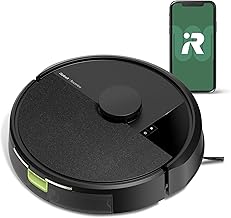
iRobot Roomba 105 Vac
Identical cleaning hardware to the model above, minus the emptying tower, which makes it the smarter buy for anyone who simply has nowhere to put a large dock. You get the same LiDAR mapping and power-lifting suction on a slim self-charging base that tucks behind a door.
Shark AV2501S AI Ultra
Matrix Clean grids over high-traffic zones repeatedly instead of passing once, which is the difference-maker on entryway rugs and under a dining table. The 30-day bagless HEPA base means no cartridge subscription, and the self-cleaning brushroll is the most convincing long-hair solution in this group.
Q10 Pro
Eight thousand pascals of suction with laser mapping and a 150-minute run time makes this the value option for larger carpeted spaces and heavy pet-hair households. It ships as a hybrid, but the mop module detaches entirely, so you can run it as a pure vacuum and store the water tank away.
Frequently Asked Questions
Are vacuum-only robots cheaper?
Usually, yes, particularly at the base-station level. You also avoid recurring costs like mop pads and cleaning solution, and you skip the water plumbing that adds failure points over a few years of use.
Can I buy a hybrid and just not use the mop?
You can, and on models with a detachable module it works well. Avoid designs where the mop plate is integrated, since the pad can sit damp against your floor during a dry run.
Do I need a self-emptying dock in a small apartment?
Not necessarily. Small floor areas fill the onboard bin slowly, so a 30-second manual empty every few days is often a fair trade for reclaiming a foot and a half of wall.
Will one handle both carpet and hardwood?
Any of these will. Look for automatic carpet boost, which raises suction when the sensors detect a rug and drops it back on hard floors to conserve battery.
Final Thoughts
For tight spaces where the robot has to live under the furniture, the eufy 11S MAX is still the most sensible machine on the market. If you want mapping and serious suction without surrendering a corner to a tower, the Roomba 105 Vac is the balanced choice, and the Shark AV2501S AI Ultra is worth the extra footprint in a pet household with real carpet.