Key takeaways
- Drainage strategy first: Decide before you buy whether you’ll empty a tank, run a gravity hose to a floor drain, or use an internal pump to push water up into a sink. In a small space, an unattended pump-and-hose setup is the difference between an appliance you love and a chore you resent every 12 hours.
- Footprint and clearance, not just capacity: Measure the actual floor space, then add the manufacturer’s recommended air clearance on all sides — usually 6 to 12 inches. A unit crammed against a wall recirculates its own dry exhaust and reads the room wrong.
- Real coverage versus advertised coverage: Ratings of 3,500 to 5,000 sq ft assume moderate dampness and open airflow. Behind closed doors or in a partitioned basement, plan on covering roughly half the claimed area per unit.
- Noise floor if it shares your room: Compressor dehumidifiers sit in the 45–52 dB range. If the machine lives near a bed or desk, prioritize a model with a genuine low-fan setting and a humidistat that cycles off rather than droning at full speed continuously.
- Energy Star and filter maintenance: A certified unit running six months a year saves meaningfully on power, and a rinsable filter you can access without tools keeps efficiency from quietly sliding as dust builds.
What's inside
In a 600-square-foot apartment, every appliance has to earn its footprint. That’s what makes buying a dehumidifier tricky: the units that actually pull enough water out of the air tend to be the ones that eat a corner of your living room, and the compact models that tuck away politely often can’t keep up with a damp basement bedroom or a bathroom with no window. Meanwhile the moisture keeps doing its quiet damage — swollen dresser drawers that stick in July, that musty note in the closet you can never fully air out, condensation beading on the inside of the glass.
A 50-pint unit is the sweet spot for most homes, and understanding why matters more than chasing the biggest number on the box. This guide breaks down what the pint rating actually measures under the 2019 DOE testing standard, which drainage setup saves you the most hassle in a tight floorplan, and how the current crop of 50-pint machines compares on noise, footprint, and long-term running cost. Then we review the standouts.
As an Amazon Associate we earn from qualifying purchases.



How to Choose a 50 Pint Dehumidifier (2026)
- Drainage strategy first: Decide before you buy whether you’ll empty a tank, run a gravity hose to a floor drain, or use an internal pump to push water up into a sink. In a small space, an unattended pump-and-hose setup is the difference between an appliance you love and a chore you resent every 12 hours.
- Footprint and clearance, not just capacity: Measure the actual floor space, then add the manufacturer’s recommended air clearance on all sides — usually 6 to 12 inches. A unit crammed against a wall recirculates its own dry exhaust and reads the room wrong.
- Real coverage versus advertised coverage: Ratings of 3,500 to 5,000 sq ft assume moderate dampness and open airflow. Behind closed doors or in a partitioned basement, plan on covering roughly half the claimed area per unit.
- Noise floor if it shares your room: Compressor dehumidifiers sit in the 45–52 dB range. If the machine lives near a bed or desk, prioritize a model with a genuine low-fan setting and a humidistat that cycles off rather than droning at full speed continuously.
- Energy Star and filter maintenance: A certified unit running six months a year saves meaningfully on power, and a rinsable filter you can access without tools keeps efficiency from quietly sliding as dust builds.
The Best 50 Pint Dehumidifier (2026)s Reviewed
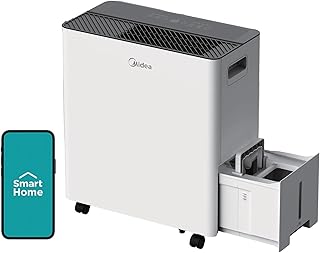
Midea 50 Pint Dehumidifier with Pump
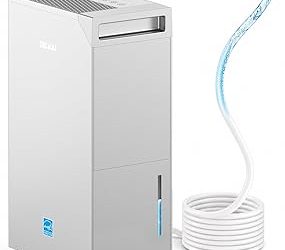
The built-in pump is what sets this apart for apartment dwellers — it lifts water into a sink or up a basement wall, so you can genuinely set it and forget it for a season. Wi-Fi with Alexa control means you can adjust humidity without walking to the unit, and the reusable filter keeps upkeep to a rinse under the tap.
Hisense 50-Pint Portable Dehumidifier
Hisense builds compressors for a living, and it shows in how steadily this one holds a target humidity without hunting up and down. Rated for 4,500 sq ft with solid energy efficiency, it’s the pick for a large open-plan home or a finished basement where a single unit has to carry the whole floor.
Whirlpool 50 Pint Dehumidifier
Notably compact for its class, which makes it the easiest of these to slot into a closet alcove or beside a dresser without visually dominating the room. Energy Star certified and pleasantly quiet — a strong whole-home choice if you value discretion over feature lists.
Manastin 5000 Sq.Ft Dehumidifier with Drain Hose
The most generous coverage rating here, paired with genuinely useful controls: three modes, a live humidity readout, a timer, and a child lock. The included drain hose supports continuous gravity drainage, so it works well positioned near an existing floor drain.
50 Pint/Day 3500 Sq.Ft Compressor Dehumidifier
A value-focused option with an intelligent humidistat that cycles the compressor automatically instead of running flat out. The 0.8-gallon tank is modest, so pair it with the included drain hose if you’re treating anything damper than mild seasonal humidity.
Frequently Asked Questions
Does a 50-pint unit really remove 50 pints a day?
Only in conditions matching the test standard — 65°F and 60% relative humidity. In a cooler basement or a drier room, expect less. That’s normal, not a defect.
What humidity level should I set?
Aim for 45–50%. Below 40% you’re spending electricity for no added protection and risking dry wood furniture; above 55% mold and dust mites become comfortable.
Can I keep it in a closet or cabinet?
No. These need unobstructed intake and exhaust. Position the unit in the open room and leave the closet door ajar so air circulates through it.
How often does the filter need cleaning?
Every two to four weeks during heavy use. A clogged filter starves airflow and quietly cuts extraction rate well before you’d notice a problem.
Final Thoughts
For most small-space buyers, the Midea 50 Pint with Pump is the one to beat — the pump plus app control removes the daily friction that makes people stop using a dehumidifier altogether. Choose the Hisense 50-Pint if raw extraction consistency across a large area matters most, or the Whirlpool 50 Pint if you need the smallest, quietest unit that still handles a whole home.