Key takeaways
- Tape out the footprint first: Mark the full length and chaise depth on your floor with painter’s tape, then walk every path you normally use. If you have to turn sideways to pass, size down. Leave 30 inches for main walkways and 18 inches between the seat edge and a coffee table.
- Reversible beats left or right: A chaise that can mount on either end protects you from a layout you haven’t planned yet. Fixed-orientation models are cheaper but lock your room in place, which matters if you move often or rearrange seasonally.
- Count seats honestly: Listings count cushion segments, not comfortable adults. A “7-seat” U-shape usually seats five in comfort. Buy for your regular household plus one guest, not for the holiday you host once a year.
- Storage and sleep functions earn their space: In a small home, a chaise with under-seat storage or a pull-out bed replaces a trunk or a guest mattress. That trade often justifies a larger piece than the room would otherwise support.
- Check assembly and door clearance: Modular pieces that arrive as separate boxes fit up stairwells and through 30-inch doors. One-piece frames frequently don’t. Measure your narrowest turn before committing.
What's inside
Sectionals with a chaise sell fast because they promise two things at once: a place to stretch out and a footprint that hugs the wall. The trouble starts when the box arrives. A chaise that faces the wrong direction blocks a doorway. A U-shape that looked airy online swallows a 12×14 living room whole. And the “modular” label gets applied to everything from genuinely reconfigurable seat blocks to a fixed frame with one detachable ottoman, which are not the same purchase at all.
This guide sorts the 2026 bestsellers by what they actually do in a real room. I’ve worked with clients in studios, railroad apartments, and awkward open-plan boxes with four traffic paths, and the pattern is consistent: the right sectional is the one whose geometry matches your floor, not the one with the most seats. Below you’ll find how to measure before you buy, plus straight reviews of the top-selling chaise sectionals and who each one suits.
As an Amazon Associate we earn from qualifying purchases.


How to Choose a/an Amazon Best Selling Sofa Chaise Sectional (2026)
- Tape out the footprint first: Mark the full length and chaise depth on your floor with painter’s tape, then walk every path you normally use. If you have to turn sideways to pass, size down. Leave 30 inches for main walkways and 18 inches between the seat edge and a coffee table.
- Reversible beats left or right: A chaise that can mount on either end protects you from a layout you haven’t planned yet. Fixed-orientation models are cheaper but lock your room in place, which matters if you move often or rearrange seasonally.
- Count seats honestly: Listings count cushion segments, not comfortable adults. A “7-seat” U-shape usually seats five in comfort. Buy for your regular household plus one guest, not for the holiday you host once a year.
- Storage and sleep functions earn their space: In a small home, a chaise with under-seat storage or a pull-out bed replaces a trunk or a guest mattress. That trade often justifies a larger piece than the room would otherwise support.
- Check assembly and door clearance: Modular pieces that arrive as separate boxes fit up stairwells and through 30-inch doors. One-piece frames frequently don’t. Measure your narrowest turn before committing.
The Best Amazon Best Selling Sofa Chaise Sectional (2026)s Reviewed
125″ U-Shaped 7-Seat Sectional with Storage Chaise and Pull-Out Bed
This is the multi-tasker for households that need one piece to do everything: adjustable headrests for reading, a storage chaise for bedding, and a pull-out sleeper for guests. At 125 inches it demands a genuinely large room, so tape it out before you order.
ovios Modular Cloud Couch in Plush Corduroy
Deep memory-foam seats and a no-assembly setup make this the easiest big sectional to live with, and the modular blocks let you break the U into an L when your layout changes. The corduroy is forgiving on dust but the sink-in depth suits lounging far better than upright conversation.
L-Shape Modular Sectional in Navy Chenille
Three single chairs plus a corner unit means you can reshape this into a loveseat and accent chairs whenever the room needs to flex. That makes it my usual recommendation for renters, and the chenille hides wear better than flat weaves.
Velvet 7-Seat Curved Floor Sectional with Ottoman
The curve softens hard corners and reads far less bulky than a right-angled sectional of the same seat count, which helps in open-plan spaces. Velvet shows every crumb, so budget for a handheld vacuum if you have pets.
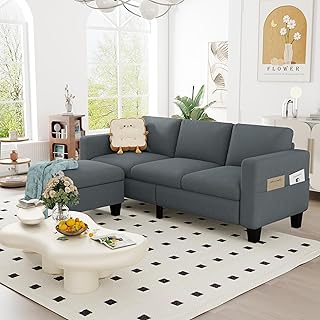
ZeeFu Convertible 3-Seat L-Shaped Sectional with Movable Ottoman
The strongest small-space pick here: a compact three-seat frame with a movable ottoman that switches the chaise from left to right in seconds. It fits studios and home offices where a full sectional would overwhelm the floor, and the dark velvet keeps it visually light.
Frequently Asked Questions
What size room do I need for a chaise sectional?
A compact L-shape like the ZeeFu works in rooms from about 10×11 feet. Large U-shapes such as the 125-inch model or the 11-seat linen sectional need at least 14×16 feet to avoid crowding walkways.
Are modular sectionals worth the extra cost?
In small or rented homes, yes. Reconfigurable pieces move through narrow doorways and adapt to new floor plans, which usually outlasts the savings on a fixed frame.
Can I switch the chaise to the other side?
Only on reversible or modular models. Ottoman-based designs like the ZeeFu and block-based sets like the ovios or navy chenille L-shape allow it; fixed-orientation frames do not.
Which fabric holds up best with kids and pets?
Chenille and corduroy hide pet hair and light wear well. Velvet looks sharp but needs regular vacuuming, and linen tends to show marks fastest.
Final Thoughts
For tight footprints, the ZeeFu Convertible L-Shaped Sectional gives you a reversible chaise without eating the room. If you want flexibility that survives a move, the L-Shape Modular Navy Chenille set breaks down into separate chairs. And for large households that need storage and a guest bed in one purchase, the 125-inch U-Shaped Sectional with pull-out chaise is the most practical use of a big floor plan.