Key takeaways
- Tooth count: Lower tooth counts generally cut faster and suit ripping, while 60- to 80-tooth blades are better for cleaner crosscuts and visible furniture edges.
- Cutting task: Match the blade to the job. A dedicated ripping blade clears material efficiently, while a fine-finish blade is preferable for cabinet parts, trim, and crosscutting.
- Arbor compatibility: Most 10-inch table saws use a 5/8-inch arbor, but confirm your saw’s specifications before ordering. A blade that does not fit securely should not be used.
- Material: Carbide-tipped teeth are the practical choice for woodworkers because they stay sharp longer and can usually be resharpened. Check whether the blade is intended for solid wood, plywood, or both.
- Storage and upkeep: In a small workshop, protect spare blades in labeled sleeves or a compact blade case. Keep them clean, dry, and separated so the teeth do not strike one another.
What's inside
Choosing a table saw blade is less straightforward than it looks. Tooth count, kerf, arbor size, and cutting style all affect the result, while a blade that excels at ripping may leave rough edges on furniture parts. For small workshops, the wrong choice also means more sanding, more blade changes, and more storage clutter.
This guide focuses on practical blades for home furniture projects, from fast cuts in sheet goods and framing stock to clean crosscuts and polished joinery. The selections below balance finish quality, versatility, and sensible workshop organization, so you can choose a blade that earns its place in a compact tool area.
As an Amazon Associate we earn from qualifying purchases.


How to Choose a 10 In Table Saw Blade (2026)
- Tooth count: Lower tooth counts generally cut faster and suit ripping, while 60- to 80-tooth blades are better for cleaner crosscuts and visible furniture edges.
- Cutting task: Match the blade to the job. A dedicated ripping blade clears material efficiently, while a fine-finish blade is preferable for cabinet parts, trim, and crosscutting.
- Arbor compatibility: Most 10-inch table saws use a 5/8-inch arbor, but confirm your saw’s specifications before ordering. A blade that does not fit securely should not be used.
- Material: Carbide-tipped teeth are the practical choice for woodworkers because they stay sharp longer and can usually be resharpened. Check whether the blade is intended for solid wood, plywood, or both.
- Storage and upkeep: In a small workshop, protect spare blades in labeled sleeves or a compact blade case. Keep them clean, dry, and separated so the teeth do not strike one another.
The Best 10 In Table Saw Blade (2026)s Reviewed
FOXBC 10-Inch 80-Tooth Ultra-Finish Blade
The FOXBC 80-tooth blade is aimed at exceptionally smooth cuts in furniture components, trim, and other projects where minimizing tear-out matters. Its high tooth count favors finish quality over speed, making it a useful dedicated blade to keep beside a general-purpose option.
DEWALT DWA11040 10-Inch 40-Tooth Blade
DEWALT’s 40-tooth fine-finish blade is a sensible middle ground for home workshops that want one dependable blade for varied work. It should offer a useful balance between cutting efficiency and edge quality, particularly when you are organizing a small shop around fewer, more versatile accessories.
WEN BL1080 10-Inch 80-Tooth Blade
The WEN BL1080 is designed for ultra-fine woodworking cuts and is compatible with both miter saws and table saws. Its 80-tooth layout makes it especially appropriate for final crosscuts and furniture parts that will receive clear finish or minimal edge treatment.
WEN BL1060 10-Inch 60-Tooth Blade
With 60 teeth, the WEN BL1060 sits between a general-purpose blade and an ultra-fine finishing blade. That makes it a practical choice for repeated crosscuts, plywood work, and furniture builds where you want a clean edge without sacrificing as much cutting speed as an 80-tooth model.
10-Inch 3-Pack: 32T, 60T, and 80T Blades
This three-pack is attractive for a compact workshop because it covers framing, fine finish, and ultra-fine cutting in one purchase. The 32-tooth blade can handle faster rough work, while the 60- and 80-tooth options let you switch to cleaner cuts as a project moves from breakdown to assembly.
Frequently Asked Questions
Is a 10-inch blade compatible with every table saw?
No. The saw must accept a 10-inch blade, and the arbor opening must match. Also check the maximum blade diameter, the saw’s guard clearance, and the manufacturer’s instructions before installation.
Should I use a 40-tooth or 80-tooth blade for furniture?
A 40-tooth blade is more versatile for general furniture construction, including ripping and crosscutting. An 80-tooth blade is better when the cut edge will be highly visible or when reducing tear-out is the priority.
Can a miter-saw blade be used on a table saw?
Only when the blade manufacturer specifically indicates compatibility and the blade’s specifications suit the table saw. Never assume that matching diameter and arbor size alone make a blade appropriate.
What is the advantage of a two-blade set?
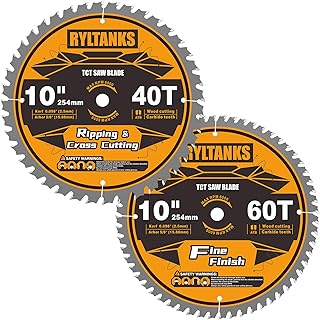
A two-pack such as the 40T ripping and crosscutting plus 60T fine-finish combination reduces compromise. You can reserve the faster blade for material removal and use the finer blade when the edge quality matters more.
Final Thoughts
For a versatile primary blade, the DEWALT DWA11040 is a strong starting point. Choose the FOXBC 80-tooth or WEN BL1080 when finish quality is the priority, while the three-blade set offers the most adaptable setup for a small furniture workshop that wants fewer storage headaches.