Key takeaways
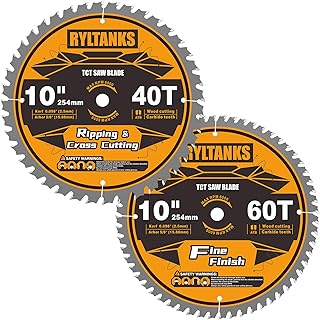
- Tooth count: Choose around 24–40 teeth for faster ripping, 40–60 teeth for general-purpose work, and 60–80 teeth for smoother crosscuts and finish cuts.
- Cutting task: Match the blade to the material and operation. Ripping blades remove stock quickly, while fine-finish blades prioritize cleaner edges and reduced splintering.
- Arbor compatibility: Most 10-inch table saws use a 5/8-inch arbor, but verify your owner’s manual rather than relying on the blade diameter alone.
- Carbide quality: Carbide-tipped teeth generally hold an edge longer than basic steel teeth and can be sharpened when replacement becomes less economical.
- Kerf and clearance: Confirm that the blade’s kerf suits your saw and riving knife. A compatible kerf helps maintain smooth feeding and proper safety equipment alignment.
What's inside
Choosing a 10-inch table saw blade sounds straightforward until you are comparing tooth counts, kerf widths, arbor sizes, and claims about finish quality. For a small workshop or home furniture setup, the wrong blade can create rough edges, excessive tear-out, slow cuts, and a surprising amount of cleanup. A blade that works beautifully for ripping framing lumber may be a poor choice for cabinet panels or visible furniture parts.
This guide focuses on practical blade selection for compact workspaces, where one purchase often needs to cover several jobs. We compare options for ripping, crosscutting, fine finishing, and occasional project versatility, while also explaining how tooth count, material, and intended use affect the result. Always confirm your saw’s specifications before ordering, especially the arbor size and maximum blade diameter.
As an Amazon Associate we earn from qualifying purchases.


How to Choose a 10 Inch Blade For Table Saw (2026)
- Tooth count: Choose around 24–40 teeth for faster ripping, 40–60 teeth for general-purpose work, and 60–80 teeth for smoother crosscuts and finish cuts.
- Cutting task: Match the blade to the material and operation. Ripping blades remove stock quickly, while fine-finish blades prioritize cleaner edges and reduced splintering.
- Arbor compatibility: Most 10-inch table saws use a 5/8-inch arbor, but verify your owner’s manual rather than relying on the blade diameter alone.
- Carbide quality: Carbide-tipped teeth generally hold an edge longer than basic steel teeth and can be sharpened when replacement becomes less economical.
- Kerf and clearance: Confirm that the blade’s kerf suits your saw and riving knife. A compatible kerf helps maintain smooth feeding and proper safety equipment alignment.
The Best 10 Inch Blade For Table Saw (2026)s Reviewed
DEWALT DWA11040 40-Tooth Fine-Finish Blade
The DEWALT DWA11040 is a sensible all-around choice for furniture makers who want one dependable blade for common sheet goods, hardwood, and general shop work. Its 40-tooth layout balances cutting speed with a cleaner edge than a coarse ripping blade, making it especially useful in a small workshop where blade changes need to stay to a minimum.
FOXBC 80-Tooth Ultra-Finish Blade
The FOXBC 10-Inch 80-Tooth blade is aimed at detail-focused cuts where edge quality matters more than speed. Its dense tooth pattern makes it a strong candidate for trim, veneered panels, and visible crosscuts, although feeding should be controlled and expectations should remain realistic when cutting thick or difficult stock.
WEN BL1080 80-Tooth Ultra-Fine Blade
WEN’s BL1080 is another high-tooth-count option for ultra-fine woodworking cuts on table and miter saws. It suits compact furniture shops that regularly work with finished boards or need cleaner edges before assembly, but its finer configuration is better reserved for moderate feed rates rather than aggressive stock removal.
WEN BL1060 60-Tooth Fine-Finish Blade
The WEN BL1060 occupies a useful middle ground between fast general cutting and ultra-fine finishing. A 60-tooth blade can be a practical choice for shelves, cabinet components, and project parts that need a tidy edge without the slower feel of an 80-tooth blade.
10-Inch 3-Pack: 32T, 60T, and 80T Blades
This three-blade set is appealing for makers who want to organize a small workspace around specific tasks rather than forcing one blade to do everything. The 32-tooth blade supports faster framing-style work, while the 60- and 80-tooth options provide progressively finer cuts for furniture components and finishing work.
Frequently Asked Questions
Is a 10-inch blade standard for a table saw?
Ten-inch blades are common on full-size and many contractor-style table saws, but diameter alone does not guarantee compatibility. Check the saw’s arbor, permitted blade thickness, maximum RPM, and manufacturer guidance before installation.
Is a 40-tooth blade good for furniture making?
Yes, a quality 40-tooth blade can be a useful general-purpose option for furniture projects. It offers a helpful compromise between efficient ripping and reasonably clean crosscuts, though delicate veneers and highly visible end grain may benefit from a finer blade.
When should I use an 80-tooth table saw blade?
Use an 80-tooth blade when a smooth, low-tear-out cut is the priority, such as on trim, plywood, veneered panels, or smaller finish components. It is not usually the fastest choice for thick hardwood or long rip cuts.
Can one blade handle both ripping and crosscutting?
A combination or general-purpose blade can handle both jobs, making it valuable in a small shop. However, dedicated ripping and finishing blades often produce better results and work more efficiently when a project involves a large volume of one cutting type.
Final Thoughts
For the broadest everyday usefulness, the DEWALT DWA11040 is a strong starting point. Choose the WEN BL1060 when cleaner furniture cuts are the priority, or select the 3-pack when limited storage makes a flexible blade rotation more valuable than owning a single do-everything option.