Key takeaways
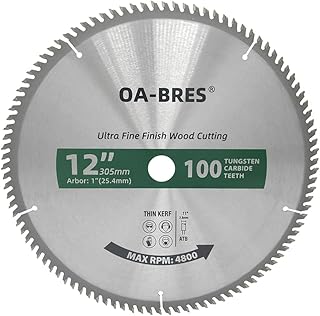
- Tooth count: For furniture-grade crosscuts in hardwood, plywood, and trim, 80 to 100 teeth is the sweet spot. Lower counts clear chips faster but leave tearout you’ll have to sand out — extra work you don’t want in a space with limited dust control.
- Kerf width: Thin-kerf blades remove less material, which means less strain on smaller motors and less airborne dust in an enclosed room. Full-kerf blades track straighter in thick stock but demand more from the saw.
- Grind geometry: Alternate top bevel (ATB) shears wood fibers cleanly on both faces of the cut, making it the default choice for visible joinery. Triple-chip grinds belong on melamine and non-ferrous work.
- Arbor fit: Nearly every 12-inch miter saw uses a 1-inch arbor. Confirm before ordering, and skip bushing adapters — any wobble at the center shows up as a wavy shoulder on your miters.
- Storage and handling: A 12-inch blade needs a flat, protected home. Wall-mounted blade sleeves or a slim under-bench case keep carbide tips off concrete and free up drawer space you can use for something else.
What's inside
Anyone building furniture out of a garage bay, a basement corner, or a balcony workshop knows the real constraint isn’t skill — it’s square footage. When your miter saw shares a bench with your clamps, your finishing supplies, and possibly your bicycle, you don’t have room for a five-blade rotation. You need one blade that leaves an edge clean enough to skip the jointer, quiet enough not to wake the neighbors, and durable enough that you’re not re-tuning your setup every third project.
That’s the lens this guide uses. Below are six 12-inch blades worth considering in 2026, judged on finish quality, kerf efficiency, and how well they suit a compact shop where every cut needs to count the first time. You’ll find a short buying framework, individual assessments of the top performers, and answers to the questions that come up most once the blade is actually spinning.
As an Amazon Associate we earn from qualifying purchases.


How to Choose a 12-Inch Miter Saw Blade (2026)
- Tooth count: For furniture-grade crosscuts in hardwood, plywood, and trim, 80 to 100 teeth is the sweet spot. Lower counts clear chips faster but leave tearout you’ll have to sand out — extra work you don’t want in a space with limited dust control.
- Kerf width: Thin-kerf blades remove less material, which means less strain on smaller motors and less airborne dust in an enclosed room. Full-kerf blades track straighter in thick stock but demand more from the saw.
- Grind geometry: Alternate top bevel (ATB) shears wood fibers cleanly on both faces of the cut, making it the default choice for visible joinery. Triple-chip grinds belong on melamine and non-ferrous work.
- Arbor fit: Nearly every 12-inch miter saw uses a 1-inch arbor. Confirm before ordering, and skip bushing adapters — any wobble at the center shows up as a wavy shoulder on your miters.
- Storage and handling: A 12-inch blade needs a flat, protected home. Wall-mounted blade sleeves or a slim under-bench case keep carbide tips off concrete and free up drawer space you can use for something else.
The Best 12-Inch Miter Saw Blades of 2026, Reviewed
DEWALT DWA112100 100-Tooth Fine Finish
This is the safest recommendation for a one-blade shop: the 100-tooth carbide leaves crosscuts in poplar, maple, and prefinished plywood smooth enough to glue up directly. It runs quietly, holds its edge through a full furniture build, and the price makes it easy to replace rather than nurse along.
Diablo D1280X 80-Tooth
Diablo’s high-density carbide and laser-cut stabilizer vents make this the calmest-running blade in the group, which matters when your saw sits three feet from a shared wall. At 80 teeth it clears chips more readily than the 100-tooth options, so it handles 4x material and dense hardwood without bogging.
Makita B-67000 100-Tooth Max Efficiency
Built around a thinner kerf than most 100-tooth blades, the B-67000 asks less of your motor while still producing a polished cut face. It’s the pick if your saw is a compact or cordless model that struggles with wide-kerf blades in oak or hard maple.
Freud LU86R012 48-Tooth Thin Kerf
A genuine general-purpose blade — 48 teeth and a thin kerf mean fast, low-effort cuts across framing lumber, sheet goods, and rough breakdown work. Finish won’t match the 100-tooth blades, but for shop fixtures, jigs, and storage builds it’s the more sensible tool.
FOXBC 100-Tooth Polished Finish
The value option that earns its place. Cut quality on softwoods and plywood is genuinely close to the premium blades, making it a smart secondary blade you can put to work on painted projects and reclaimed stock without worrying about hidden nails.
Frequently Asked Questions
Is 100 teeth too many for general woodworking?
For crosscutting, no — that’s exactly what high tooth counts are designed for. Problems only appear when you push thick, wet, or resinous stock through, where chips can’t clear fast enough and the blade begins to burn.
How long should a quality blade last?
A well-treated premium blade will run several hundred board feet of clean hardwood before the finish starts to degrade. Sharpening services typically restore it two or three times, which is cheaper than replacement.
Do I need a stabilizer or dampening blade?
Expansion slots and copper plugs meaningfully reduce ringing and vibration. In a small enclosed shop, that noise reduction alone justifies the upgrade.
Can I use these blades on a table saw?
Some are rated for both, but 12-inch table saws are uncommon and miter-specific blades often carry a negative hook angle unsuited to feeding stock by hand. Check the manufacturer’s rating before crossing over.
Final Thoughts
For most compact furniture shops, the DEWALT DWA112100 delivers the best balance of finish and value, while the Diablo D1280X is the one to choose if noise and vibration are a concern. Keep the Freud LU86R012 alongside it for rough work, and you’ve covered nearly every cut a small-space build will throw at you — with only two blades to store.