Key takeaways
- Footprint: Measure both the machine and the clearance needed to guide long boards safely around the table.
- Motor and power: A 1 HP motor can handle many furniture tasks, while 1.5 to 2 HP provides more reserve for thick hardwood and resawing.
- Resaw capacity: Check the maximum cutting height if you plan to turn wide boards into thinner panels or veneers.
- Table and guides: A rigid cast-iron table, dependable blade guides, and a useful fence make accurate cuts easier to repeat.
- Electrical setup: Confirm whether the saw runs on standard 120-volt power or can be wired for 240 volts before buying.
What's inside
Choosing a 14-inch band saw is rarely as simple as comparing motor horsepower. In a compact workshop, the machine must also earn its floor space, leave room for material handling, and offer adjustments you can reach without dismantling your setup. A saw that looks powerful on paper may be awkward beside a workbench or excessive for occasional furniture projects.
This guide focuses on the details that matter in a home furniture workspace: footprint, table support, blade capacity, speed control, electrical requirements, and everyday usability. The selections cover approachable starter machines, heavy-duty options, and models suited to makers who expect their projects—and stock sizes—to grow.
As an Amazon Associate we earn from qualifying purchases.


How to Choose a 14-Inch Band Saw (2026)
- Footprint: Measure both the machine and the clearance needed to guide long boards safely around the table.
- Motor and power: A 1 HP motor can handle many furniture tasks, while 1.5 to 2 HP provides more reserve for thick hardwood and resawing.
- Resaw capacity: Check the maximum cutting height if you plan to turn wide boards into thinner panels or veneers.
- Table and guides: A rigid cast-iron table, dependable blade guides, and a useful fence make accurate cuts easier to repeat.
- Electrical setup: Confirm whether the saw runs on standard 120-volt power or can be wired for 240 volts before buying.
The Best 14-Inch Band Saw (2026)s Reviewed
14-Inch Dual-Speed 2 HP Bandsaw
This dual-speed 14-inch bandsaw stands out for buyers who want substantial cutting power without moving into a commercial-scale machine. Its 2 HP, 120-volt motor, solid cast-iron table, overload protection, and selectable 1,445 or 2,950 FPM speeds give it useful flexibility for furniture parts and thicker stock. It is a particularly appealing choice when a home shop needs extra capacity but still relies on standard household power.
JET JWBS-14SFX-BLK
The JET Black 14-Inch Woodworking Band Saw is a strong fit for a serious home workshop where stability and long-term usability matter more than the smallest footprint. Its 1.75 HP motor offers a healthy power reserve, while dual-voltage operation gives owners more flexibility as their shop electrical system develops. Consider it for frequent hardwood work, curved components, and substantial resawing.
JET JWBS-14CS
The JET 14-Inch Woodworking Band Saw with a 1 HP motor is a sensible middle ground for makers who want a respected shop-machine platform without stepping up to the larger motor of the SFX-BLK. It suits general furniture work, joinery preparation, and moderate resawing, provided the blade is selected and tensioned correctly. Its dual-voltage design also helps future-proof a permanent workshop installation.
WEN BA1411 Industrial Band Saw
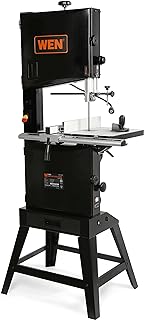
WEN’s Industrial 14-Inch Band Saw combines a 1 HP motor with dual-voltage operation and two speeds, making it versatile for a home furniture shop that handles varied materials. It offers a practical balance between capability and cost-conscious ownership, especially for users who want speed flexibility without immediately committing to a premium machine. Allow adequate clearance around it; a 14-inch saw is still a substantial piece of equipment in a small room.
Powermatic PWBS-14CS
The Powermatic 14-Inch Woodworking Bandsaw is aimed at furniture makers who prioritize a robust, refined machine for repeated use. Its 1-1/2 HP motor and 115/230-volt configuration provide a useful blend of everyday control and future electrical flexibility. It is best suited to a dedicated shop area where its footprint, work envelope, and heavier construction can be fully appreciated.
Frequently Asked Questions
Is a 14-inch band saw too large for a small workshop?
Not necessarily, but the stated wheel size is only part of the space calculation. Measure the saw’s footprint, table height, doorways, and the infeed and outfeed paths required for your longest boards. A mobile base can help, but it does not replace safe clearance while cutting.
What motor size is best for furniture making?
A 1 HP model is adequate for many curves, smaller components, and routine solid-wood work. Choose 1.5 HP or more if you regularly resaw wide hardwood, work with dense species, or prefer a machine that maintains momentum under heavier cuts.
Do I need a two-speed band saw?
Two speeds are useful when your work includes more than ordinary wood cutting, or when you want additional control over different blade and stock combinations. For a shop dedicated almost entirely to wood, a well-tuned single-speed saw can still perform very effectively.
What should I check before using a new band saw?
Verify blade tracking, tension, guide adjustment, table alignment, fence squareness, and dust collection. Start with a sharp blade suited to the material, keep hands outside the cutting zone, and make sure the machine is firmly supported before processing stock.
Final Thoughts
The dual-speed 2 HP bandsaw is a compelling choice for maximum cutting reserve on standard household power, while the JET JWBS-14CS offers a balanced route into dependable 14-inch performance. For a more substantial long-term investment, the JET JWBS-14SFX-BLK or Powermatic PWBS-14CS deserves consideration—provided your small workshop can accommodate the machine and its working space.