Our Top Picks
For the most absorbency, diatomite stone mats and thick cotton or microfiber chenille mats suit households that want a dry floor fast, while memory foam mats suit buyers who prioritise cushioning and cotton terry mats suit those who want something that washes easily and feels traditional. The right pick depends on how wet the floor gets, whether you want to machine wash the mat, and whether the surface underneath is tile, wood or vinyl. This guide compares the main types, what makers state about materials and sizes, and where each one falls short.
Absorbent Bath Mats at a Glance
| Type | Typical material (as makers state) | Best for | Limits |
|---|---|---|---|
| Diatomite stone mat | Diatomaceous earth (diatomite) slab with non-slip base | Instant drying, no laundry | Hard underfoot, can chip or stain, cannot be washed |
| Microfiber chenille mat | Polyester microfiber chenille, often with latex or TPR backing | Soft, fast absorption, machine washable | Backing can wear, slower drying when thick |
| Memory foam mat | Foam core with microfiber top | Cushioned standing at sinks or vanities | Slow to dry, needs careful washing |
| Cotton terry mat | Woven cotton loop pile | Natural feel, classic bathrooms | Heavier when wet, may slip without a backing |
| Cotton tufted rug mat | Tufted cotton, often with latex backing | Plush look, colour choices | Backing wear, can be slow to dry |
| Bamboo or cork mat | Wood slats or cork | Drying fast, spa look | Not soft, needs air flow underneath |
How Bath Mats Absorb Water
Absorbency comes from three things: the fibre, the pile and the space available for water to travel. Cotton absorbs readily but holds water, so it dries slowly. Microfiber, made from fine polyester-based fibres, wicks water quickly across a large surface, which many reviewers prefer for fast mopping of a wet floor. Diatomite, a stone-like material made from fossilised algae, draws water into tiny pores and releases it by evaporation. Memory foam sits in between, absorbing through a microfiber top while the foam core adds cushioning.

GORILLA GRIP Bath Rug Mat for Bathroom, Absorbent Chenille, 24x17 Grey | Soft Thick Quick Dry Microfiber Mats, Rubber Backing, Machine Washable Tub and Shower Floor Rugs, Home Decor Essentials
Chosen because it specifies Absorbent Chenille and 24x17 Grey.
View on Amazon
OLANLY Memory Foam Bath Mat 30x20, Super Soft and Absorbent Bathroom Rugs | Grey, Quick Dry Bath Rug, Machine Washable Shower Floor Mats, Bathmat Carpet for Bathroom Floor, Tub and Shower
Chosen because it specifies Super Soft and Absorbent Bathroom Rugs and Grey.
View on Amazon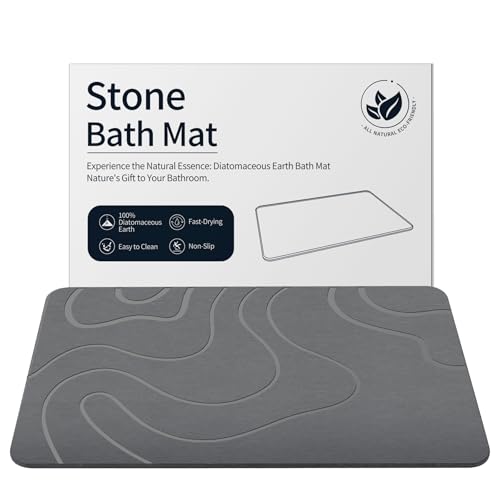
Stone Bath Mat for Bathroom, Diatomaceous Earth Shower Mat, Quick Dry, Grey | Fast Drying, Super Absorbent, Natural Diatomaceous Earth, Non-Slip Design, Easy to Clean
Chosen because it specifies Diatomaceous Earth Shower Mat and Quick Dry.
View on AmazonNo type absorbs infinite water. Heavy splashing from a children’s bath or a shower with no curtain will overwhelm most mats, which is why a larger size or a second mat is often better than searching for the single best material.
Well-Known Options by Type
- Diatomite mats: Several brands sell stone bath mats made from diatomite, usually in a slim rectangular slab. Makers state that the mat dries within moments and resists mildew since it does not hold standing water. Reviewers note they are firm underfoot and that cleaning is done by wiping or lightly sanding, depending on the maker’s instructions.
- Gorilla Grip: Sells a range of non-slip bath mats, including chenille, memory foam and cotton styles. The maker describes machine-washable construction and slip-resistant backing on many of these.
- Mohawk Home and similar rug makers: Offer tufted bathroom rugs with latex or non-slip backings, positioned for colour and style.
- Chilewich: Known for woven vinyl-style floor mats suited to entrances and some bathrooms. These are lighter on absorbency and suited to wipe-clean needs.
- Cotton hotel-style mats: Many bedding and bath brands, including Brooklinen, Parachute and Frontgate, offer cotton bath mats designed to match their towel ranges.
Sizes and Fit
Common sizes include about 17 by 24 inches for small vanities and 20 by 32 inches for tub-side mats, with longer runners reaching 24 by 60 inches or more for double vanities. Measure the space between the tub and the vanity and leave a small gap so doors can open without catching. For a shower with a glass door, a mat that sits just outside the door covers the usual splash zone.
- Underfloor heating: Check the maker’s guidance, since some backings are not suited to heated floors.
- Tile and stone floors: Rubber or TPR backings grip well, but they may stain light tiles over long periods if kept damp.
- Wood and vinyl: Some latex backings can discolour vinyl or finished wood. Read the maker’s floor-compatibility notes.
Budget Tiers and Trade-offs
| Tier | What you typically get | Trade-off |
|---|---|---|
| Budget | Basic microfiber or chenille, thin backing | Backing may crack or slip over time; absorbency varies |
| Mid-range | Thicker chenille, memory foam, better backing, diatomite slabs | Best overall value for most households |
| Premium | Heavy cotton, designer weaves, quality stone or woven wood | Higher outlay; some need delicate care |
Care and Safety Notes
Slips are a genuine risk in bathrooms, so choose a mat with a stated non-slip backing and lay it flat on a clean, dry floor. Replace a mat if the corners curl, since a curled corner is a trip hazard. Follow the maker’s instructions for washing: many chenille and cotton mats are machine washable on a gentle cycle, but foam mats and latex backings can degrade at high temperatures or in a hot dryer. Hang or lay mats flat to dry fully between uses, because a constantly damp mat can develop odours or mildew. Diatomite mats are not washable in the usual sense, so follow the maker’s cleaning steps.
If anyone in your home has mobility concerns or balance difficulties, speak to a healthcare professional about bathroom safety, since a mat alone does not replace grab bars or a non-slip tub surface.
Pick X If… Decision Table
| Pick this | If you want |
|---|---|
| Diatomite stone mat | Very fast drying and no laundry |
| Microfiber chenille mat | A soft, washable mat that absorbs quickly |
| Memory foam mat | Cushioning where you stand for longer periods |
| Cotton terry mat | A natural-fibre feel that matches towels |
| Bamboo or cork mat | An easy-wipe, quick-drying surface for a modern look |
| Larger runner | Double vanities or a busy family bathroom |
Alternatives
- Two smaller mats: Rotating two mats lets one dry while the other is in use, which often helps more than finding a single super-absorbent mat.
- Bath towel on the floor: A quick option for guests, though it does not grip the floor.
- Shower curtain or screen upgrade: Reducing splashes in the first place can reduce what the mat has to absorb.
Choosing for Your Bathroom Layout
Where the mat sits matters as much as what it is made of. In front of a tub, the mat takes the heaviest load of drips from wet feet and towels, so a larger, more absorbent mat tends to pay off there. Beside a vanity, the mat mainly protects the floor from splashes and gives a comfortable standing surface, so cushioning may matter more than raw absorbency. In a shower stall with a glass door, a flat, quick-drying mat just outside the door usually works best because it dries between uses.
Think about who uses the bathroom. Families with young children often prefer a washable chenille or cotton mat that can be tossed in the machine after a messy bath. Households with pets may favour a mat with a tight pile that does not trap fur. Guests are often happiest with a simple cotton mat that matches the towels. People who stand at a vanity for long periods, for example while shaving or styling hair, may like memory foam, whereas those who dislike a squishy feel may prefer a firm diatomite slab.
Drying habits that extend mat life
Whatever the material, a mat lasts longer when it dries fully between uses. Lift it and hang it over the tub edge or a rail after showering, and let air reach both sides. A small bathroom fan or an open window helps. Rotating two mats gives each one time to dry out, which many care guides suggest reduces odours and wear on the backing.
Reading product listings carefully
Listings sometimes use words such as quick-dry, ultra-absorbent or non-slip without defining them. Look for concrete details instead: stated fibre content, stated dimensions, the type of backing, whether the mat is machine washable and what the maker says about floor types and heated floors. If a listing gives few specifics, treat the marketing language cautiously and compare against better-documented options.
Frequently Asked Questions
What is the most absorbent type of bath mat?
Makers and reviewers point to thick microfiber chenille and diatomite stone as the fastest at clearing water from a floor. Cotton absorbs well too but dries more slowly. The best choice depends on whether you prefer a soft mat or a firm one that needs no washing.
Are diatomite bath mats safe on all floors?
Makers generally say they sit on tile, wood and vinyl with non-slip feet. Follow the maker’s instructions for your floor type, and be aware that a stone slab can chip if dropped.
Can I machine wash memory foam bath mats?
Many makers say yes on a gentle cycle with cool or warm water, and advise air drying or a low-heat setting. Heat can damage foam and backing, so follow the care label.
How often should I wash a bath mat?
Many care guides suggest roughly weekly washing for mats in daily use, and more often if they stay damp. Always let the mat dry fully between uses.
Why does my bath mat slide on the floor?
Worn backing, a dusty floor or soap residue can reduce grip. Clean the floor, wash the mat, and replace it if the backing has cracked or hardened. Never use a mat that slides if anyone with balance concerns uses the bathroom.
What size bath mat should I buy?
Measure the space in front of the tub or shower and leave room for doors. A tub-side mat around 20 by 32 inches is common, with smaller mats for sinks and longer runners for double vanities.