Key takeaways
- Airflow: Check delivered CFM at the working pressure, not only the motor’s horsepower. Sand blasting consumes air continuously, so CFM is usually the deciding specification.
- Pressure: A useful range for many small blasting jobs is roughly 60–125 PSI. Confirm that the compressor and blasting attachment overlap within their recommended operating range.
- Duty cycle: Intermittent blasting can tolerate a smaller compressor, while cabinet work and paint removal require a pump designed for extended operation without overheating.
- Space and power: Measure doorways, storage clearance, and electrical access before buying. Large rotary screw systems may need three-phase power and a permanent location.
- Moisture control: Compressed air creates condensation, which can clog abrasive media and spoil the finish. A tank, dryer, water trap, or inline filter can make a substantial difference.
What's inside
Choosing an air compressor for sand blasting is less about buying the largest machine and more about matching airflow to the tool. Many compact compressors can reach the advertised pressure, yet fall short on continuous CFM, leaving the blast stream weak, uneven, and frustrating. In a small workshop, excess noise, heat, electrical demands, and floor space matter just as much.
This guide compares compressor systems, blasting guns, and cabinet-ready options with those practical constraints in mind. We focus on sustained airflow, pressure range, workshop footprint, setup requirements, and the kind of furniture, metal, or restoration work each option can realistically handle.
As an Amazon Associate we earn from qualifying purchases.




How to Choose a/an Air Compressor For Sand Blasting (2026)
- Airflow: Check delivered CFM at the working pressure, not only the motor’s horsepower. Sand blasting consumes air continuously, so CFM is usually the deciding specification.
- Pressure: A useful range for many small blasting jobs is roughly 60–125 PSI. Confirm that the compressor and blasting attachment overlap within their recommended operating range.
- Duty cycle: Intermittent blasting can tolerate a smaller compressor, while cabinet work and paint removal require a pump designed for extended operation without overheating.
- Space and power: Measure doorways, storage clearance, and electrical access before buying. Large rotary screw systems may need three-phase power and a permanent location.
- Moisture control: Compressed air creates condensation, which can clog abrasive media and spoil the finish. A tank, dryer, water trap, or inline filter can make a substantial difference.
The Best Air Compressor For Sand Blasting (2026)s Reviewed
40HP VSD Rotary Screw Air Compressor
This 40HP VSD rotary screw compressor is an industrial-scale choice, delivering a claimed 185 CFM at 125 PSI for demanding, continuous blasting. Its variable-speed design can improve efficiency under changing loads, but the 480V three-phase requirement and substantial footprint make it a serious shop-installation purchase rather than a casual garage tool.
7.5KW 10HP Rotary Screw Compressor System
The 10HP rotary screw system is a more approachable heavy-duty option, pairing approximately 35 CFM at 125 PSI with an 80-gallon tank and integrated air dryer. For a dedicated restoration workspace, that combination supports steadier blasting while reducing moisture problems, although the tank and three-phase electrical requirement still call for careful planning in a compact room.
40 Gallon Bench Top Air Sandblasting Cabinet
This steel cabinet is a practical space-conscious route for contained blasting, particularly when removing rust, stain, or old paint from hardware and small furniture components. It includes a gun and four nozzles, and its stated 6–25 CFM requirement gives buyers a clear target; remember that the cabinet is an air-consuming accessory, not a compressor.
Light-Duty Air Sandblaster Gun Kit
For occasional surface preparation, this siphon-and-gravity-feed gun kit is easier to store than a full cabinet and can handle small metal, wood, or glass-etching projects. Its ceramic nozzle and light-duty construction suit limited sessions, but it requires a compatible compressor and will not turn a low-CFM household unit into a continuous blasting system.
Inokraft Leak-Proof Portable Sand Blaster Gun Kit
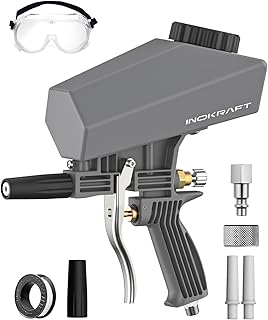
The Inokraft portable kit is a compact choice for spot rust and paint removal, working with compressors in the stated 60–120 PSI range. Its small footprint is appealing for apartment workshops or shared garages, though users should expect slower progress and more frequent pauses than with a cabinet and high-output compressor.
Frequently Asked Questions
What CFM does sand blasting require?
Requirements vary by nozzle size, abrasive, pressure, and attachment. Small guns may work around 6–10 CFM, while cabinet systems can demand considerably more; always use the tool’s required CFM at its working PSI as the baseline.
Can a small pancake compressor run a sandblasting gun?
It may run a small gun briefly, but the compressor will likely cycle continuously and lose pressure. For occasional spot work, that can be acceptable; for consistent stripping or cabinet blasting, choose a larger tank and higher delivered CFM.
Is a rotary screw compressor better than a reciprocating compressor?
For frequent, prolonged blasting, a rotary screw model generally offers steadier airflow and is designed for longer duty cycles. A reciprocating compressor is often more affordable and compact for intermittent household projects.
Do I need an air dryer for sand blasting?
An air dryer or effective moisture separator is strongly recommended, especially in humid conditions. Water can make abrasive media clump, interrupt the feed, and create an inconsistent finish.
Final Thoughts
For intensive professional work, the 40HP VSD rotary screw compressor is the airflow leader, while the 10HP rotary screw system is a more manageable heavy-duty choice. For small-space restoration, pair a properly sized compressor with the 40 Gallon Bench Top Cabinet; choose one of the portable gun kits when storage and occasional use matter most.