Key takeaways
- Stowed footprint, not spec-sheet size: Measure the unit with the hose coiled and nozzle attached, since that’s the shape you actually have to store. Models with an integrated hose channel and onboard adapter compartment fit a glovebox or closet cube; ones with loose accessory bags never stay tidy.
- Power source honesty: Cordless units win on convenience but need charging discipline. Dual-power designs that run on 12V and battery give you a fallback, which matters if your inflator lives in a drawer indoors and gets forgotten for months.
- Duty cycle and cylinder count: A 100% duty cycle means the compressor can run continuously without a forced cooldown. Dual-cylinder pumps move more air per revolution, so you spend less time standing in a cold parking lot.
- Auto shut-off accuracy: Set-and-forget pressure control is the difference between a two-minute task and a babysitting job. Check that the digital gauge reads in whole PSI increments and holds calibration.
- Battery platform overlap: If you already own cordless tools, a bare-tool inflator on the same battery system eliminates a whole charger and brick from your storage load. That’s genuine square-footage savings.
What's inside
A tire inflator is one of those tools that earns its keep exactly once a year, which makes it a strange thing to own when your storage plan is a hall closet and a shoebox under the bed. In apartments and small homes, the garage-mounted pancake compressor was never an option, and the cheap plug-in units that come bundled with roadside kits tend to be bulky, loud, and slow enough that you question your life choices in a parking garage at 7am. The real problem isn’t inflation power. It’s finding something that disappears into an entryway bench or a console bin between uses.
This guide looks at portable tire inflators through that lens: how compact they actually are once the hose and adapters are attached, whether the cord and accessories stay contained, and how they hold up when you need to fill four tires on an SUV instead of topping off a bike. I’ve weighed cordless convenience against dual-power reliability, noted which models handle sustained runtimes without overheating, and flagged where a smaller footprint costs you real capability.
As an Amazon Associate we earn from qualifying purchases.


How to Choose a/an Air Compressor For Tires (2026)
- Stowed footprint, not spec-sheet size: Measure the unit with the hose coiled and nozzle attached, since that’s the shape you actually have to store. Models with an integrated hose channel and onboard adapter compartment fit a glovebox or closet cube; ones with loose accessory bags never stay tidy.
- Power source honesty: Cordless units win on convenience but need charging discipline. Dual-power designs that run on 12V and battery give you a fallback, which matters if your inflator lives in a drawer indoors and gets forgotten for months.
- Duty cycle and cylinder count: A 100% duty cycle means the compressor can run continuously without a forced cooldown. Dual-cylinder pumps move more air per revolution, so you spend less time standing in a cold parking lot.
- Auto shut-off accuracy: Set-and-forget pressure control is the difference between a two-minute task and a babysitting job. Check that the digital gauge reads in whole PSI increments and holds calibration.
- Battery platform overlap: If you already own cordless tools, a bare-tool inflator on the same battery system eliminates a whole charger and brick from your storage load. That’s genuine square-footage savings.
The Best Air Compressor For Tires (2026)s Reviewed
ETENWOLF VORTEX S7
The 38400mAh pack and dual-cylinder pump make this the one to reach for if you drive a truck or a loaded SUV and want to fill all four tires from flat without a recharge pause. It’s the largest unit here, so plan on a dedicated cargo-area cube rather than a glovebox, but the 160PSI ceiling and full duty cycle justify the space.
DEWALT DCC020IB
Sold as a bare tool on the 20V MAX platform, which is the smartest storage math in this roundup if you already own DEWALT batteries — no extra charger, no proprietary brick. Automatic shut-off and the built-in LED cover the practical basics, and the flat-bottomed housing stacks well in a bin.
ETENWOLF VORTEX S6
Essentially the S7’s compact sibling: same dual-cylinder architecture and 100% duty cycle in a noticeably smaller shell with a 19200mAh battery. This is the sweet spot for sedans, e-bikes, and paddleboards, and it’s the model most likely to fit a console bin without a fight.
OlarHike 12000mAh Heavy Duty Inflator
A dual-power unit that runs cordless or off 12V, with a 150PSI rating and inflation speeds that make quick work of light-truck tires. The tradeoff for its slim profile is a smaller battery, so treat 12V as your primary mode for anything larger than a crossover.
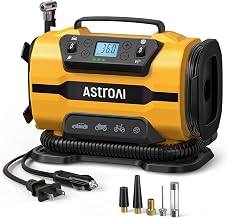
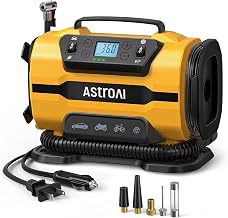
AstroAI Cordless 160PSI Inflator
Genuinely pocketable, dual-power, and accurate enough for weekly pressure checks on cars, motorcycles, and bikes. Runtime is limited by design, which is exactly right if you want something that lives in a kitchen drawer or entryway basket and handles top-offs rather than full inflations.
Frequently Asked Questions
How much storage space should I actually plan for?
Compact cordless models like the AstroAI or VORTEX S6 fit a 6×8-inch cube or a deep glovebox. Heavy-duty units such as the S7 need closer to a shoebox footprint, so give them a cargo-area organizer rather than interior storage.
Can I keep a cordless inflator indoors between uses?
Yes, and it’s better for the battery than a hot or freezing car. Store it in a cool interior closet and top the charge every three to four months so it’s ready when you need it.
Is 150PSI enough, or should I get 160PSI?
For passenger vehicles, 150PSI is more than sufficient — most car tires sit between 30 and 40PSI. The higher rating matters for light-truck and RV tires, where max pressures run considerably higher.
Do I still need a separate bike pump?
No. All the models here include Presta or Schrader adapters and handle bike tires, sports balls, and inflatables, which is one less object competing for closet space.
Final Thoughts
For most small-space owners, the ETENWOLF VORTEX S6 hits the best balance of real inflation capability and a footprint that won’t dominate a storage bin. If you drive something heavier or tow, step up to the VORTEX S7 and accept the larger case. And if you already have 20V MAX batteries on the shelf, the DEWALT DCC020IB is the lowest-clutter choice available.