Key takeaways
- Drying method: Air-line separators remove liquid water and particles, while refrigerated dryers cool compressed air to condense moisture more thoroughly. Choose a refrigerated unit for continuous spraying, CNC work, or high-demand shop tools.
- Airflow capacity: Check the dryer’s CFM rating against your compressor’s delivered CFM. A restriction or undersized dryer can reduce tool performance and create pressure drop.
- Port size: Match 1/4-inch, 3/8-inch, or 1/2-inch NPT connections to your existing plumbing, using appropriately rated adapters when necessary.
- Drain style: Manual drains cost less but require regular attention. Semi-automatic and automatic drains are more convenient, particularly where the separator is installed in a difficult-to-reach location.
- Placement: Install a separator close to the tool for point-of-use protection, or place a refrigerated dryer downstream of the compressor and receiver tank with suitable filtration before and after it.
What's inside
Moisture is one of the easiest ways to undermine a compressed-air setup. Water can collect in hoses, contaminate paint, interfere with plasma cutting, shorten tool life, and encourage rust inside tanks and air lines. The right air dryer helps, but the best choice depends on whether you need simple point-of-use filtration or true refrigerated drying for a larger workshop.
This guide compares compact water separators, filter-regulator combinations, and refrigerated systems for home garages, furniture shops, and light industrial spaces. We focus on connection size, airflow, drainage, filtration, compressor capacity, and installation practicality so you can match the dryer to your tools instead of overbuying.
As an Amazon Associate we earn from qualifying purchases.


How to Choose a/an Air Dryer For Compressor (2026)
- Drying method: Air-line separators remove liquid water and particles, while refrigerated dryers cool compressed air to condense moisture more thoroughly. Choose a refrigerated unit for continuous spraying, CNC work, or high-demand shop tools.
- Airflow capacity: Check the dryer’s CFM rating against your compressor’s delivered CFM. A restriction or undersized dryer can reduce tool performance and create pressure drop.
- Port size: Match 1/4-inch, 3/8-inch, or 1/2-inch NPT connections to your existing plumbing, using appropriately rated adapters when necessary.
- Drain style: Manual drains cost less but require regular attention. Semi-automatic and automatic drains are more convenient, particularly where the separator is installed in a difficult-to-reach location.
- Placement: Install a separator close to the tool for point-of-use protection, or place a refrigerated dryer downstream of the compressor and receiver tank with suitable filtration before and after it.
The Best Air Dryer For Compressor (2026)s Reviewed
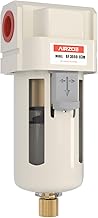
AIRZOE AF3000-03 3/8-Inch Air Dryer
The AIRZOE AF3000-03 is a practical choice for a small workshop that needs basic moisture and particulate separation without a bulky installation. Its 5-micron brass element, poly bowl, and semi-auto drain make it well suited to nailers, blow guns, and general furniture-shop air lines.
VEVOR 85 CFM Refrigerated Air Dryer
For demanding setups, the VEVOR refrigerated dryer offers a more complete approach to moisture control than a simple separator. Its 85 CFM capacity, automatic drainage, and color-screen controls make it a strong fit for larger compressors and continuous-use applications, provided you have room for proper ventilation and a dedicated electrical connection.
Schulz 35 CFM Refrigerated Air Dryer
The Schulz refrigerated dryer occupies a useful middle ground for serious home workshops and smaller professional spaces. Rated at 35 CFM and supplied with a pre-filter, it is designed for compressors in the 7.5- to 10-horsepower range and is a sensible upgrade when point-of-use separators no longer keep up.
BLCH AF2000-02Z 1/4-Inch Air Line Dryer
The compact BLCH AF2000-02Z works well where cabinet space and budget are limited. Its manual drain, 5-micron filtration, poly bowl, and 0-160 PSI range suit a single tool station, though the 1/4-inch port is better for lighter-duty air consumption than for high-flow equipment.
AIRZOE AC3110-03 Filter-Regulator Dryer
The AIRZOE AC3110-03 combines water separation with pressure regulation, making it convenient for a dedicated spray gun, sander, or finishing bench. Its gauge, semi-auto drain, 5-micron brass element, and 0-145 PSI range provide useful control in a compact package, especially when consistent tool pressure matters.
Frequently Asked Questions
Is an air dryer the same as a water separator?
Not always. A water separator removes condensed liquid and some particles from the air stream, while a refrigerated air dryer lowers the air temperature to condense and drain moisture more effectively. For occasional tools, a separator may be enough; for painting or continuous production, refrigerated drying is usually more dependable.
Where should I install a compressor air dryer?
Let the compressor discharge into the receiver tank first, allowing the air to cool and shed some moisture. Install the main dryer downstream of the tank, followed by a final filter or point-of-use separator near sensitive tools.
Do I need a filter-regulator combination?
A filter-regulator is helpful when tools require controlled pressure and cleaner air at the same station. It does not replace a properly sized refrigerated dryer, but it can be an efficient final-stage solution for spray guns, nailers, and pneumatic woodworking tools.
How often should I drain an air separator?
Drain frequency depends on humidity, compressor duty cycle, and tank size. Check the bowl regularly until you understand your system; never allow collected water to reach the filter element or rise into the outlet path.
Final Thoughts
For a compact furniture workspace, the AIRZOE AF3000-03 is a straightforward general-purpose pick, while the AIRZOE AC3110-03 adds useful pressure control at the tool. If your shop runs high-demand equipment or handles frequent finishing work, the VEVOR 85 CFM or Schulz 35 CFM refrigerated dryer offers substantially stronger moisture management.