Key takeaways
- Blade span versus room shape: A 52-inch fan suits most bedrooms and studios up to roughly 225 square feet. Go to 65 inches for open-plan living areas or long, narrow rooms where air needs to travel past a sofa or partition.
- Ceiling height and downrod: With eight-foot ceilings, use the shortest downrod supplied and keep blades at least seven feet off the floor. Taller ceilings need a 12-inch rod or longer so the airflow reaches you rather than pooling overhead.
- DC motor for quiet output: DC motors deliver more airflow per watt and run noticeably quieter than older AC designs, which matters in a small home where the fan is rarely more than ten feet from your head.
- Six speeds beat three: Fine speed control lets you find the setting that circulates air without rattling a lampshade or riffling paperwork on a nearby desk.
- Reverse mode and light quality: Winter reverse pulls warm air down from the ceiling, and adjustable color temperature means one fixture can handle both task lighting and evening wind-down.
What's inside
In a compact home, air circulation competes for the same square footage as everything else. A floor fan eats a corner, a tower fan blocks a walkway, and a window unit steals the one surface you were using for plants or storage. The ceiling plane is the only real estate in a small apartment that nobody is fighting over, which makes a high-airflow ceiling fan one of the few upgrades that adds function without subtracting space.
This guide focuses on fans chosen for air movement first: blade span, motor type, speed range, and how efficiently they push air through rooms that have furniture in the way. Every pick below also carries an integrated light, so the fan replaces a fixture instead of adding a device, and each one is remote-controlled to keep wall clutter and extra switches to a minimum.
As an Amazon Associate we earn from qualifying purchases.


How to Choose a Air Movement Ceiling Fan (2026)
- Blade span versus room shape: A 52-inch fan suits most bedrooms and studios up to roughly 225 square feet. Go to 65 inches for open-plan living areas or long, narrow rooms where air needs to travel past a sofa or partition.
- Ceiling height and downrod: With eight-foot ceilings, use the shortest downrod supplied and keep blades at least seven feet off the floor. Taller ceilings need a 12-inch rod or longer so the airflow reaches you rather than pooling overhead.
- DC motor for quiet output: DC motors deliver more airflow per watt and run noticeably quieter than older AC designs, which matters in a small home where the fan is rarely more than ten feet from your head.
- Six speeds beat three: Fine speed control lets you find the setting that circulates air without rattling a lampshade or riffling paperwork on a nearby desk.
- Reverse mode and light quality: Winter reverse pulls warm air down from the ceiling, and adjustable color temperature means one fixture can handle both task lighting and evening wind-down.
The Best Air Movement Ceiling Fan (2026)s Reviewed
65″ Farmhouse Ceiling Fan with Textured Glass Shade
Eight dual-finish blades across a 65-inch span move a genuinely impressive volume of air, and the quiet DC motor holds up at higher speeds where cheaper fans start to hum. The textured glass shade and included 6-inch and 12-inch downrods make it adaptable to open living areas with mixed ceiling heights.
Fanbulous 65″ Black Ceiling Fan with 3CCT Light
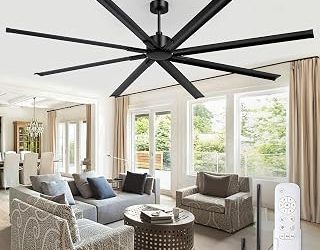
This is the pick for one large room doing several jobs at once: six speeds and a reversible DC motor let you dial airflow precisely, while the 24W LED with three color temperatures covers cooking, working, and relaxing. The all-black finish reads as architectural rather than decorative, which helps in rooms with limited visual breathing room.
Madera 52″ Smart Ceiling Fan with Wood Blades
The distressed Koa solid wood blades give this fan real warmth, and the 2700K–6000K tunable LED plus iOS and Android app control means you can schedule circulation instead of remembering to switch it on. A strong choice for a small living room or covered patio where the fan is a focal point.
OPONL 52″ Ceiling Fan with 6CCT Dimmable Light
Six color temperatures and full dimming make this the most flexible light source of the group, useful when one fixture has to serve as both overhead and ambient lighting. The reversible motor runs quietly enough for a bedroom directly under a shared wall.
52″ Matte Black and Gold 3-Blade Ceiling Fan
Three slim blades and a black-and-gold finish keep the visual footprint light in rooms where a bulky fan would dominate. Rated for outdoor use, it works equally well on a balcony or in a bedroom that needs steady airflow without a heavy silhouette.
Frequently Asked Questions
Is a 65-inch fan too large for a small apartment?
Not necessarily. Larger blades move more air at lower speeds, which means less noise and less draft. The real constraint is ceiling height and clearance from walls, so allow at least 18 inches between blade tips and any vertical surface.
Can I install one of these on an eight-foot ceiling?
Yes, using the shortest downrod or flush-mount option included. Confirm the finished blade height clears seven feet, which is the standard safety minimum in most residential codes.
Do outdoor-rated fans work better indoors?
They tolerate humidity well, which makes them a smart fit for bathrooms, sunrooms, and kitchens in older buildings with weak ventilation. Performance indoors is the same as any comparable fan.
Will a ceiling fan actually lower my cooling costs?
It lets you raise the thermostat a few degrees while feeling equally comfortable, since moving air speeds evaporation from your skin. It cools people, not rooms, so switch it off when you leave.
Final Thoughts
For open-plan spaces where one fixture has to serve the whole floor, the 65-inch farmhouse fan and the Fanbulous 65-inch both deliver serious airflow with quiet DC motors. If your priority is a smaller footprint with better light control, the Madera 52-inch smart fan is the more refined choice.